Toddler products live a harder life than almost anything else you can make. A one-year-old will throw it, chew it, climb on it, and drop it off the couch—on day one. So designing toddler products means building for a specific developmental stage while meeting a strict safety bar.
If you’re a first-time maker trying to turn a toddler idea into something you can actually sell, this is the full path from concept to a manufacturable design. Gembah builds products like these with founders every week, and baby and toddler product development is where that work starts. Want a gut check before you spend on tooling? Read on.
How do you create a product for toddlers? Start with the child’s developmental stage, not the product. Design for durability and safety from the first sketch, check it against the toy and small-parts rules that apply to under-3s, prototype and test with real toddlers, then manufacture with a compliance-capable factory.
Quick Answer
Toddler product success comes down to four moves: start with the child’s developmental stage, design for durability and safety instead of bolting them on later, test with real toddlers before you tool, and manufacture with a factory that can pass U.S. safety testing. The rules for under-3s are stricter than most first-timers expect—small parts are banned outright, not just labeled—so safety has to shape the design from the first sketch. This post walks the whole path, idea to production.
Key Points
- “Toddler” is its own design brief, not a scaled-down baby product.
- Durability is a feature—toddlers stress-test everything they touch.
- Small parts are a legal ban at this age, not just a warning label.
- Safety standards shape the design, not just the label—ASTM F963-23 for toys, CPSIA broadly.
- Test with real toddlers before you commit to tooling.
Also Read
- Baby Product Manufacturers: How to Find and Vet the Right Partner
- Private Label Baby Products: A Starting Point for New Brands
- How to Build a Product Roadmap
What makes a toddler product different
“Toddler” is defined as roughly one to three years old, and that age band behaves nothing like a newborn or a five-year-old. Toddlers walk, grab, climb, and put almost everything in their mouths. A product built for a six-month-old fails the moment a two-year-old gets hold of it.
That’s why a toddler product is its own design brief. Treating it as a shrunk-down baby product—or a scaled-down kids’ product—is how you end up with something that breaks, chokes, or fails testing.
Start with the toddler, not the product
Before you sketch anything, map the child. What can a toddler at your target age actually do with their hands? What are they trying to do that frustrates them, or their caregiver? The best toddler products solve a real daily use case, not a feature you think is clever.
Write down the developmental need, the real-world moment, and the caregiver pain point first. The design follows from those three, not the other way around.
Design for how toddlers actually use things
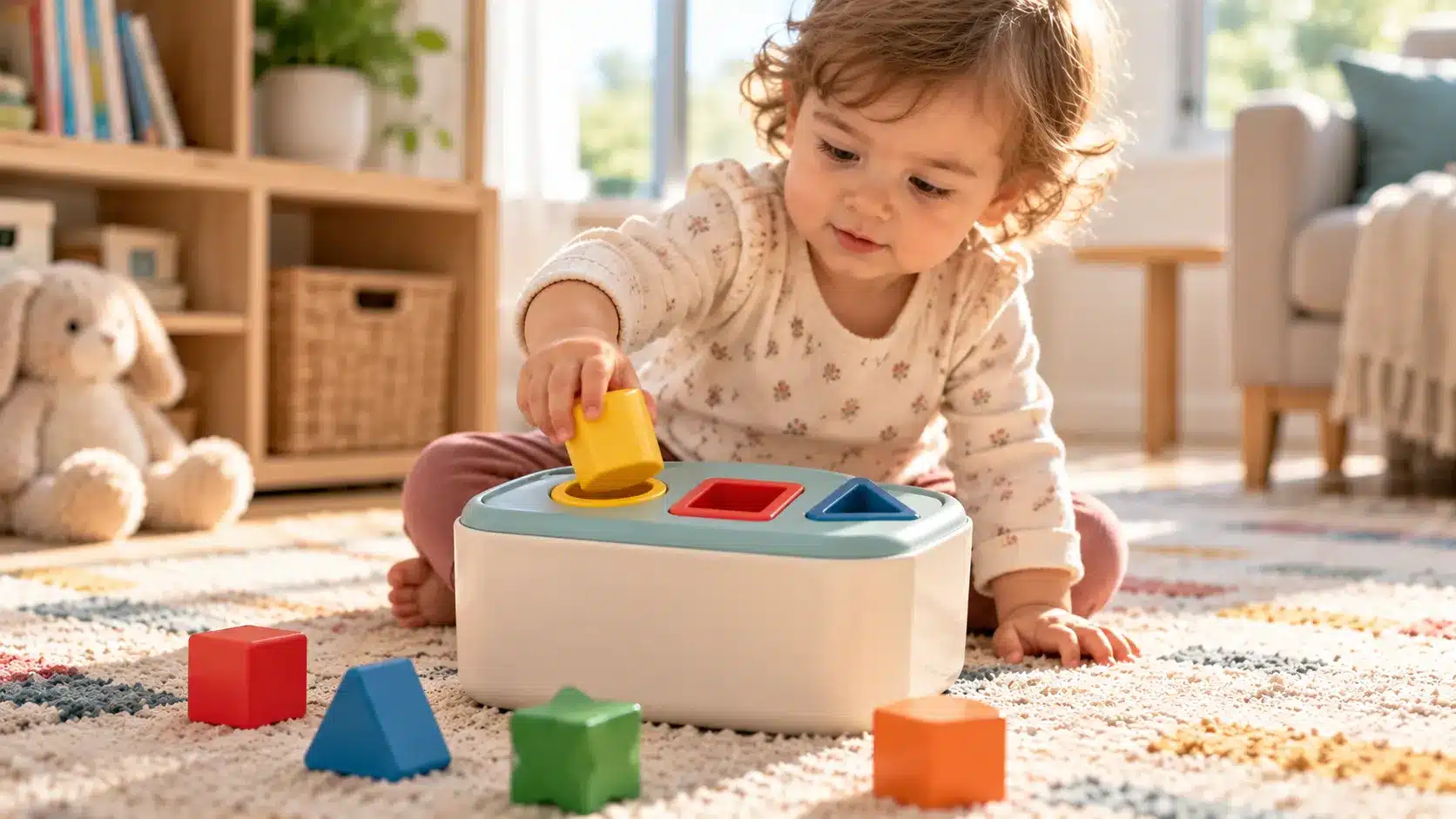
Toddlers don’t use products the way the box imagines. They drop them, swing them, and test every joint. So toddler product design starts with durability: drop- and abuse-resistance, no small parts that can detach, rounded edges, and non-toxic, washable materials.
These material choices determine whether the product passes safety testing later. A cheaper resin or one extra detachable piece now can mean a failed test and a redesign in six months.
Trying to design something that survives both toddlers and testing? Talk to a Gembah expert.
Know the safety rules before you design
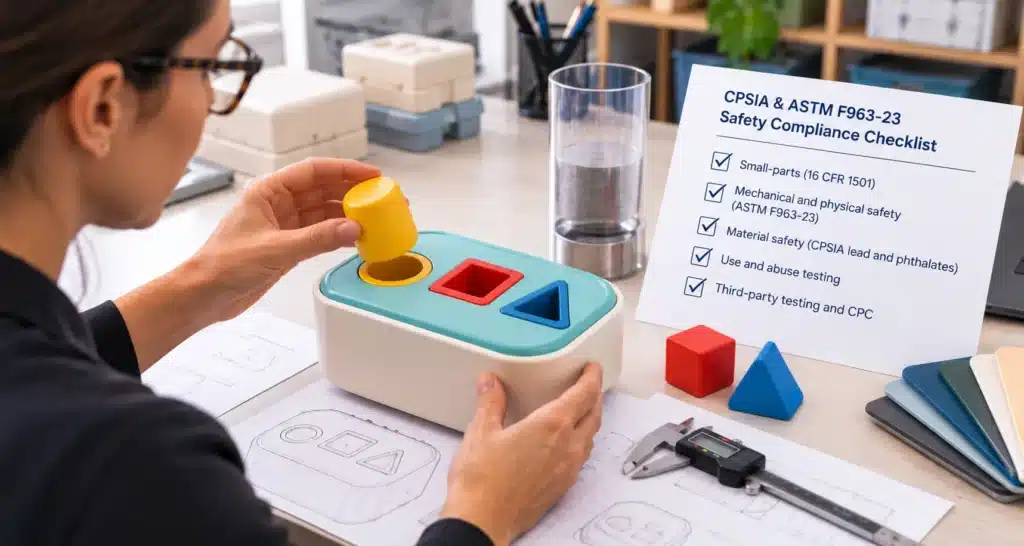
If your product is a plaything, ASTM F963-23 is the mandatory U.S. toy standard (effective April 2024), and CPSIA lead limits apply. The small-parts rule is where toddler products trip people up, because two different rules get mixed together:
- Small-parts ban (under 3): For a toddler product, 16 CFR Part 1501—under §1500.18(a)(9)—bans small parts in anything intended for children under 3, tested with the small-parts cylinder plus use-and-abuse. It’s a ban, not a label.
- Small-parts warning (3 to under 6): 16 CFR 1500.19 is only a warning label, for toys aimed at ages 3 to under 6 (and small balls and marbles up to under 8), tested with the cylinder as received. It doesn’t cover the toddler band.
Testing sits on top: third-party testing and a Children’s Product Certificate (CPC) are required for a children’s product subject to a safety rule, which is nearly every toddler product. The importer issues the CPC for an imported product, or the domestic manufacturer or private labeler for a US-made one—never a retailer or distributor.
Prototype and test with real toddlers (and real abuse)
A toddler ignores your instructions, so only real observation can honestly test it. Build samples, then run use-and-abuse testing. Watch actual toddlers and caregivers use the product before you commit to tooling.
Caregiver feedback catches what a spec sheet misses—a strap that’s hard to clip one-handed, a seam that pinches. Fix those now, while a change costs only a new sketch and not a mold.
Source and manufacture toddler products
When you’re ready to manufacture toddler products, the factory makes or breaks the first run. You want compliance-capable factories that have passed U.S. toddler-product testing before, can meet a minimum order quantity you can afford, and run real quality control.
First-timers get tripped up by MOQ and by factories whose test reports are out of date—CPSC keeps updating which ASTM revision applies, so ask which revision a factory last tested to before you commit.
Not sure a factory can make your product to spec? Get a Gembah sourcing quote.
Position and launch
Toddler parents buy on trust. Lead with proof of safety—third-party testing, clear materials, real reviews—not just a nice photo. Then meet them where they shop: direct-to-consumer for margin and data, Amazon for reach, specialty baby retail for credibility.
Myth vs. Reality
Myth: “If it’s safe for adults, it’s safe for toddlers.”
Reality: toddler safety is a separate, stricter standard built around choking, materials, and abuse testing.
How Gembah Helps You Build a Toddler Product That Passes
Most first-time toddler-product makers try to coordinate a designer, a sourcing agent, and a factory on their own—and the safety requirements fall through the cracks between them. Gembah runs design and engineering, prototyping, sourcing and manufacturing, and quality control as one team. We plan safety from the first sketch and run in-process and final inspections on the line. The process extends through Market Validation and the Pre-Launch, Crowdfunding, and Launch stages that bring it to market.
The result is a product designed to pass testing the first time, made by a factory that can prove it. See how baby and toddler product development works end to end.
From Idea to a Toddler Product You Can Ship
A toddler product isn’t a smaller version of something else—it has its own rules, stresses, and safety bar. Start with the child, design for real toddler use, learn the under-3 rules before you sketch, and manufacture with a factory that can prove compliance. Do that, and you ship a product that survives both toddlers and testing.

Ready to turn your toddler idea into a product that’s built to pass? Get a quote from Gembah—or contact the team to talk through the build.
FAQs
How do I create a product for toddlers?
Start with the child’s developmental stage, design for durability and safety from the first sketch, check it against the under-3 toy and small-parts rules, test with real toddlers, and manufacture with a compliance-capable factory.
What’s the difference between a baby product and a toddler product?
A toddler product is built for a mobile, curious one-to-three-year-old who throws, climbs, and mouths everything. It faces tougher durability demands and the stricter under-3 small-parts ban, so you can’t just scale down a baby product.
What safety standards apply to toddler products?
If it’s a plaything, ASTM F963-23 is the mandatory U.S. toy standard, and CPSIA lead limits apply. For under-3s, 16 CFR Part 1501 bans small parts outright, and products subject to a safety rule need third-party testing and a Children’s Product Certificate.
How do I make a toddler product durable enough for real use?
Design for drop and abuse resistance, remove detachable small parts, round the edges, and pick non-toxic, washable materials. Then prove it with use-and-abuse testing and real-toddler trials before you commit to tooling.
Do toddler products need third-party safety testing?
Yes, for any toddler product subject to a children’s product safety rule—which covers nearly all of them. Testing must be done at a CPSC-accepted lab, and the importer or domestic manufacturer then issues a Children’s Product Certificate.
What does it cost to develop a toddler product?
Expect product-side costs across design, prototyping, tooling, third-party testing and certification, and the first production run. Testing and certification are fixed entries you can’t skip, so build them into your budget from the start.