


John built Magtie for grooms like himself, but Market Validation showed its strongest early demand came from the fathers of the bride and groom. Magtie is a ready-to-wear, hand-tied silk bow tie held in place when worn by a patent-pending magnetic collar stay system. Gembah developed it based on the founder’s homemade prototype into a launched product.
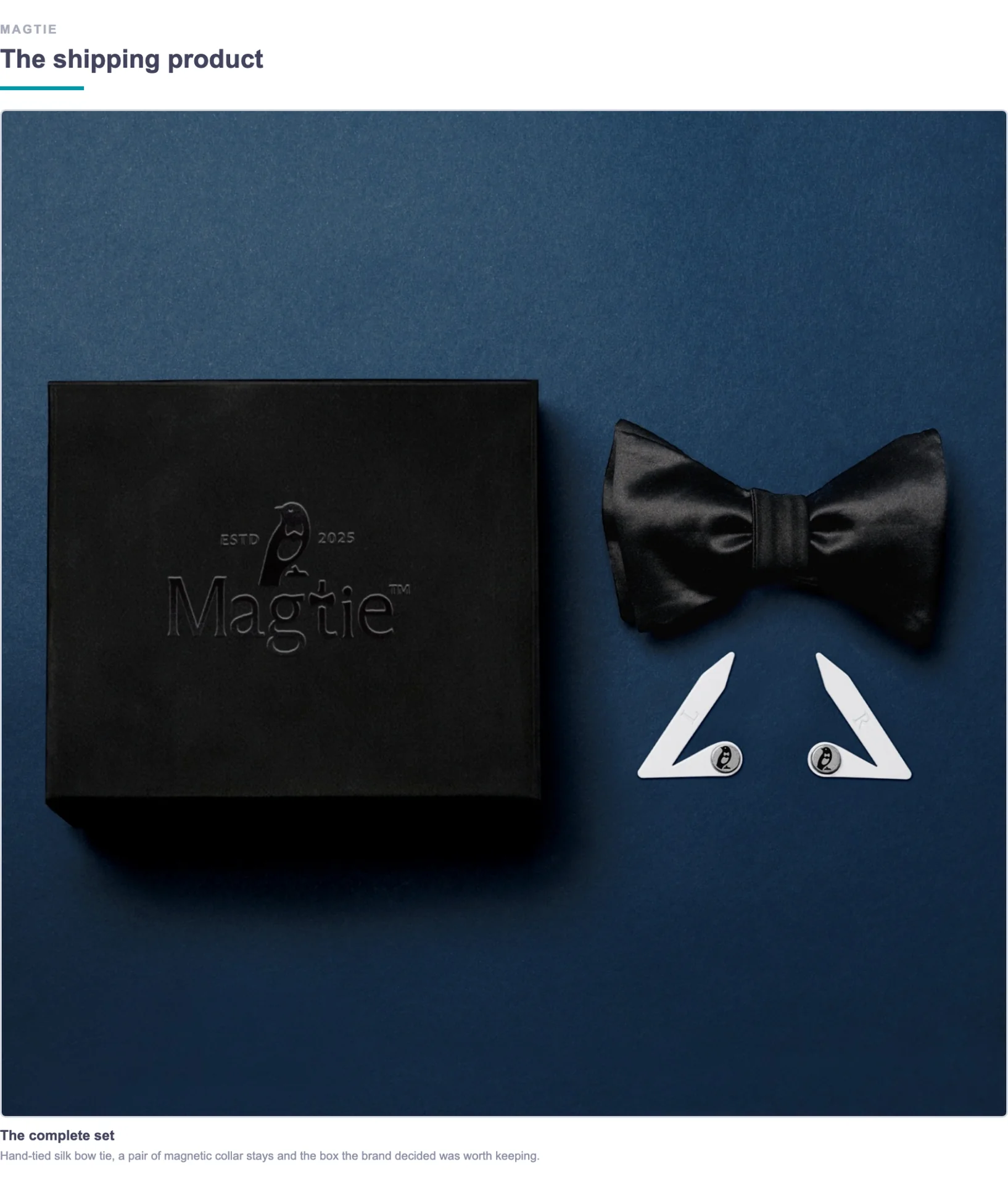
- Founder: John, who manages commercial partnerships at a life science robotics and automation company
- Product: Magtie, a pre-tied bow tie that is hand-tied in production and held by magnets in the bow and the collar stays
- Gembah’s role: Research & Ideation, Final Concept, Engineering & Design, Design Pack, Source Factory, Sampling & Tooling, Production, then Market Validation and Launch — Gembah still runs Magtie’s marketing today
- Key finding: the strongest early demand came from fathers of the bride and groom, not young grooms
Where did the idea for Magtie come from?
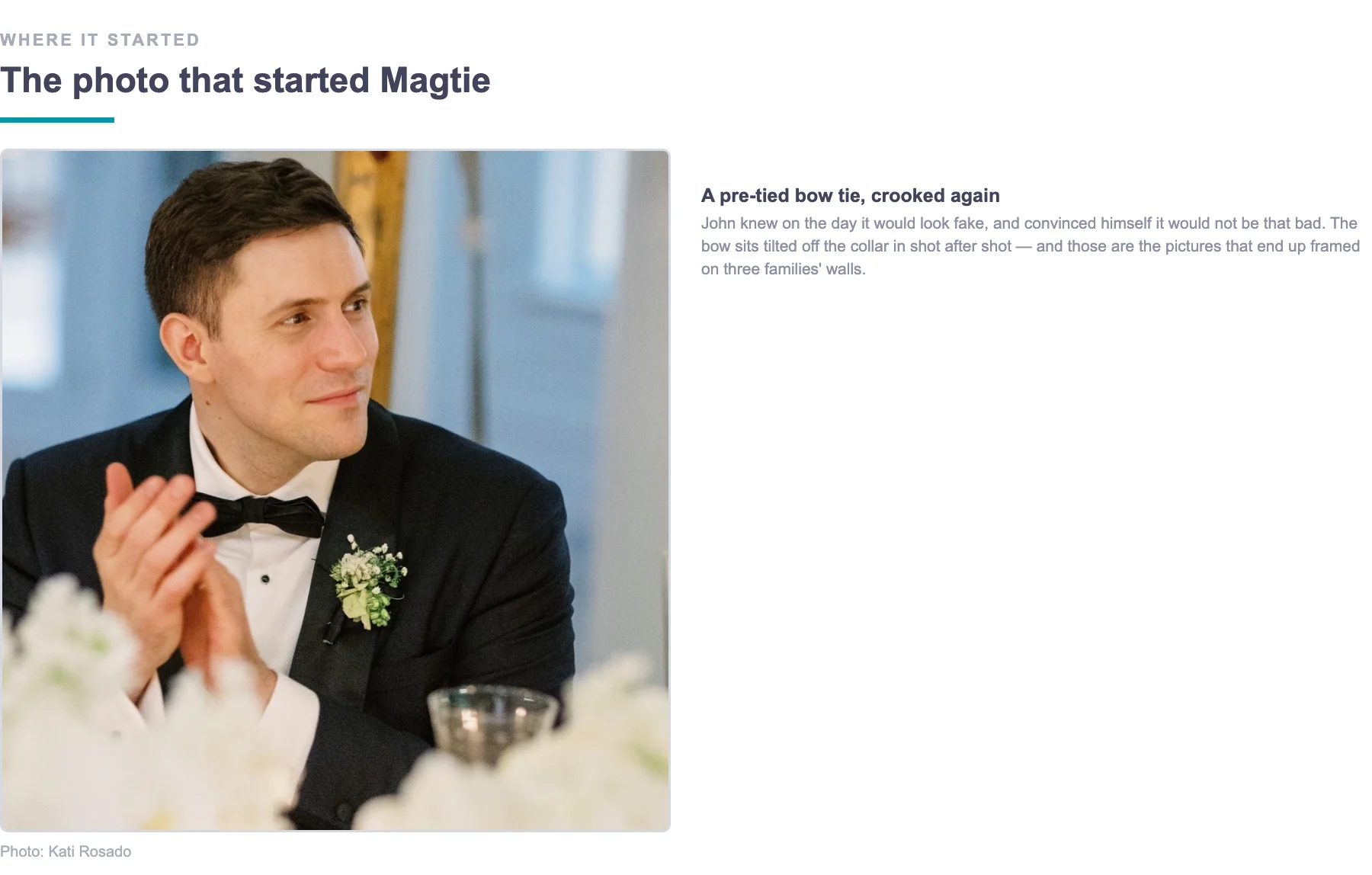
Magtie started with John’s wedding photos, where his pre-tied bow tie looked crooked or flopped forward in almost every shot.
He knew on the day that his pre-tied bow tie would look fake and convinced himself it wouldn’t be that bad. Then the photos came back.
“It was crooked, flopped forward, or just ‘off’ in virtually every picture, which of course are memorialized forever in a frame and hung around our home, my parents’ and in-laws’ homes.”
Only one groomsman could tie a bow tie, and only on himself. After that, John couldn’t stop seeing fake bow ties, on TV, in photos, at every event he attended.
What did the first Magtie prototype look like?
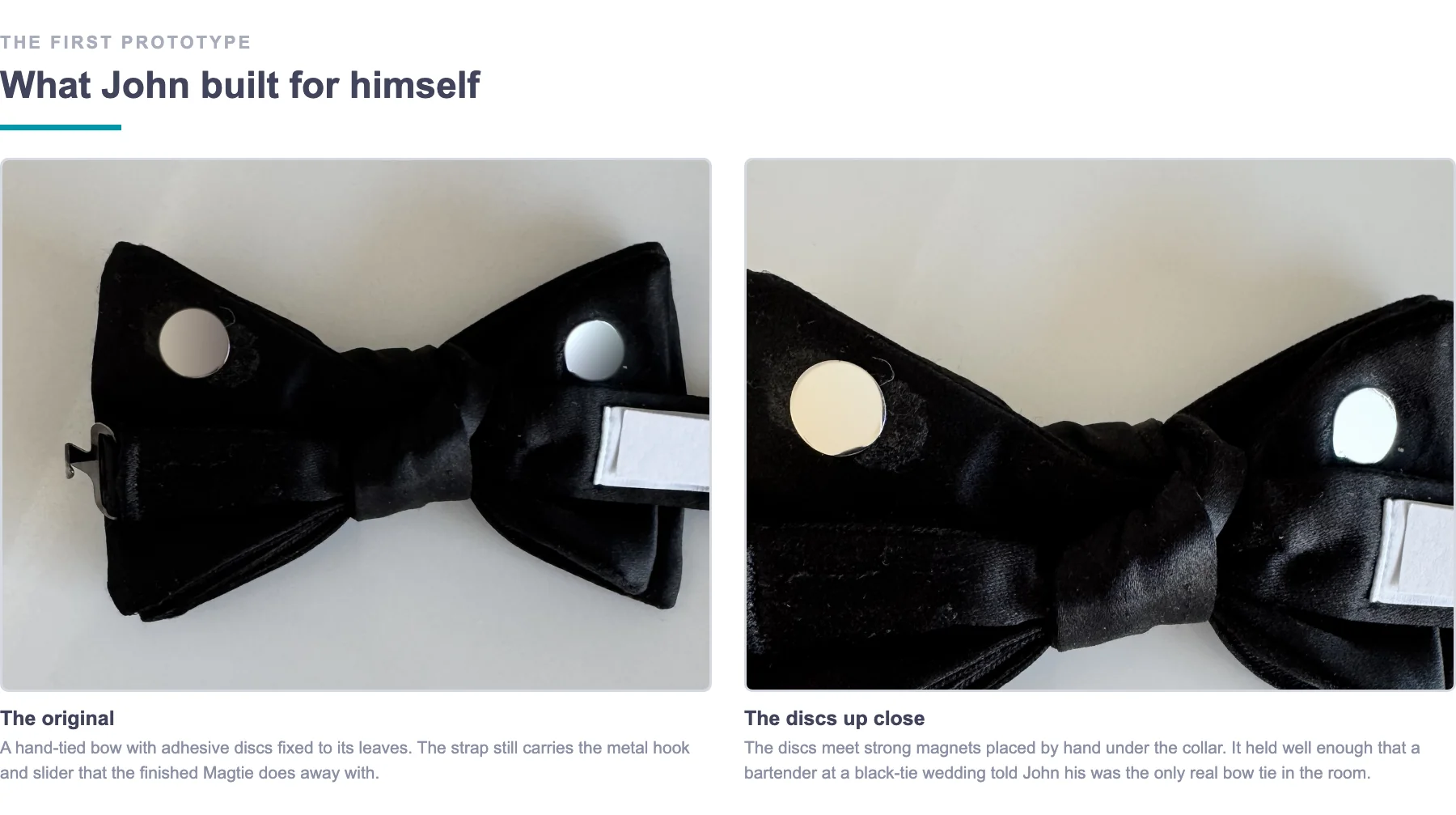
The first Magtie was a custom hand-tied bow with adhesive discs on its leaves and strong magnets fitted manually under the collar. John was working full time at a robotics company, with a newborn at home. Learning to tie a bow tie for a few events a year wasn’t going to happen, and nothing on the market passed what he called the sniff test.
So he built one, and it worked. At a black-tie wedding, a bartender spent the night calling out every clip-on in the room and told John his was real. That was when he thought he had something.
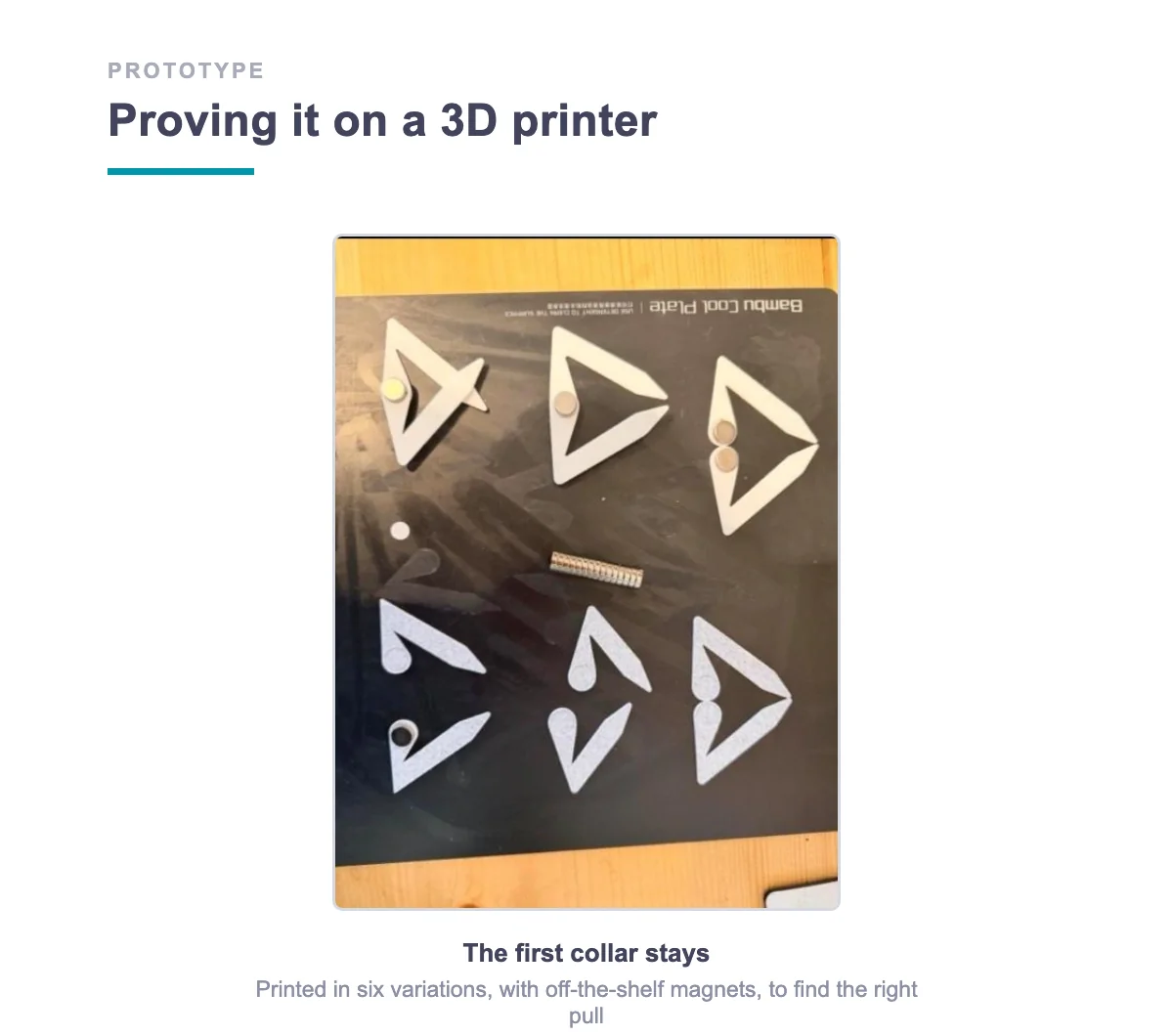
Next came collar stays he designed in CAD software and had 3D printed, with off-the-shelf magnets glued on to find the strength he needed. It proved the idea. It also showed the limit of doing it alone.
“I knew I was on the right track, but didn’t have the in-house knowledge on how to rapidly iterate new versions.”
Each order took too long, and the stays had almost no margin for error. They had to fit real shirts and meet the collar in exactly the right spot.
How did Gembah help develop Magtie?
Gembah took Magtie through Research & Ideation, Final Concept, Engineering & Design, the Design Pack, Source Factory, Sampling & Tooling and Production, turning a working prototype into a product that could be made at scale. John arrived with a clear list of what was wrong with every pre-tied bow tie he’d owned, including six specific failure modes.
His background is lab automation, where a workflow problem often turns out to be a geometry problem. He approached the bow tie the same way, one component at a time.
“I set out to identify all of the problematic areas or components that could be improved, and designed the Magtie from there.”
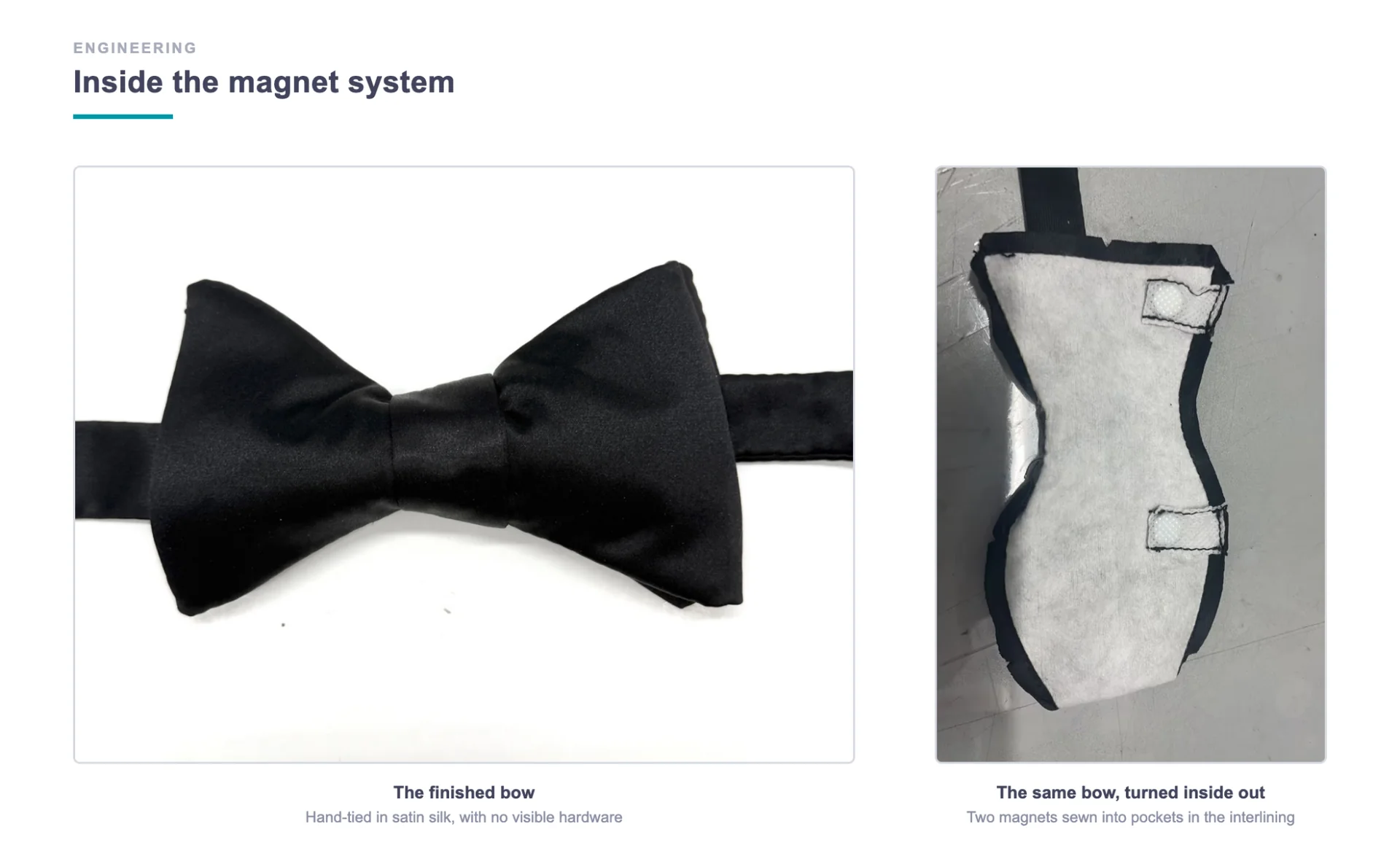
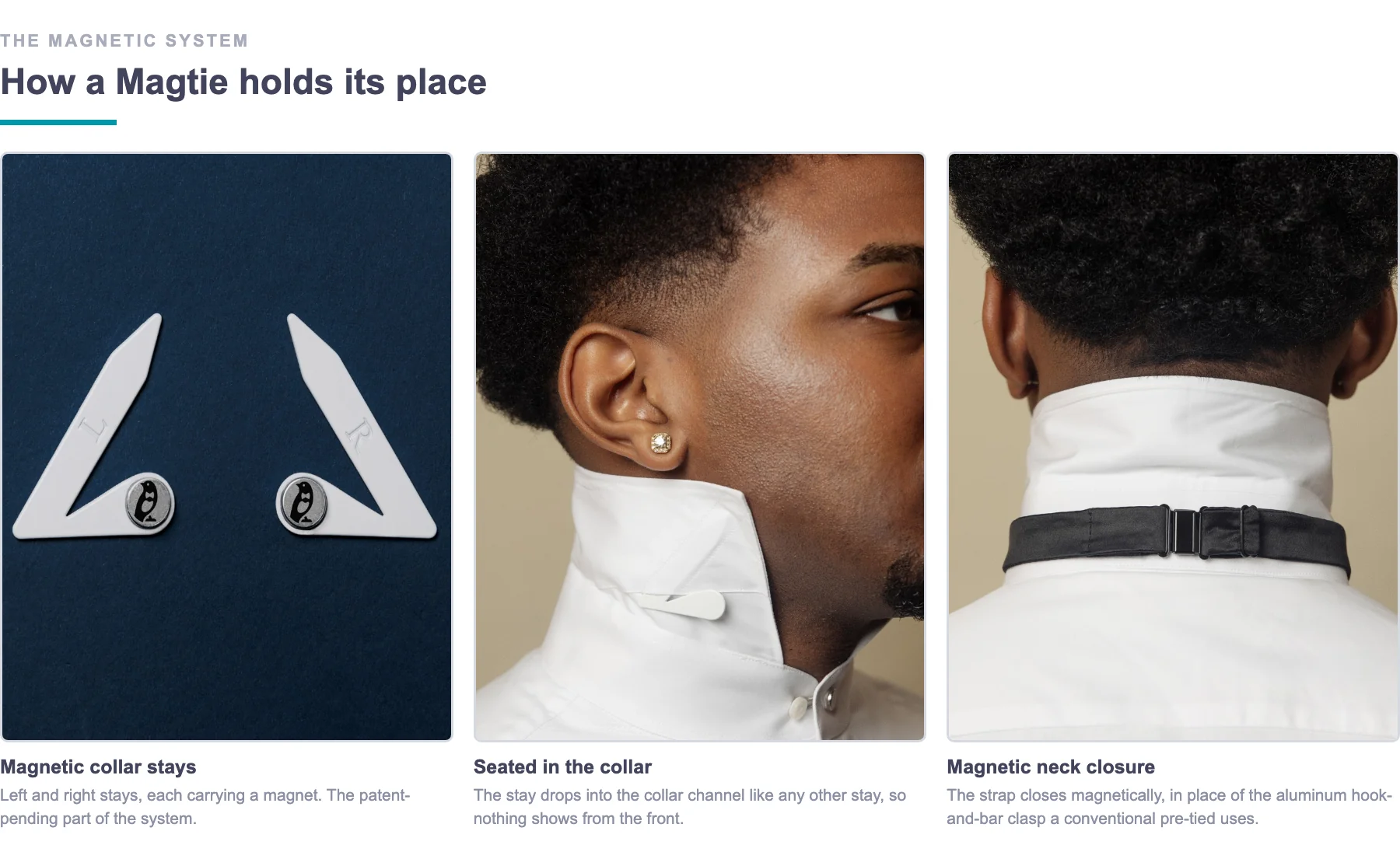
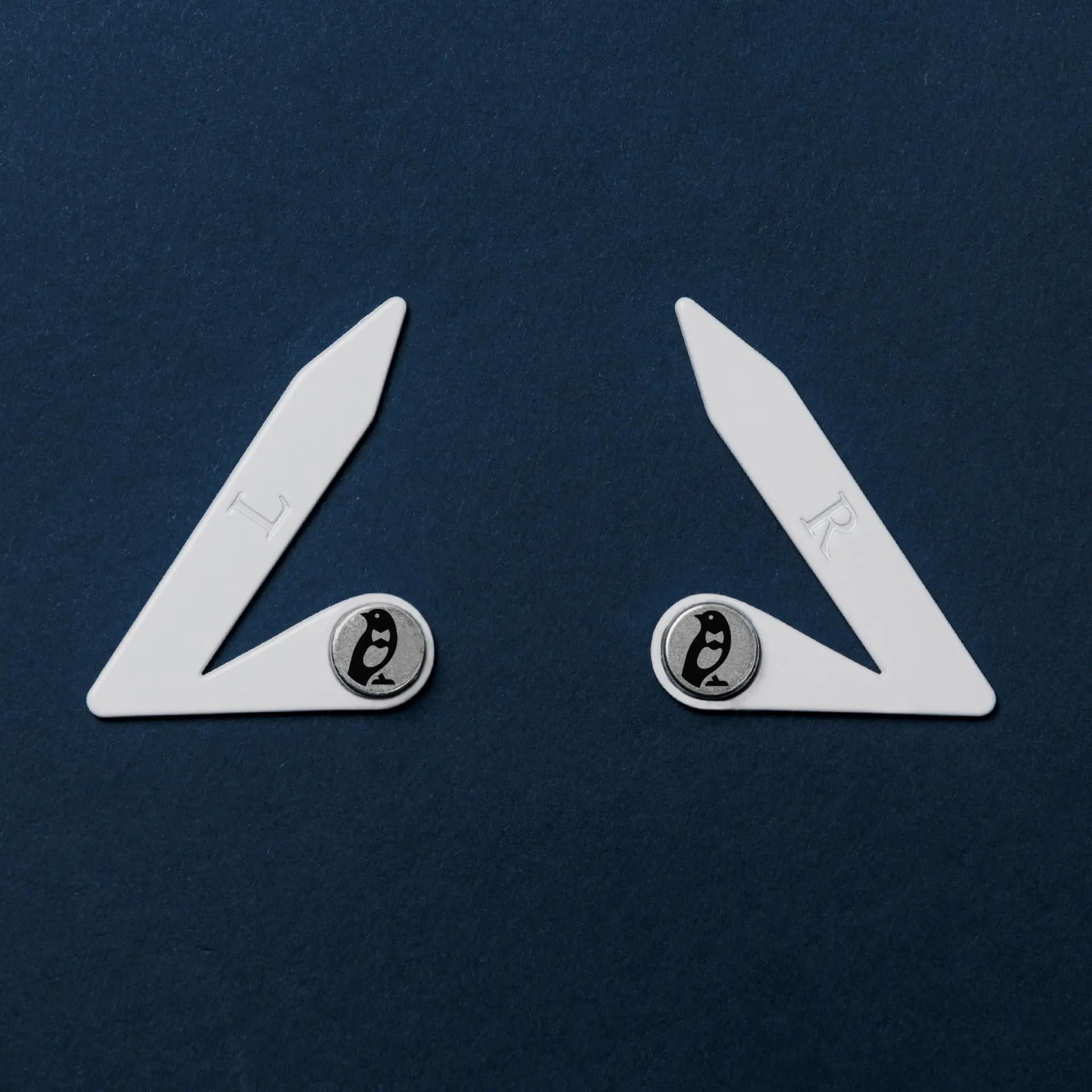
That list became the brief. 28-momme satin silk over fusible interlining instead of thin polyester. An adjustable neck strap that closes magnetically instead of the usual aluminum hook. A better sizing adjuster. And at the core, the collar stays with magnets that connect to magnets hidden inside the bowtie itself.
What was wrong with every other pre-tied bow tie
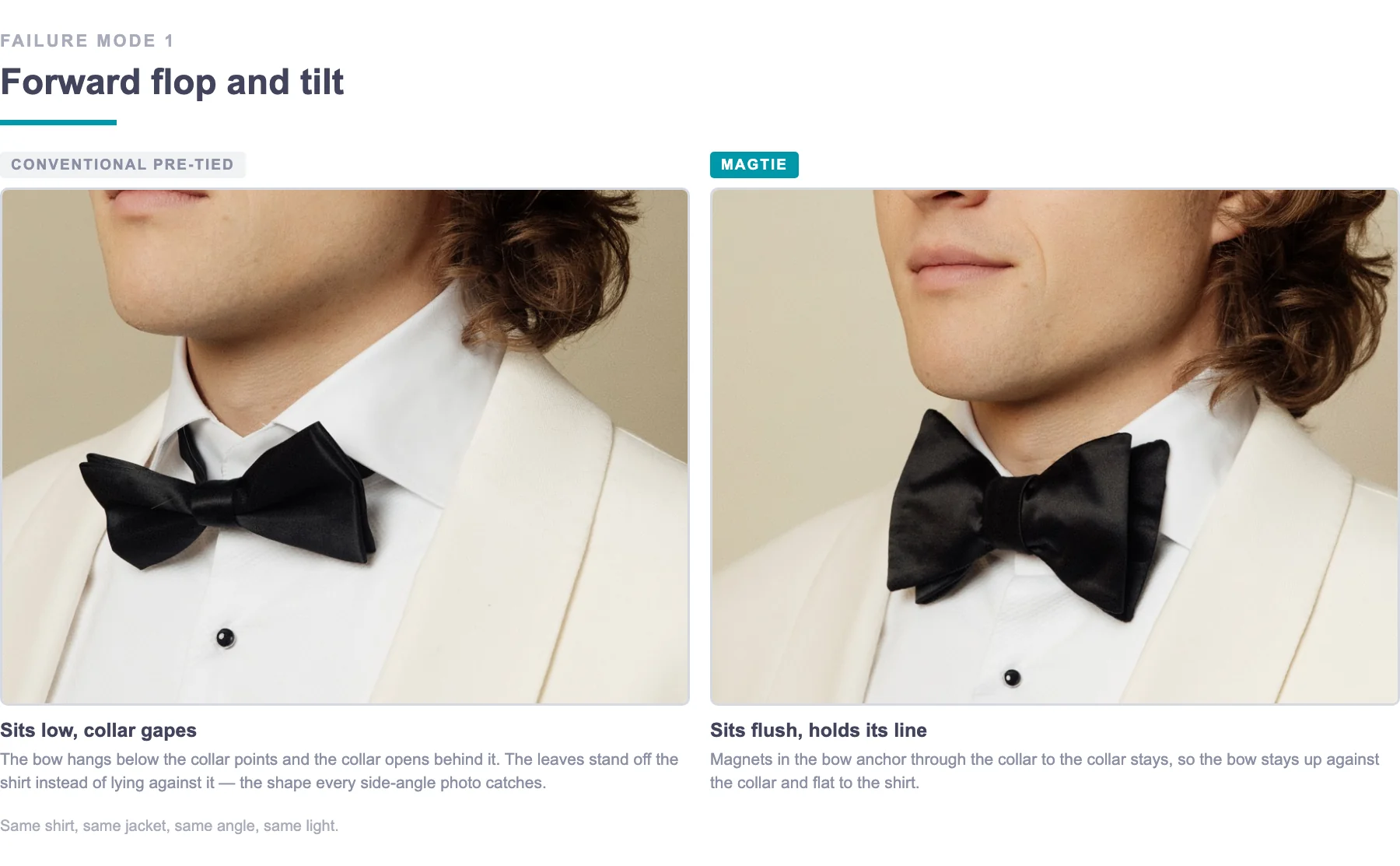
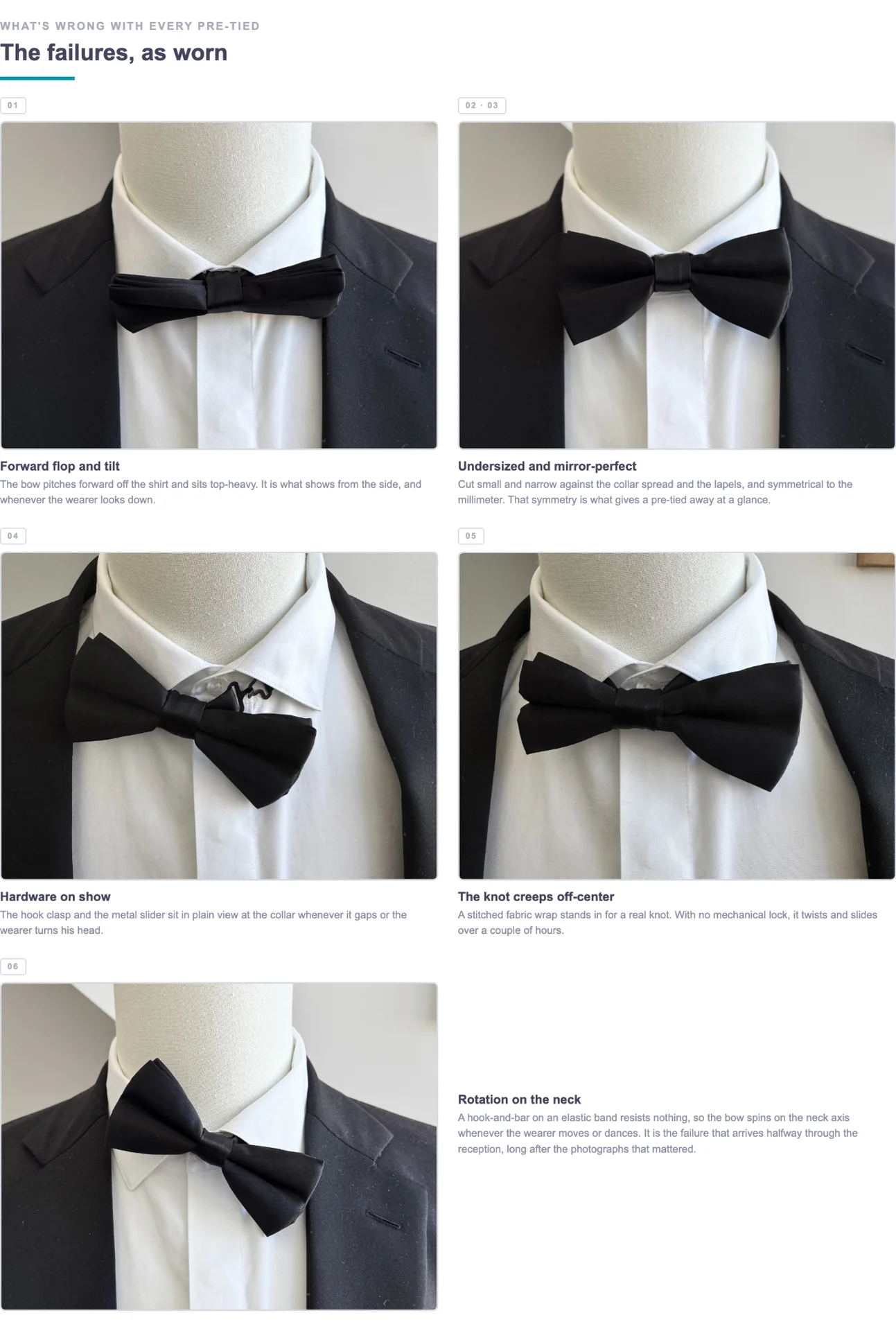
John’s list named six failure modes, and each one has a specific fix in the finished product.
- Forward flop and tilt. The bow pitches forward off the shirt, so it looks top-heavy in photos, especially from the side or when the wearer looks down. Magtie’s fix: N52 magnets in the bow anchor through the collar to the magnetic collar stays, which hold it flush against the shirt.
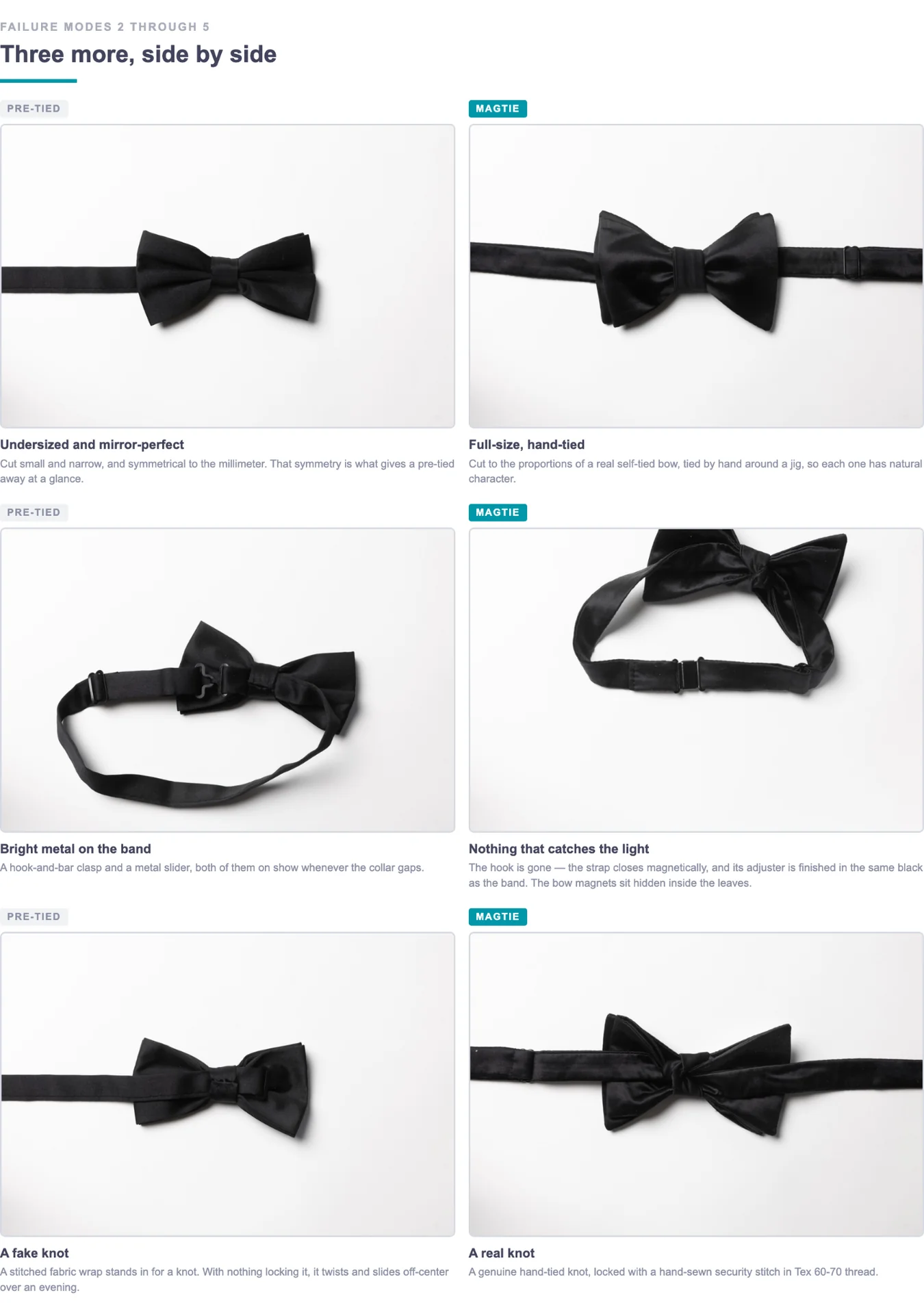
- Undersized profile. Most pre-tieds are cut small and narrow, so the bow looks shrunken against the collar spread and the width of the jacket lapels. Magtie’s fix: the bow is cut and tied to the proportions of a real self-tied bow.
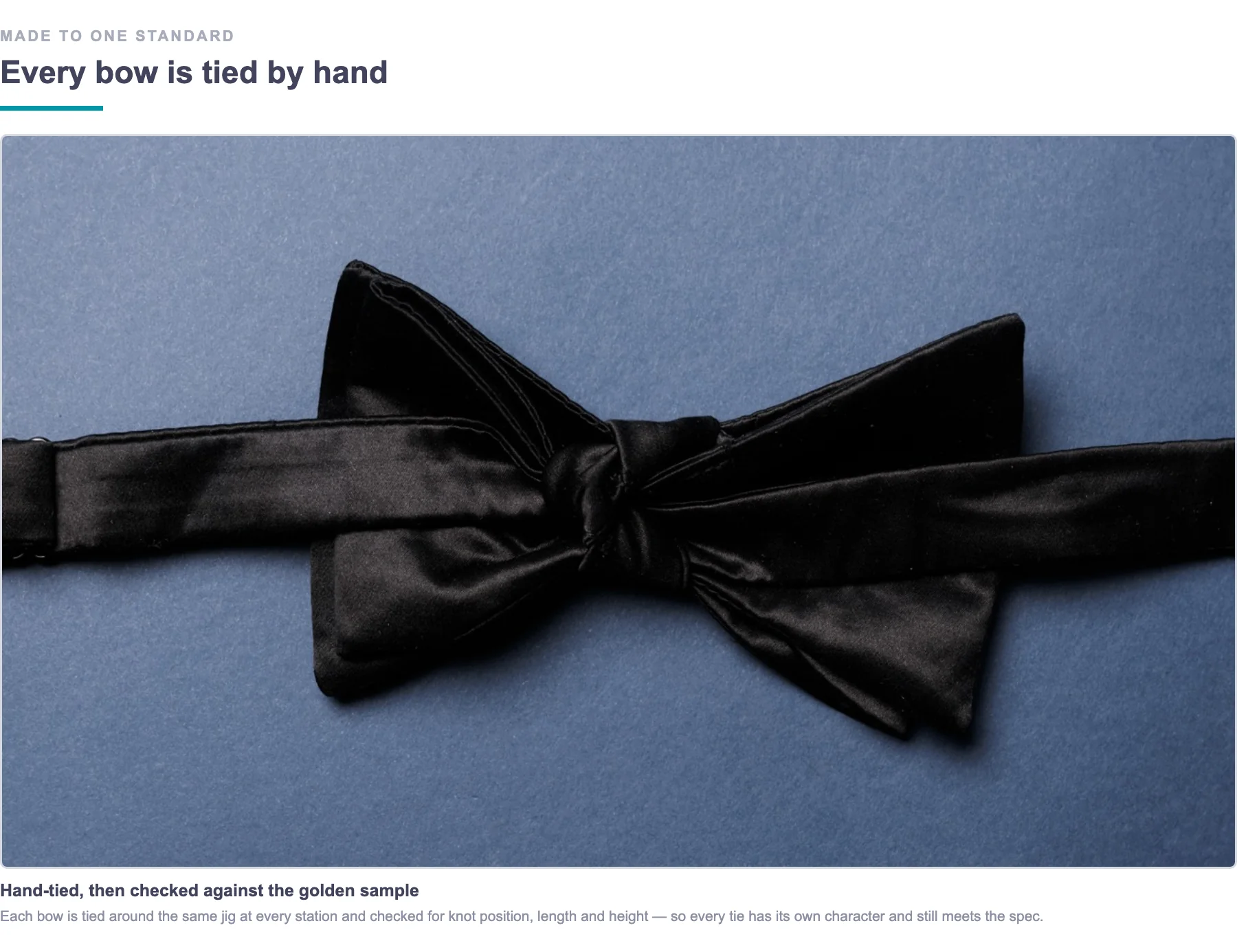
- Rigid symmetry. Machine-made bows are perfect mirror images, and that uncanny symmetry is what gives a pre-tied away at a glance. Magtie’s fix: every bow is hand-tied around a jig, so each one has natural character but still meets the golden-sample spec.
- Visible hardware. The metal slider, hook clasp and elastic band show at the collar, especially when the collar gaps or the wearer turns his head. Magtie’s fix: a magnetic neck-strap closure replaces the aluminum hook, and the magnets hide inside the bow.
- Center knot collapse. A stitched fabric wrap stands in for a real knot. With no mechanical lock it twists, crimps and slides off-center over a couple of hours. Magtie’s fix: a real hand-tied knot, locked with a hand-sewn security stitch in Tex 60-70 thread.
- Lateral rotation. A hook-and-bar on an elastic band has no resistance to rotation, so the bow spins on the neck axis whenever the wearer moves or dances. Magtie’s fix: the paired magnets give the bow two fixed anchor points at the collar.
The magnets were the hardest balance. Early versions were too weak to hold. Too strong caused its own problem, because the extra friction would wear the shirt and the silk faster. The team tested a range of magnet strengths across several formal shirts, through moderate and vigorous movement, dancing included.
How is every Magtie hand-tied to the same standard?
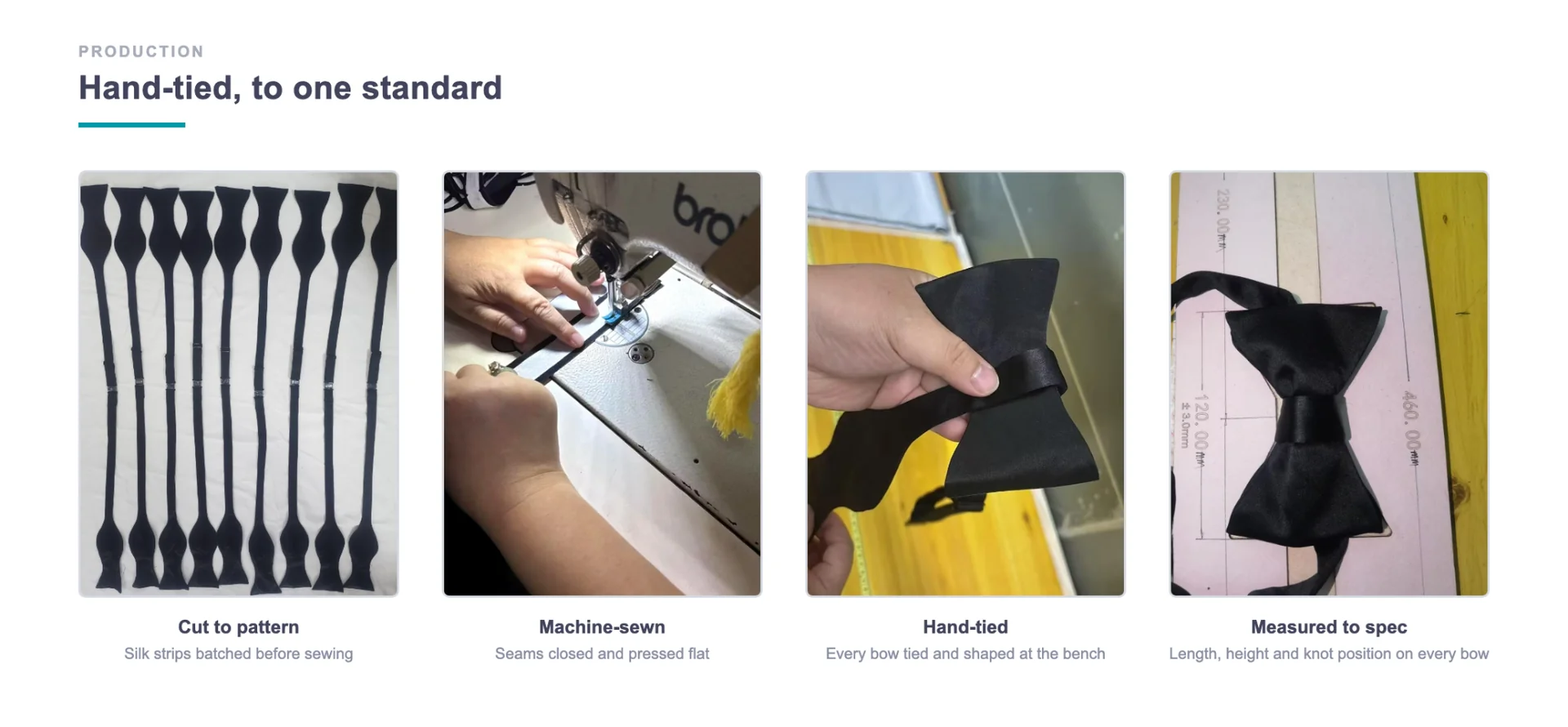
Each bow is tied around a standard jig and checked against a golden sample, so every tie has its own natural character but meets the same spec.
Every Magtie is hand-tied, and the bow has to survive going on and coming off without losing its shape. The jig is the same at every station, and the golden-sample check covers knot position, length and height.
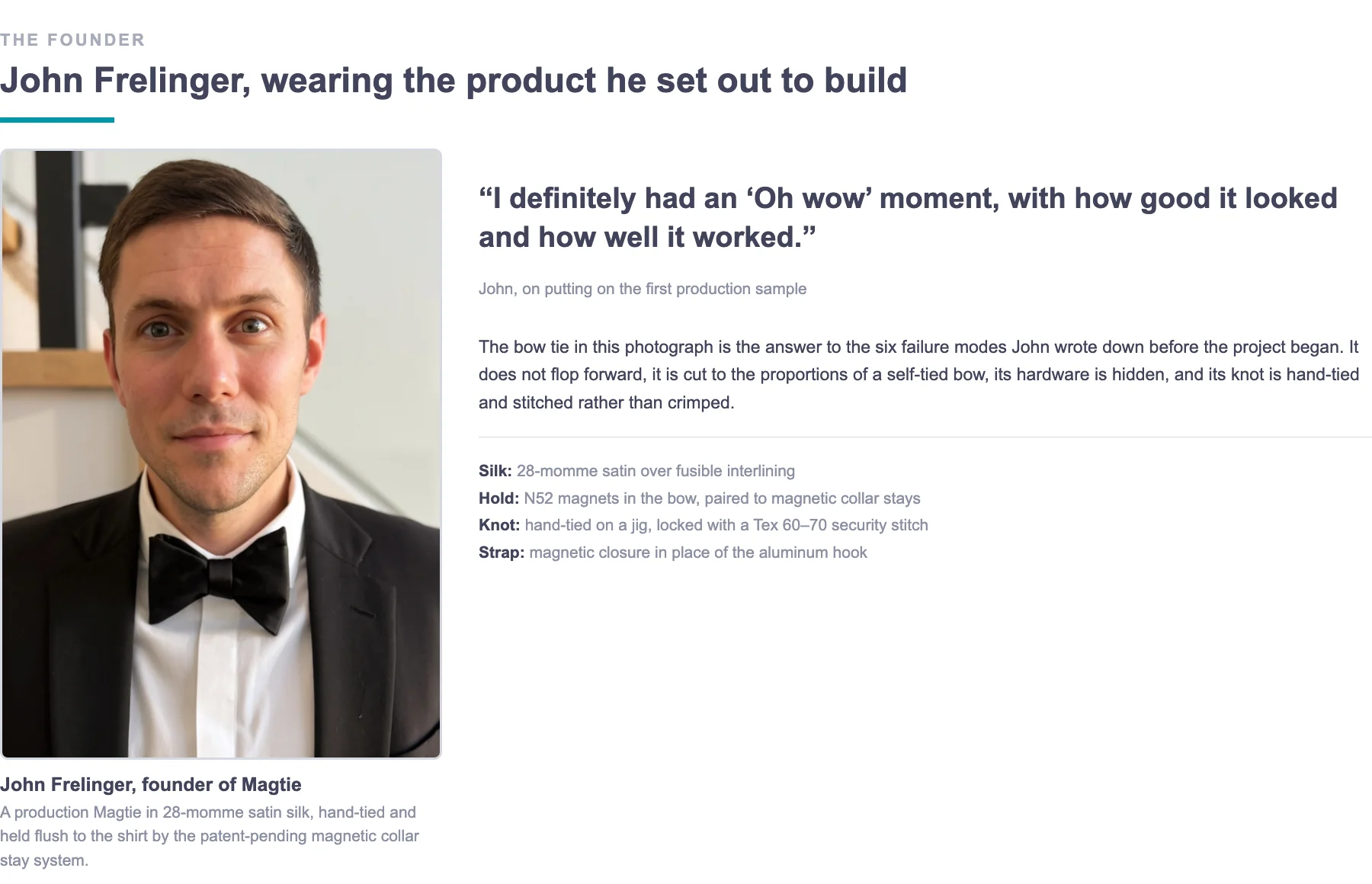
When John put on the first production sample, his reaction was simple.
“I definitely had an ‘Oh wow’ moment, with how good it looked and how well it worked.”
What did Market Validation reveal about Magtie’s customers?
Market Validation showed that Magtie’s strongest early buyers were fathers of the bride and groom, not the young grooms John expected. Market Validation runs live campaigns to test real demand, pricing and messaging before a founder invests in manufacturing. John expected customers like himself, younger grooms worried about the photos.
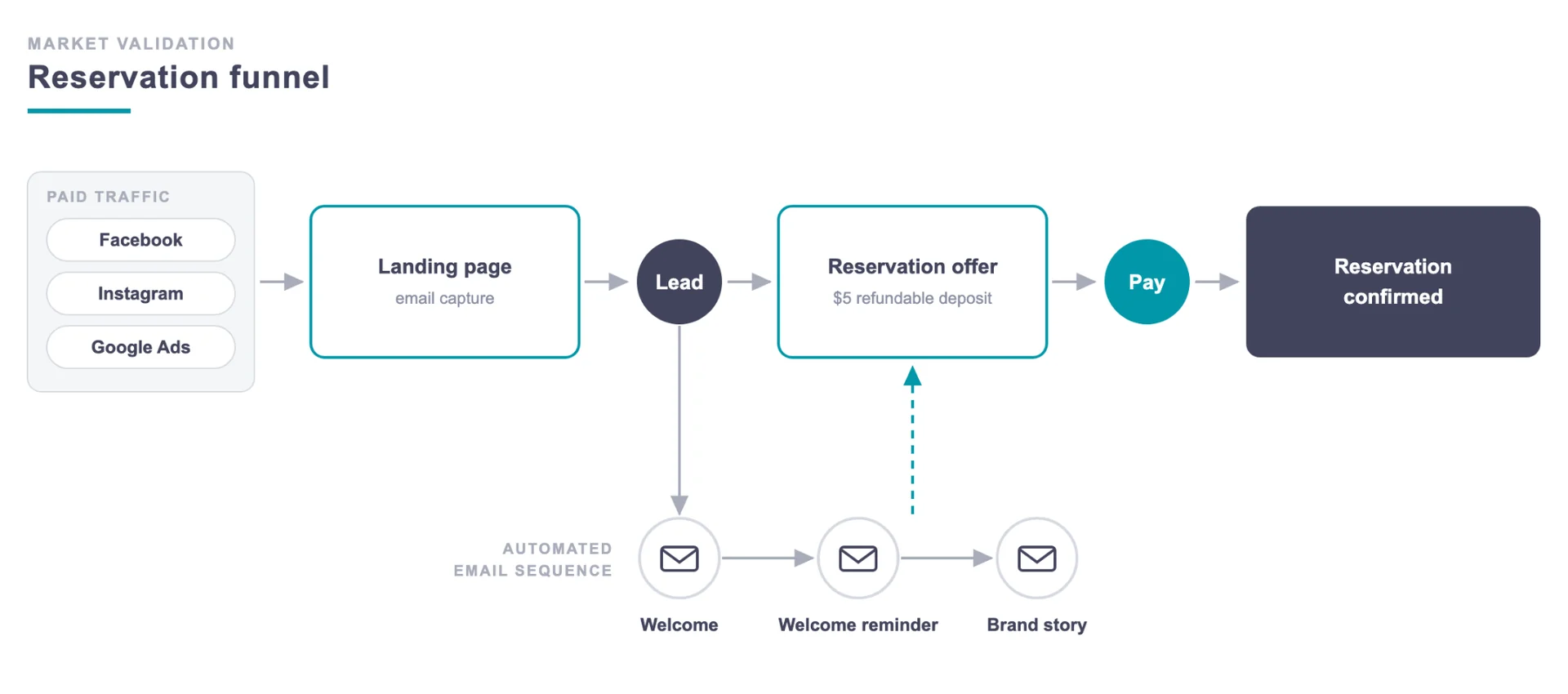
He knew the problem was real. Based on surveys he’d seen, roughly 90% of men can’t tie a bow tie without a video to follow. The harder question was how to market a problem nobody talks about.
“It’s sort of a hidden shame, but also a collective one, since seeing everyone in the same boat as you provides shared comfort.”
The fathers wanted to look confident on their child’s wedding day. Many were executives, doctors, lawyers and surgeons who attend galas and awards ceremonies regularly. Advertising on Facebook, which skews older, reinforced the pattern.
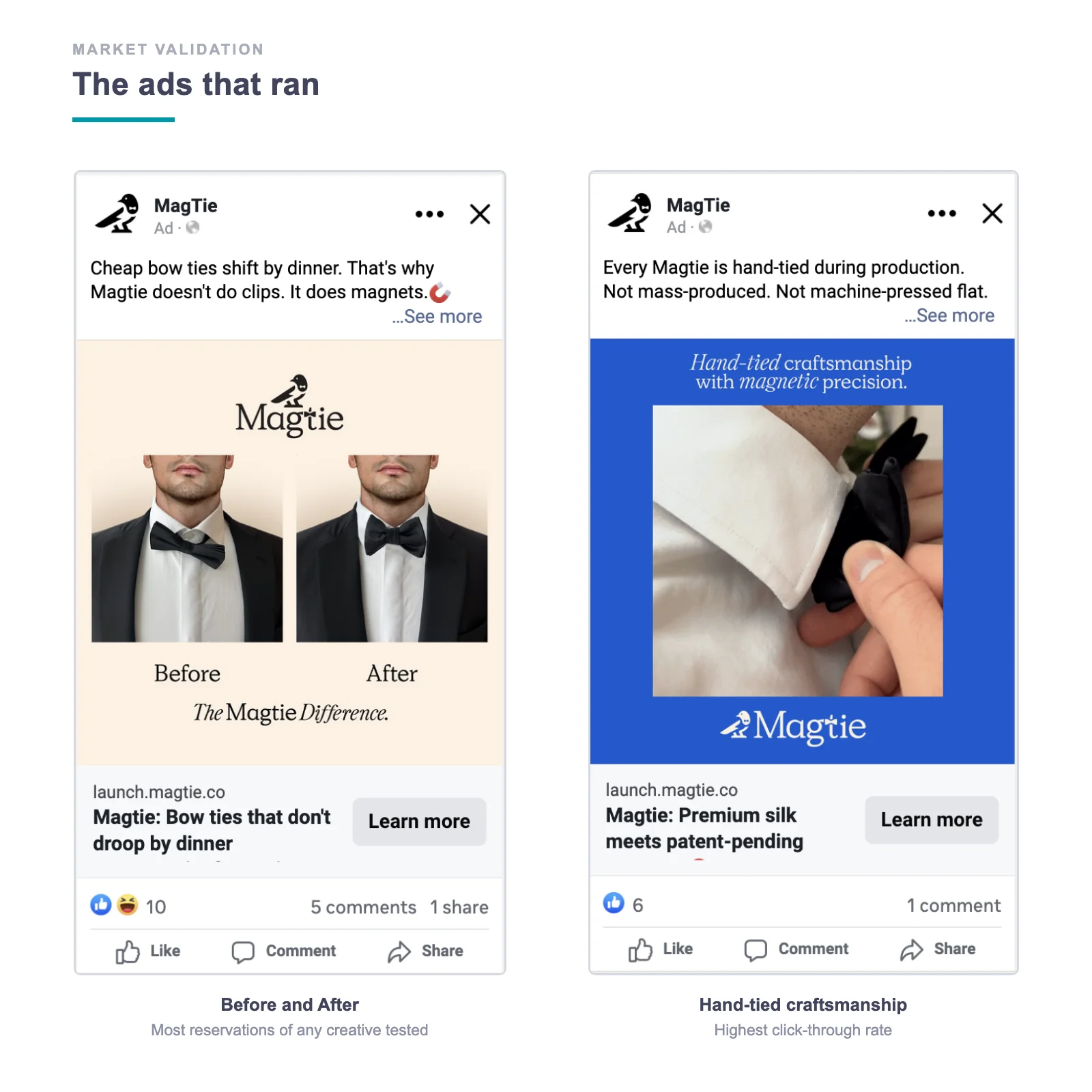
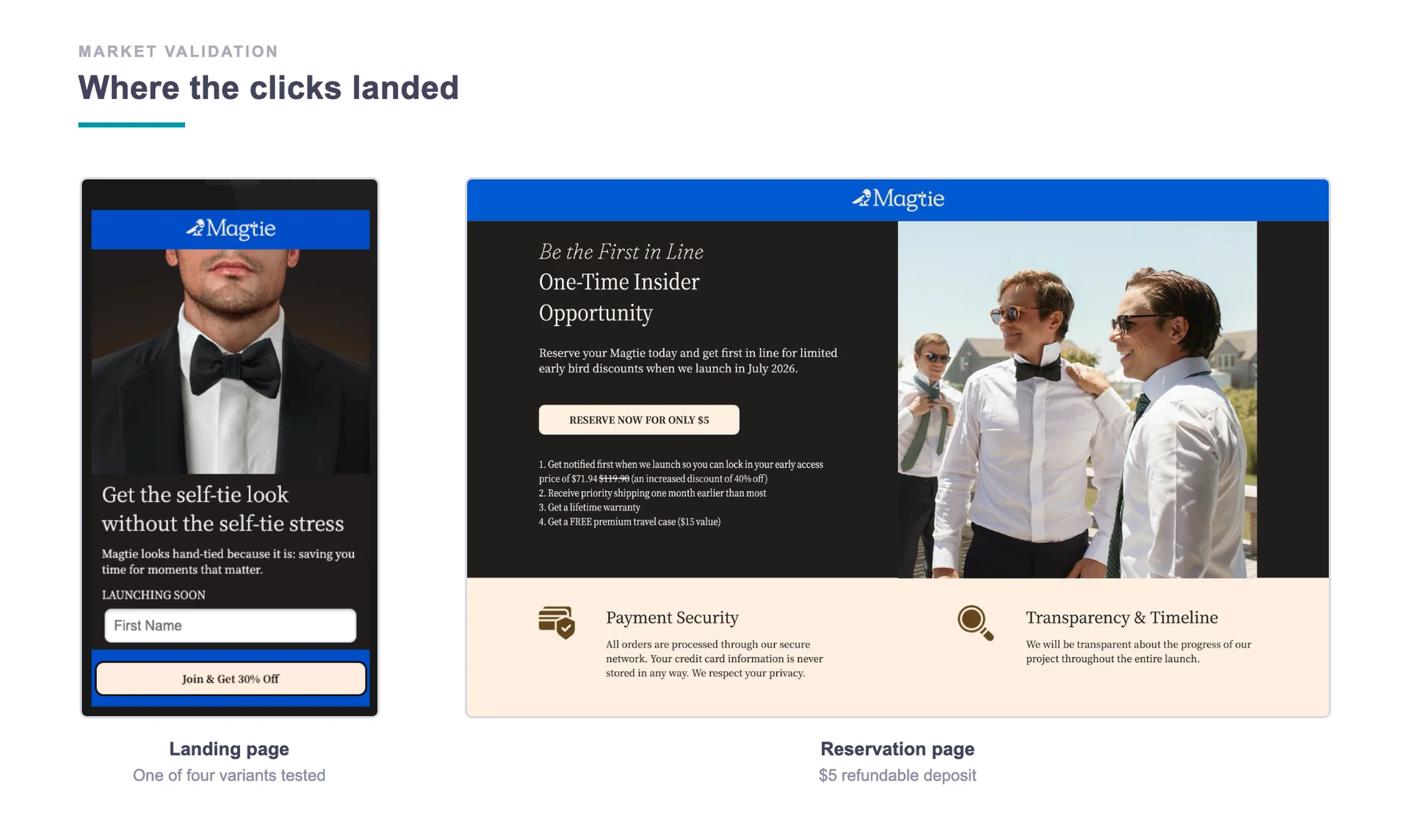
The lesson was to lean into the premium side: hand-tied silk, the patent-pending magnetic system, and packaging good enough that people keep the box. That packaging, and the Magtie brand identity around it, were designed in collaboration with Peter Murphy Design (petermurphy.design).
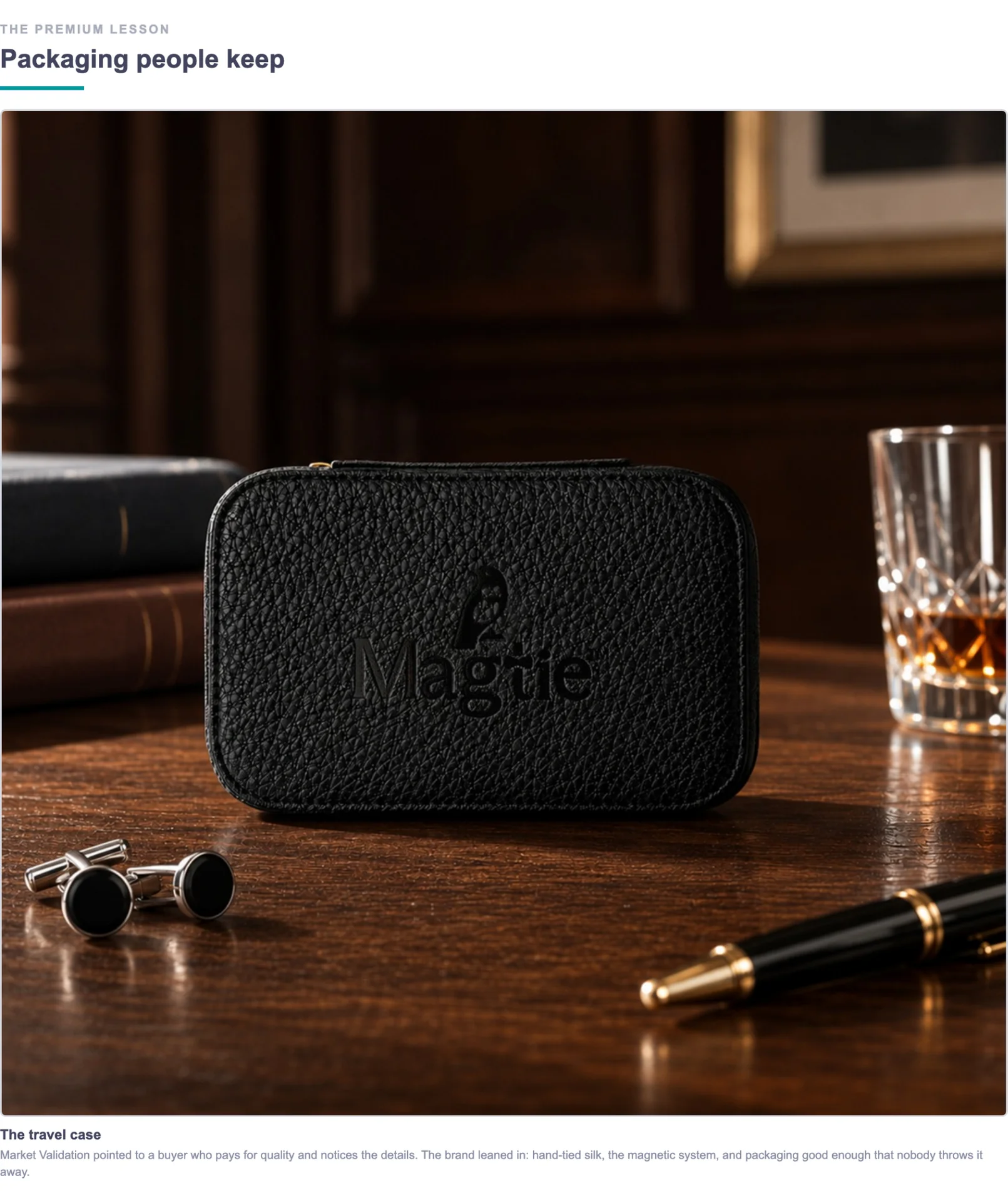
“People are generally comfortable paying a higher price if you actually get what you pay for.”
John is clear about what the alternative would have been.
“I think we would have just been posting and boosting posts randomly, which I assume would be a waste of money and inefficient.”
How is Magtie doing after launch?
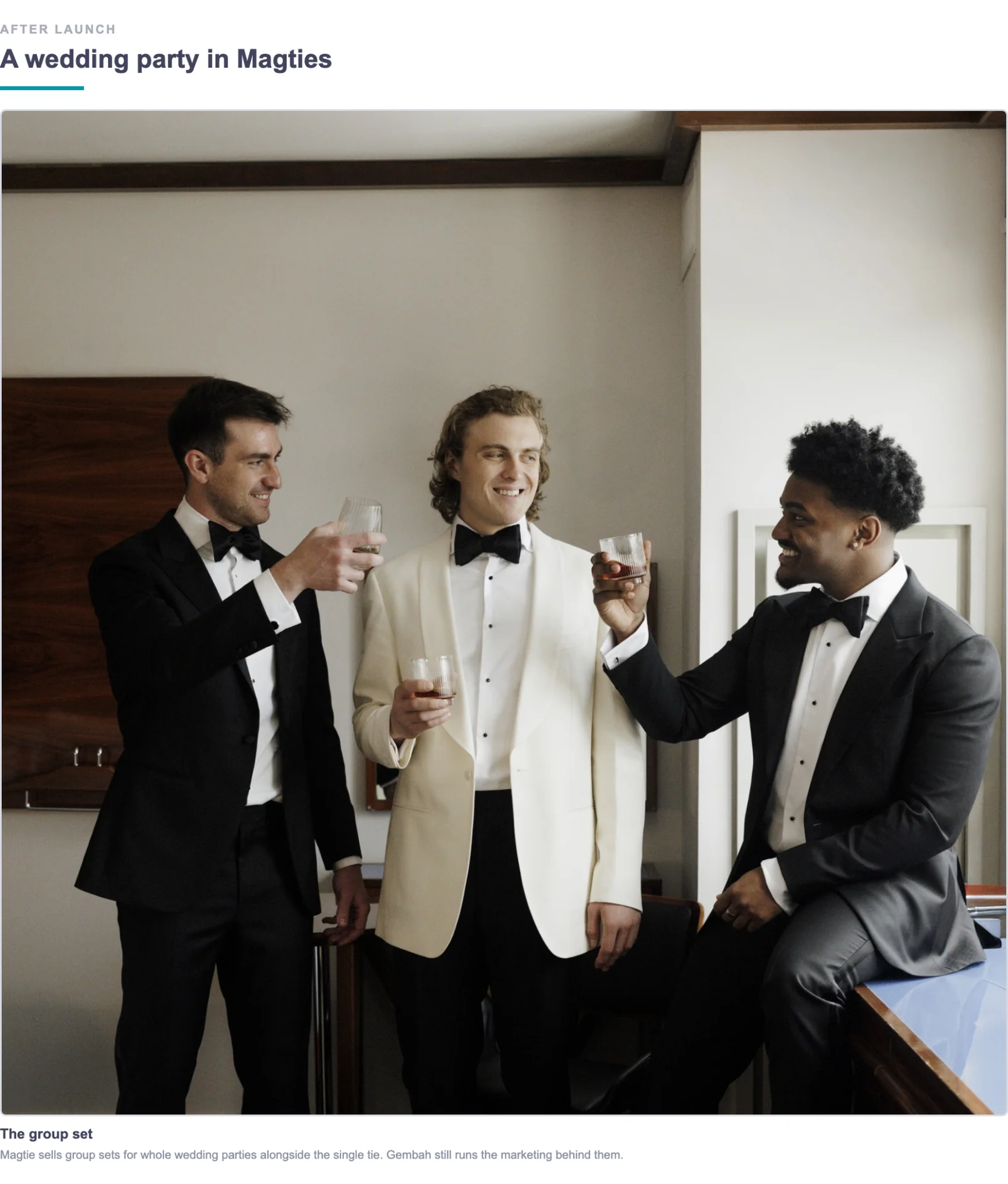
Magtie has launched and is selling now, with group sets for whole wedding parties alongside the individual tie, and Gembah still runs Magtie’s marketing through its Launch service, managing paid acquisition, retention and post-launch growth.
Quality control continues past the production line. After packing, every tie is checked again for fraying, magnet placement and presentation. Magtie’s logistics partner spot-checks every order before it ships and sends John photos of anything that looks slightly off.
If a tie still disappoints, John sends a replacement he has checked personally, or a refund.
“This approach has worked really well so far, and has helped educate me on what other processes we can implement at the production level.”
What advice does Magtie’s founder give inventors in traditional categories?
Improve every part of the product, not just the one people complain about. In old categories, quality slips because customers have no other option.
“The $100+ pre-tieds from large well-known brands are actually worse in some ways than a $15 one from Amazon. They are both terrible, however, you spend a lot more on one of them and they share the exact same design and structural flaws.”
Cheap polyester, crimped fabric instead of a real knot, a cheap metal sizing hook, cheap packaging. Magtie set out to fix all of it at once.
Frequently Asked Questions
Rare-earth magnets hidden inside the hand-tied bow connect to magnets in Magtie’s patent-pending collar stays, which hold the tie centered through the collar all night.
Yes. Each bow is hand-tied in satin silk during production, so it looks self-tied but goes on in seconds.
Six things, by Magtie’s count: it flops forward off the shirt, it is cut too small for the collar and lapels, it is unnaturally symmetrical, its hardware shows at the collar, its fake knot collapses within a couple of hours, and it rotates on the neck. Magtie was designed to fix all six.
The strongest early demand came from fathers of the bride and groom, many of them professionals who attend galas and black-tie events regularly, alongside younger grooms.
Gembah ran all seven development stages — Research & Ideation, Final Concept, Engineering & Design, the Design Pack, Source Factory, Sampling & Tooling and Production — then Market Validation to test demand and set the go-to-market path, and now Launch, Gembah’s service running Magtie’s marketing and growth after launch.
Market Validation tests how real customers respond to a product before a founder invests in manufacturing. Gembah runs live campaigns to test messaging, pricing and demand, then recommends a go-to-market path.
Launch is the stage of Gembah’s marketing service that turns a validated audience into customers. Gembah manages sales pages, paid acquisition, retention and post-launch strategy, following the path set during Market Validation. Market Validation tests demand once; Launch carries the work on after launch.
Start Your Journey Today