The two mistakes that sink a patent both happen early, and both are avoidable. The first is showing the invention publicly before filing. The second is trying to patent a product that is not yet defined well enough to actually claim. Neither is about legal cleverness. Both come down to sequencing.
Knowing how to get a patent on a product is really about running that sequence in the right order: document the invention, search for prior art, choose the right patent type, and file before you disclose. This guide walks each step, lays out real 2026 costs, and shows why a fully developed, documented product produces a stronger claim. It is a practical walkthrough rather than legal advice; the filing itself is handled by a registered patent firm, and part of what Gembah does is connect you with the right one and manage the path alongside them.
Also Read
- White Label vs Custom Product Development
- Product Design: How to Create Products That Sell and Scale
- How to Choose the Best Product Manufacturing Platform
In Plain English
Getting a patent is a sequence. Document your invention in detail, run a prior-art search, and decide whether you need a utility patent for how it works, a design patent for how it looks, or both. Then file, often starting with a provisional application that locks a priority date and buys you 12 months. A well-engineered product with real documentation makes the whole process cheaper and the resulting patent stronger, which is exactly where product development and patenting connect. File before you disclose publicly, and lean on the right patent firm for the claims, which Gembah helps you line up as part of one coordinated project.
Key Points
- A patent protects an invention, not just an idea. You need a concrete, described product to claim.
- There are two main product patents. A utility patent covers how it works; a design patent covers how it looks.
- Provisional applications buy time. They lock a filing date for 12 months and let you say “patent pending.”
- Disclosure timing is critical. Public disclosure before filing can forfeit rights, especially outside the United States.
- Cost varies widely. A provisional can start around $2,500, while a full utility patent commonly runs into five figures over its life.
- Documentation strengthens claims. CAD, engineering drawings, and a tech pack give a patent firm more to protect.
- Development and patenting are linked. A vague concept produces a weak patent; a fully engineered product produces a defensible one.
The Two Patents Most Products Need
Most product inventors need one or both of the two main patent types, and knowing which one fits shapes both cost and strategy. The USPTO recognizes several application types, but for consumer products the decision usually comes down to utility, design, or a provisional placeholder.
A utility patent protects how a product works: its function, mechanism, or method. It is the broadest and most valuable protection for a functional invention, and it runs 20 years from the filing date. A design patent protects how a product looks, its ornamental appearance, lasts 15 years from grant, and is faster and cheaper to obtain, which makes it strong for products whose distinctiveness is visual. A provisional application is not a granted patent at all; it is a placeholder that establishes a priority date for 12 months while you prepare a full utility filing. Plant patents exist for new plant varieties, but they rarely apply to consumer products.
|
Type |
Protects |
Term |
Typical 2026 cost |
Best for |
|
Utility patent |
How it works (function) |
20 years from filing |
$5,000 to $8,000+ to file, $10,000 to $20,000+ over its life |
Functional inventions, mechanisms |
|
Design patent |
How it looks (ornamental) |
15 years from grant |
Roughly $500+ in USPTO fees plus preparation |
Distinctive product appearance |
|
Provisional application |
A 12-month priority date |
12-month pendency, not examined |
Around $2,500 all-in |
Locking a date early, “patent pending” |
What Makes an Invention Patentable
Before you spend on a filing, your invention has to clear three tests, and understanding them upfront saves both money and disappointment. The invention must be useful, novel, and non-obvious.
Usefulness is the lowest bar: the invention needs a real, specific, and credible function, the standard captured in 35 U.S.C. 101. Novelty is stricter. Under 35 U.S.C. 102, your invention cannot already exist in public prior art, which is exactly why the prior-art search matters and why disclosing publicly before filing is so dangerous. Non-obviousness is the test that trips up the most applications: under 35 U.S.C. 103, an invention cannot be an obvious combination of existing ideas to a person skilled in the field. A product that clears all three is patentable; one that fails any of them is not, no matter how polished the paperwork.
The Filing Process, Step by Step
The path from idea to granted patent follows a consistent order, and the USPTO patent process overview maps most of it.
Start by documenting the invention. Write down exactly what it is, how it works, and what makes it new, with drawings, because that detail becomes the backbone of your claims. Next, run a prior-art search across existing patents and products to confirm your invention is novel and non-obvious before you spend on a filing. Then choose the patent type, deciding utility, design, or both based on whether your edge is functional, visual, or a mix.
From there, file a provisional application to lock the date. It establishes priority for 12 months and requires a clear description but no formal claims. When you are ready, file the nonprovisional utility application, the full filing with formal claims, drawings, and specifications, submitted through the USPTO Patent Center. A USPTO examiner then reviews it and usually issues office actions, which the patent firm responds to while negotiating the scope of your claims. If the application is allowed, you pay an issue fee, and utility patents then require periodic maintenance fees to stay in force.
Turning an idea into something you can actually claim? Gembah’s product development and engineering teams produce the CAD, drawings, and documentation a patent firm needs, and we help connect you with the right firm for your project. Talk to a Gembah expert.
What It Costs and How Long It Takes
Costs scale with complexity, and the figures move, so treat these as 2026 ranges and confirm current numbers on the USPTO fee schedule before you budget.
A provisional application often starts around $2,500 all-in. A full utility patent commonly runs $5,000 to $8,000 to file through professional services, and lifetime costs including prosecution and maintenance frequently reach $10,000 to $20,000 or more. Design patents are meaningfully cheaper, with USPTO fees for a micro entity in the low hundreds plus preparation.
Protecting It Beyond the United States
A US patent only protects you in the US. If you plan to sell or manufacture abroad, which most product founders eventually do, you need a plan for international protection, and the timing is unforgiving because most countries offer no grace period for public disclosure at all.
The common route is the Patent Cooperation Treaty, administered by WIPO. A single international application preserves your right to seek a patent in more than 150 member countries and gives you about 30 months from your priority date to decide where to actually file, before you commit to the cost of translations and national filings. It does not grant a worldwide patent, which does not exist, but it buys time and keeps your options open while you learn where the product actually sells. For a founder still validating demand, that breathing room is often worth more than the filing itself.
Timelines are long, and lately they are getting longer. As of fiscal year 2025, the average wait just for a first office action from a USPTO examiner reached roughly 26 months, against a backlog of more than 800,000 unexamined applications, according to the USPTO patents dashboard. A provisional gives you 12 months to file the nonprovisional, and utility examination itself commonly runs two to three years from filing to grant. None of this is a reason to rush the documentation; it is a reason to get the early steps right so you are not paying to fix a weak filing later.
Why a Finished Product Makes a Stronger Patent
Patents are only as strong as what they describe. A napkin sketch produces vague claims that a competitor can design around. A fully engineered product, with CAD, tolerances, and a tech pack, gives a patent firm concrete, defensible material to claim.
Development and protection reinforce each other. Turning an idea into a manufacturable, documented product is often the very step that makes it patentable in the first place. That is what happened with Bella & Co., which patented a product feature, including a 1.25-inch containment lip, developed through Gembah’s factory-led engineering, detailed in the Bella & Co. case study. The original-product route in Gembah’s PDJ framework is built for exactly this kind of invention headed toward patent protection.
Documentation is what a patent firm actually protects. Gembah produces the CAD, drawings, and tech pack that turn a thin claim into a defensible one, then lines up the right patent firm to file it. Talk to the Gembah team.
Three Myths About Patenting a Product
A lot of first-time inventors carry the same misconceptions into the process. Clearing them up early saves money and rights.
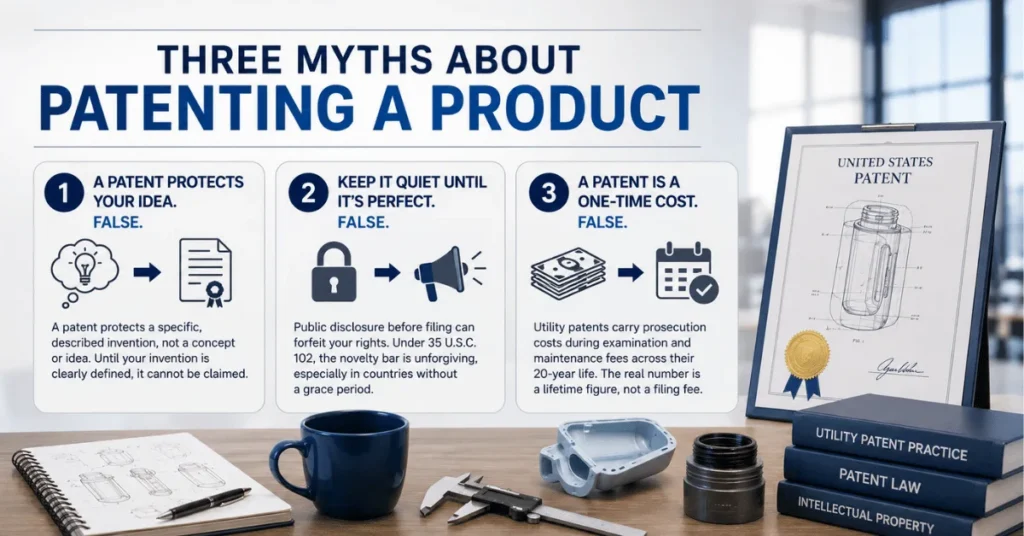
The first myth is that a patent protects your idea. It does not. It protects a specific, described invention, which is why a concept scribbled on a napkin cannot be claimed until it is defined. The second myth is that you should keep the invention quiet until it is perfect, then show it around before filing. Public disclosure before filing can forfeit your rights, and under 35 U.S.C. 102 the novelty bar is unforgiving, especially in countries without a grace period. The third myth is that a patent is a one-time cost. Utility patents carry prosecution costs during examination and maintenance fees across their 20-year life, so the real number is a lifetime figure, not a filing fee.
Common Mistakes That Cost Inventors Their Rights
Beyond the myths, a few concrete mistakes show up repeatedly. Disclosing before filing is the big one: showing the invention at a trade show or online can forfeit rights before you have protected anything. Skipping the prior-art search is the expensive one, because filing on something already patented wastes both money and months.
Writing weak or narrow claims is the subtle one. DIY claims on a complex invention often leave gaps a competitor can engineer around, which is why the claims themselves belong with a registered patent professional. And confusing the types of intellectual property is the common one: patents protect inventions, trademarks protect brand names and logos, and copyright protects creative works, a distinction the U.S. Copyright Office lays out clearly.
How Gembah Helps You Get to a Patent
Gembah is built to be a one-stop shop for getting a product made, and for original inventions that includes helping you get to a patent. Rather than sending you off to figure out the legal side alone, Gembah connects you with the right patent firm for your project and works hand in hand with them, so development, documentation, and filing move together instead of in disconnected handoffs.
That coordination matters because the strength of a patent depends on the quality of what it describes. Gembah’s product development and engineering services turn an idea into a fully documented, manufacturable product: CAD, drawings, prototypes, and a tech pack that give the patent firm strong material to protect. For original inventions, Gembah’s unique-invention path takes a concept from sketch to a production-ready, patentable product, with the patent firm looped in from early on, so protection and manufacturability advance on the same timeline. You get one team accountable for the whole journey, from first sketch to a product that is both patent-backed and ready to build.
Conclusion
Getting a patent is a defined sequence: document the invention, search for prior art, choose the right type, file before you disclose, and lean on a patent firm for the claims, with a well-engineered product making every step stronger. Do it in that order and the two early mistakes that forfeit rights simply do not happen. That is the whole of how to get a patent on a product without leaving value on the table.
Have an original product you want to protect and build? Let Gembah turn your idea into a fully documented, patentable, manufacturable product, and connect you with the right patent firm to carry it across the line. Get started with Gembah.