Picture two founders in the same week, making opposite mistakes. The first uploads a rough sketch to a self-service parts marketplace and gets a slick quote in seconds, for a product that was nowhere near ready to be quoted. The second hands a finished, production-ready design to a full-service development team and pays for months of engineering she had already done herself. Both were hunting for the best product manufacturing platform. Both picked the wrong kind of one.
That is the trap hiding inside the phrase. “Manufacturing platform” now covers three genuinely different business models, and which one is right for you depends almost entirely on how finished your product already is. The product sourcing process starts well before the first factory quote, and the choice you make at that fork quietly shapes the cost of everything after it.
At Gembah, we run end-to-end product development for brands and entrepreneurs, so we watch this mismatch play out almost every week. What follows is how to tell the three models apart, and how to match one to the product you actually have in front of you.
Also Read:
- How to Manufacture a Product
- China Manufacturing Challenges
- Contract Manufacturing
- Product Manufacturing at Gembah
The Short Version
There is no single best product manufacturing platform, because the term covers three different things. Instant-quote marketplaces suit engineers who need custom parts fast. Sourcing agents suit buyers who already have a finished spec and just need a factory found and managed. End-to-end platforms suit brands taking an idea all the way to a finished, manufacturable product. Work out your stage first, then weigh pricing transparency, engineering depth, country coverage, and quality control. For concept-to-production work, an end-to-end partner carries the most of the load.
Why “Best” Is the Wrong Question
Asking which platform is best assumes the options are interchangeable versions of the same thing. They are not. A product manufacturing platform, in the broadest sense, is any service that connects you to the factories, engineering, and logistics needed to make a physical product at scale. The problem is that the label now stretches to fit a self-service parts website and a full development team with equal ease, and those two things could not be more different to work with.
The stakes are what make the distinction worth getting right. MIT Professional Education reports that as many as 95 percent of new products miss the mark , and a meaningful share of those misses trace back to a product that landed at the wrong kind of partner at the wrong moment. So the useful question is not which platform is best in the abstract. It is which model matches the product you are holding today.
The Three Models Hiding Behind One Word
Almost every option on the market falls into one of three buckets. Once you can tell which bucket you are looking at, you already know most of what you need to know about whether it fits.
Instant-Quote Marketplace
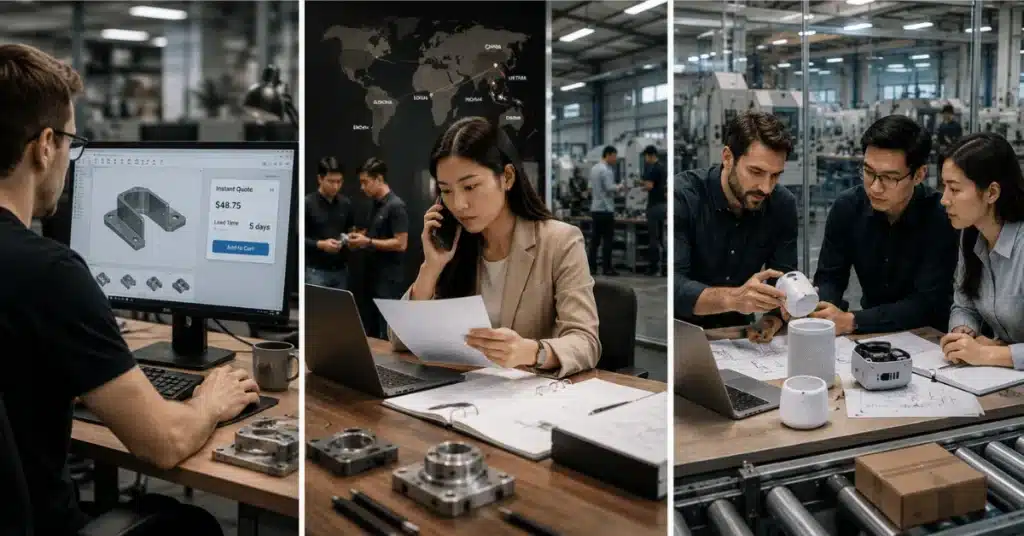
You upload a CAD file, an algorithm returns a price and a lead time in seconds, and you order parts. These marketplaces are built for engineers who need prototypes or custom components across processes like CNC machining, 3D printing, sheet metal, and injection molding, often with zero minimums.
Their strength is raw speed. Their weakness is that the model is self-service and built for parts, not whole products. There is little room for design dialogue, and nobody is checking whether the part you uploaded belongs in a product real people will buy.
Sourcing Agent
A sourcing agent is a person or firm that finds a factory, negotiates terms, and inspects production on your behalf. This works well when you already have a production-ready specification and simply need a qualified factory found and managed for you.
The catch is pricing. Many agents mark up the factory price to earn their margin, and you may never see the real number underneath. The scope is narrow too: an agent finds and manages a factory, but does not design or engineer the product itself.
End-to-End Platform
An end-to-end platform handles research, design, engineering, sourcing, manufacturing, and logistics inside one managed relationship. It is built for brands taking a concept to a finished product, not for buyers shopping for parts.
This is Gembah’s model. The network spans more than 2,000 vetted factories, with teams on the ground in China, Vietnam, India, Mexico, and the United States, plus contacts in many more, and project managers run the back-and-forth with the factory so you do not have to. It is the most hands-on of the three, and the right fit when the product still needs to be built, not just bought.
Seven Things to Weigh Before You Commit a Run
Once you know which model you are leaning toward, these are the seven factors that separate a platform that fits from one that frustrates you six months in.
- Product stage fit. Does the platform serve your stage: a raw idea, a working prototype, or a production-ready spec? This is the single most important filter, and most of the others only matter once you clear it.
- Pricing transparency. Can you see the real factory cost, or only a marked-up quote? Ask directly, and get the answer in writing before anything is signed.
- Engineering and DFM support. Is design-for-manufacturing help included, or are you expected to arrive with a finished tech pack? Research on design-stage cost estimation has long shown that decisions made during early design lock in roughly 70 to 80 percent of a product’s eventual cost, which is why this support matters more than it first looks.
- Country coverage and tariff strategy. Does the platform offer China, Vietnam, India, Mexico, and US options? In February 2026 the Supreme Court ruled that the president could not use the International Emergency Economic Powers Act to impose tariffs, striking down the steep 2025 China duties, according to a Congressional Research Service summary. The administration rebuilt rates through other authorities, and the Tax Foundation’s tariff tracker now puts the effective rate on Chinese goods near 30 percent, well below the 2025 peak. Rates move, so a “China plus one” hedge stays valuable.
- Quality control. Look for on-the-ground inspection, pre-production planning, and final inspection, not just a promise that partners are vetted.
- Minimums and volume fit. Zero-minimum parts and full production runs are different worlds. Match the platform to your order size.
- Total cost of ownership. Add tooling, freight, defect rates, and your own time to the unit price. The cheapest quote is rarely the cheapest project.
Want a transparent quote that shows the real factory cost? Gembah breaks pricing into clear phases, so you see the factory price and the project fee separately. Get a quote from Gembah.
How the Three Models Stack Up
Lined up against the questions that actually decide a launch, the differences get hard to miss.
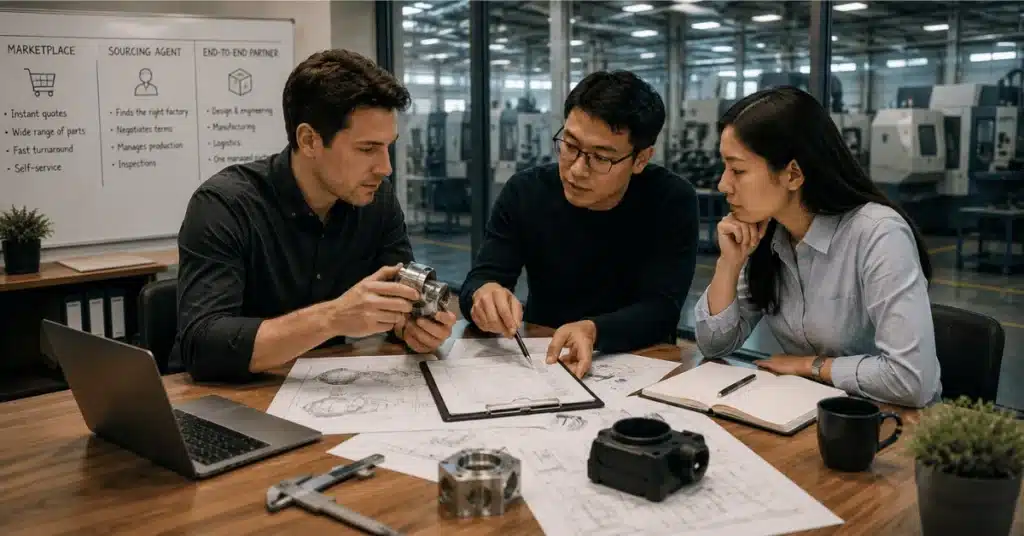
| Dimension | Instant-quote marketplace | Sourcing agent | End-to-end platform |
| Best for | Engineers needing parts | Buyers with a finished spec | Brands, concept to production |
| What you bring | A CAD file | A finished spec | An idea or early concept |
| Engineering help | Automated, self-service | None | Hands-on with a team |
| Pricing | Visible per-part price | Often opaque markup | Transparent, project-scoped |
| Relationship | Transactional | Project-based | Ongoing managed partner |
A marketplace wins on speed for a known part. A sourcing agent wins on a finished spec, as long as the pricing is clear. An end-to-end platform wins when the product still needs design, engineering, and a managed run to exist at all.
When a Marketplace or Agent Is the Smarter Choice
End-to-end is not always the answer, and a good partner will tell you when it is not. If you are an engineer who needs five CNC parts next week, a self-service marketplace beats any managed relationship, and you should just use it.
If you already have a finished, production-ready spec and only need a factory found, a sourcing agent can be a clean fit, provided you confirm exactly how they price and what their inspection process covers. The brand-side risk of an opaque markup is real, which is why we break it down in detail in our look at what brands need to know about sourcing agents.
The line breaks the moment you need design help, a whole product rather than a part, real supplier transparency, or a managed production run. That is the exact gap an end-to-end platform is built to fill.
Where Gembah Fits
Gembah is the end-to-end option: research, design, engineering, sourcing, manufacturing, and logistics under one accountable team. Rather than handing a finished file to a factory and hoping, you get end-to-end product development with vetted factories pulled into the conversation during design, where the expensive surprises get caught while they are still cheap to fix.
The proof shows up in the products. Bella & Co. used Gembah’s factory-led model to turn a home-preservation problem into a patented, eco-friendly pet product, modifying existing factory tooling to reach a unique design without the six-figure cost of new injection molds, and reaching market in roughly half the usual time. The full Bella & Co. case study has the engineering detail. It is the kind of outcome a parts marketplace or a sourcing agent is simply not built to deliver.
Not sure which of the three models fits your product? Tell us where your product sits today and get a clear recommendation, with no obligation to start a full engagement. Talk to a Gembah expert.
The One Question That Settles Most of It
Strip away the feature lists and almost every platform decision collapses into a single question: how finished is your product right now, really? If a factory could quote it from your documents without one follow-up call, you are spec-ready, and a marketplace or a sourcing agent will serve you well. If that factory would come back with questions, your product still needs development, and no instant quote will change that fact. It will only hide it for a while.
That one test, answered honestly, sorts the three models faster than any comparison chart. Everything else on this page, transparency, country coverage, quality control, total cost, is how you choose well inside the right category. It is not how you pick the category. Get the stage right first, and the rest of the decision gets a lot smaller.
Questions We Get a Lot
Which platform is best for a startup?
For most startups taking an idea to a finished product, an end-to-end platform beats a parts marketplace or a sourcing agent, because it covers design, engineering, and manufacturing in one place. A marketplace is the better pick only when you already have finished CAD files and need parts fast.
What does it actually cost to use one?
It depends on tooling, volume, country, and complexity, so the unit price on its own is misleading. Judge the total cost of ownership, which folds in tooling, freight, defect rates, and the management time you will personally spend, not just the headline per-unit number.
Can a platform help me move production out of China?
Yes, and country diversification across Vietnam, India, Mexico, and the United States is one of the main reasons to use a multi-country platform in 2026. US goods imports from China fell nearly 30 percent in 2025, to about $308 billion, according to the Bureau of Economic Analysis, and that shift is still underway.
Do I need a finished design first?
Marketplaces and sourcing agents generally assume you do. End-to-end partners do not, which is the whole point of using one while your product is still an idea or an early concept.
The Bottom Line
“Best” is the wrong question. “Best for my product’s stage” is the right one. Match the model to where your product actually sits, then weigh transparency, engineering, country coverage, and quality control before you commit a run. Get that first call right and the rest of the project gets easier. Get it wrong and you pay for it later, on the factory floor.
For concept-to-production work, Gembah is the end-to-end choice: one accountable team, transparent factory pricing, and a vetted network spanning China, Vietnam, India, Mexico, and the United States. It is the model built for brands that need a product developed, not just a part quoted.
Ready to map your product to the right path? Talk to a Gembah expert and get a transparent quote with a clear path from concept to production. Get started with Gembah.