
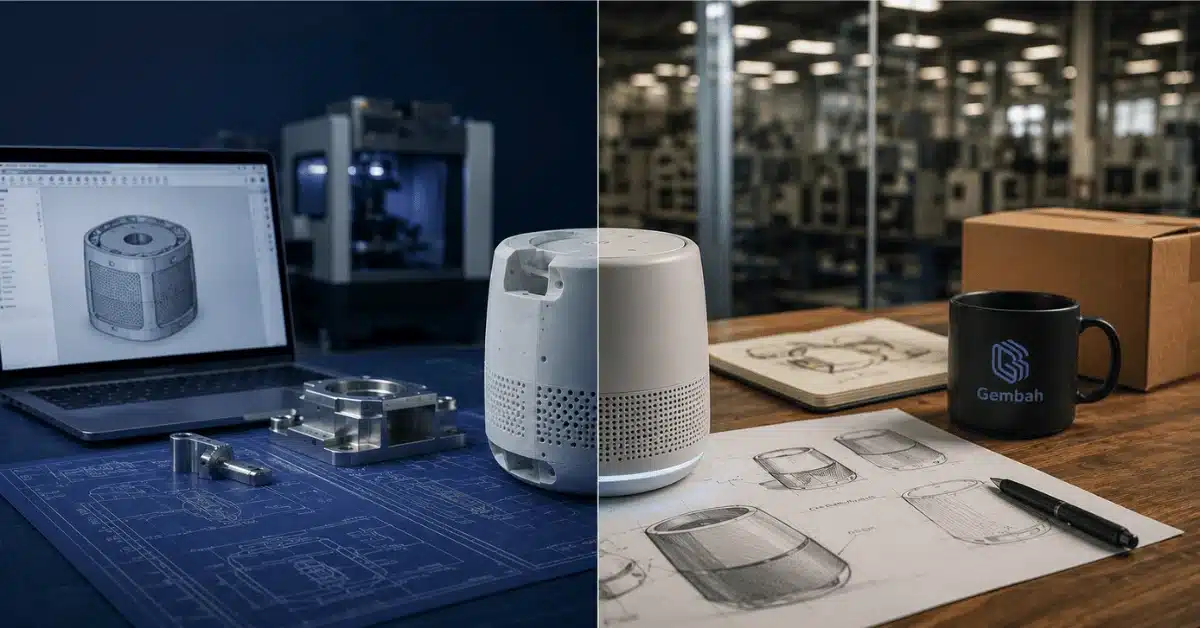
The Gembah vs Xometry question comes up because both companies connect you to factories. The honest answer is that they solve opposite problems. Xometry is an instant-quote marketplace for custom parts and prototypes. Gembah is an end-to-end partner that takes a product from concept all the way to manufacturing.
That difference matters more than any feature list. If you already have a CAD file and need parts machined this week, Xometry is built for you. If you have a product to build and a brand to launch, that is a different job, and it is the one Gembah is built for. Picking the wrong tool here does not just slow you down. It sends you to a partner who is structured to do something you do not actually need.
This guide compares the two on business model, ideal user, engineering support, and pricing, and shows the exact point where one stops being the right tool and the other takes over.
Also Read:
TL;DR
Gembah and Xometry fit different stages. Xometry is an AI-native instant-quote marketplace where engineers upload a CAD file and order custom parts, such as CNC machining, 3D printing, sheet metal, and injection molding, in minutes, often with zero minimums. Gembah is an end-to-end product development partner that handles research, design, engineering, sourcing, and managed manufacturing for brands taking a concept to a finished product. Choose Xometry when you have a finished design and need parts fast. Choose Gembah when you need a product developed, engineered for manufacturing, and produced at scale.
Key Points
- They do different jobs. Xometry sources custom parts; Gembah develops and manufactures whole products.
- They serve different users. Xometry is built for engineers and procurement teams; Gembah is built for brands and entrepreneurs.
- Self-service versus managed. Xometry is instant and self-serve; Gembah assigns project managers to run the process for you.
- Engineering depth differs. Deep design-for-manufacturing dialogue is core to Gembah and lighter on a self-service marketplace.
- Pricing models differ. Xometry gives instant per-part quotes; Gembah gives transparent, project-scoped quotes.
- Both operate at real scale. Xometry is publicly traded; Gembah runs a vetted network of more than 2,000 factories across its global hubs.
- The handoff point is clear. When you move from “I need a part” to “I need this product built,” you have crossed from one model to the other.
Not sure whether you need parts or a product? Tell us where your product stands today and we will point you to the right model, even when that is not us. Talk to a Gembah expert.
What Is Xometry?
Xometry is an AI-native, on-demand manufacturing marketplace. An engineer uploads a 3D CAD file and gets an instant price, lead time, and basic design feedback for custom parts. The core of the product is a patented instant quoting engine trained on a large dataset of custom-part jobs.
The marketplace covers processes like CNC machining, 3D printing, sheet metal, laser cutting, and injection molding, across a wide range of materials, with zero minimums on many jobs. That makes it genuinely useful for engineers, hardware teams, and procurement professionals who need parts and prototypes quickly and do not want a managed relationship to get them.
It also operates at scale. Xometry is a public company (NASDAQ: XMTR), and its publicly reported results for fiscal year 2025 show revenue of roughly $687 million, up about 26 percent year over year, and around 81,800 active buyers. Those figures change every quarter, so treat them as a snapshot rather than a fixed fact. The point is simple: Xometry is a serious, well-run marketplace for custom parts.
What Is Gembah?
Gembah is an end-to-end product development and manufacturing platform. It takes a product from research and design through engineering, sourcing, and managed manufacturing, rather than quoting a single part.
The network spans more than 2,000 vetted factories with Gembah teams in China, Vietnam, India, Mexico, and the United States, plus contacts in many more, and the pricing is transparent so brands see the real factory cost alongside the project fee. Quality control is managed in process and at final inspection, not left to chance.
The best fit is a brand, a direct-to-consumer operator, or an entrepreneur building a product, not just buying parts. If your starting point is an idea, a sketch, or an early concept, you are in Gembah’s lane.
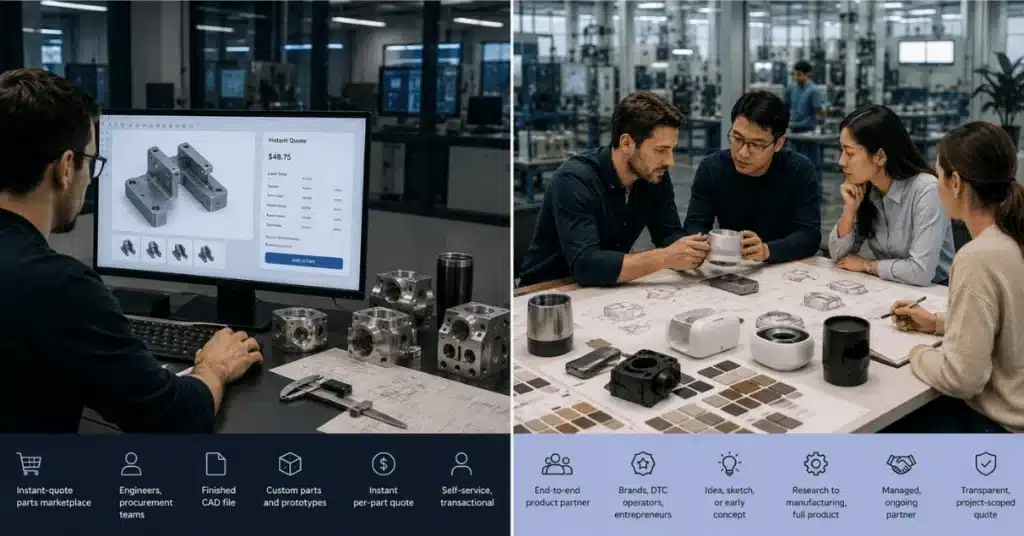
Side-by-Side Comparison
Laid out against the questions that actually decide a project, the two models separate cleanly.
| Dimension | Xometry | Gembah |
| Core model | Instant-quote parts marketplace | End-to-end product development partner |
| Best for | Engineers, procurement, hardware teams | Brands, DTC operators, entrepreneurs |
| What you bring | A finished CAD file | An idea, sketch, or early concept |
| Scope | Custom parts and prototypes | Research to manufacturing, full product |
| Engineering / DFM | Automated, self-service | Hands-on with a team |
| Quality control | Vetted partners, varies by job | Managed in-process and final inspection |
| Pricing | Instant per-part quote | Transparent, project-scoped quote |
| Relationship | Self-service, transactional | Managed, ongoing partner |
When to Choose Xometry
Xometry is the better choice in a specific and common set of situations. Reach for it when:
- You are an engineer or hardware team with a finished design.
- You need prototypes or custom parts quickly, often with zero minimums.
- You want instant, self-service pricing without a managed relationship.
- You are sourcing individual components, not developing a whole consumer product.
In those cases, a managed development partner would only add overhead. The marketplace model is faster and cheaper for a known part, and that is exactly what it is built to be.
When to Choose Gembah
Gembah is the better choice when the product itself still needs work. Reach for it when:
- You have an idea or early concept, not a production-ready CAD file.
- You need design and engineering to make the product manufacturable in the first place.
- You want one accountable team running sourcing, production, and quality control.
- You are launching or scaling a consumer brand and want transparent factory pricing plus country diversification handled for you.
Design-stage decisions lock in roughly 70 to 80 percent of a product’s eventual cost, which is why bringing engineering and factory input together early, rather than after a design is frozen, is the heart of what Gembah does through its product engineering services. It is also why so many launches fail: MIT Professional Education reports that as many as 95 percent of new products miss the mark, often because manufacturability problems surface too late to fix cheaply.
Country diversification is not abstract in 2026 either. The Tax Foundation’s tariff tracker shows US rates moving repeatedly through the year, US goods imports from China fell nearly 30 percent in 2025 according to the Bureau of Economic Analysis, and Deloitte’s 2026 Manufacturing Industry Outlook reports reshoring momentum building. A multi-country development partner lets you move with those shifts. A single-part marketplace does not.
Building a product, not just ordering parts? Get a transparent, project-scoped quote with a clear path from concept to production. Get a quote from Gembah.
Can You Use Both?
Yes, and many hardware teams do exactly this. A parts marketplace is excellent for fast prototype components during research and development, when you are iterating on a single bracket or housing and want it in hand quickly.
Then, when the work shifts from “I need this part” to “I need this whole product built and produced reliably,” an end-to-end partner takes over for design refinement, manufacturing, and scaled production. The two are not rivals so much as tools you pick up at different moments. The handoff point is the tell: the day your question stops being about a part and starts being about a product, you have moved into Gembah’s territory.
How Gembah Fits
Gembah owns the development-to-production phase: design, engineering, sourcing, and managed manufacturing under one team. That is the difference between buying a part and building a product, and it shows up in the outcomes.
Bella & Co. is a clear example. The brand used Gembah’s factory-led model to turn a home-preservation problem into a patented, eco-friendly pet product, modifying existing factory tooling to reach a unique, protectable design without the six-figure cost of new molds, and getting to market in about half the usual time. The full Bella & Co. case study walks through the engineering. For founders weighing whether they need a parts source or a development partner at all, our breakdown of a product development company versus a sourcing agent is a useful next read.

6 Questions That Tell You Which Partner You Need
Share these with your team before you sign up for anything. The answers usually settle the Gembah vs Xometry question in a minute.
- Do you have a finished CAD file, or an idea? A file points to a marketplace; an idea points to a development partner.
- Do you need a part, or a product? This is the single cleanest cut between the two models.
- Who is doing the engineering? If the answer is “no one yet,” you need a team, not a quote.
- Do you need to see the real factory price? Transparent project pricing and instant per-part quotes are different things.
- Is anyone managing quality on the floor? Managed inspection matters once you move past prototypes.
- Are you diversifying across countries? Tariff and lead-time strategy is a development-partner job, not a marketplace feature.
Frequently Asked Questions
What is the main difference between Gembah and Xometry?
Xometry is an instant-quote parts marketplace, and Gembah is an end-to-end product development and manufacturing partner. One sells you parts fast from a finished file; the other builds the product with you from an idea.
Is Gembah a Xometry alternative?
Only partly. Gembah is an alternative if you need full product development. If all you need is instant custom-part quotes from a finished CAD file, the two serve genuinely different needs and a marketplace is the better fit.
Which is better for a consumer product startup?
For a brand building a consumer product from a concept, an end-to-end partner like Gembah usually fits better than a parts marketplace, because the product still needs design, engineering, and a managed production run.
Does Gembah offer instant online quotes like Xometry?
Gembah uses transparent, project-scoped quoting rather than an instant per-part price, because product development needs to be scoped. A whole-product engagement has variables that a single-part algorithm is not built to price.
Conclusion
Xometry and Gembah are not really rivals. They are tools for different stages of the same journey. For parts and prototypes from a finished design, Xometry is built for the job. For concept-to-production product development, that is Gembah’s lane.
The deciding factors come down to three questions: where your product sits today, whether you need parts or a whole product, and whether you want self-service speed or a managed team. Answer those honestly and the choice is usually obvious. Gembah’s end-to-end model, transparent pricing, and vetted multi-country network exist for the founders whose answer is “I have a product to build.”
Have a product worth getting right? Talk to a Gembah expert and get a clear path from concept to production. Get started with Gembah.