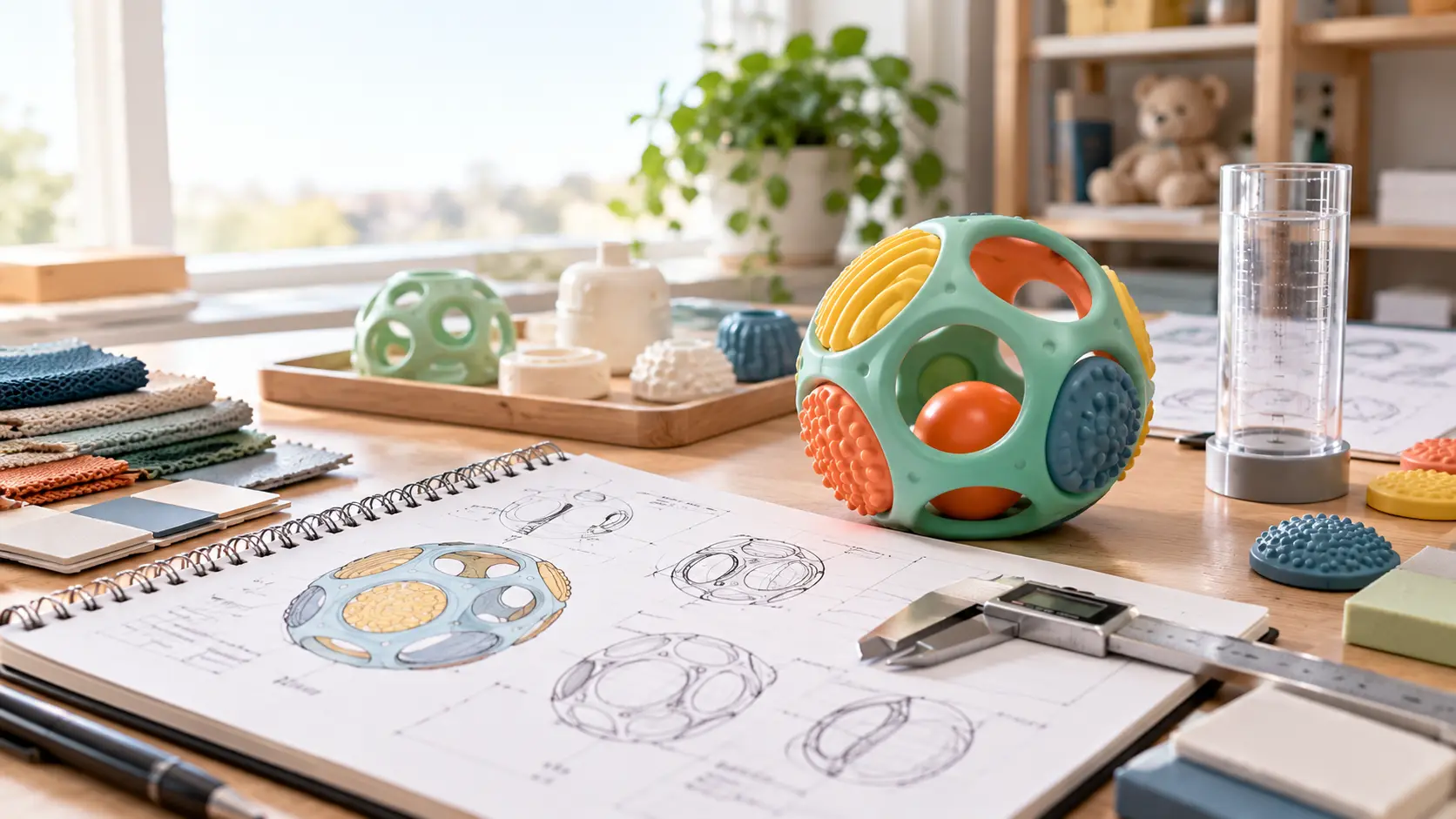
Baby toy development falls under some of the strictest consumer product safety rules—so how you design the toy and who you choose to make it can’t be separated. A beautiful concept that no compliant factory can produce is a dead end.
This guide walks you through the full path from idea to a manufactured first run, and how to choose a baby toys manufacturer that can pass U.S. testing. Gembah runs baby toy development end to end, from design through a compliant first run, and across baby products more broadly.
Can one company handle baby toy design, prototyping, and manufacturing, or do I need separate partners? One accountable partner can run the whole chain—design, prototyping, sourcing, and manufacturing—so safety requirements don’t fall through the cracks between vendors. Splitting the work across a freelance designer, a sourcing agent, and a factory is cheaper per step but riskier when testing fails, and no one owns the problem.
The Short Version
Baby toy development runs idea → design → prototype → test → manufacture, and safety rules shape every step. ASTM F963-23 is the mandatory U.S. toy standard, the small-parts ban applies to under-3s, and battery safety runs through the toy standard—not Reese’s Law, which exempts toys. Testing and a Children’s Product Certificate are required for a covered product. The factory you pick has to prove it can meet all of it, so vetting for compliance matters as much as price. This guide covers the path and the questions that separate a capable baby toys manufacturer from a risky one.
Key Points
- One idea moves through five stages—design, prototype, test, source, produce.
- Safety rules drive the design, not the other way around.
- Baby toys are exempt from Reese’s Law; battery safety runs through ASTM F963-23.
- Not every toy factory can make a baby toy that complies.
- MOQ and safety testing are the real first-run costs.
Also Read
- Toy Product Design and Manufacturing
- Private Label Toys
- Baby Product Manufacturers: How to Find and Vet the Right Partner
The baby toy development path, start to finish
Baby toy development follows five stages, and each hands off to the next: concept and design, prototyping, safety testing, sourcing, and production. Skip or rush one, and it shows up later as a failed test or a delayed run.
The sequence matters because safety isn’t a final checkpoint—it’s a design input. The age band, materials, and part count you choose at the design stage determine whether the toy can pass testing.
Can one company handle design, prototyping, and manufacturing, or do I need separate partners?
One partner that owns design through manufacturing keeps the safety requirements connected across every stage. Separate vendors are cheaper per step, but when a test fails, a freelance designer, a sourcing agent, and a factory can each point at the others. One accountable team removes that gap.
What to have ready before you contact a manufacturer
A factory can’t quote a vague idea. Before you reach out, pin down your concept, the target age band, your safety targets, a budget range, and the volume you expect.
People underestimate the age band: a toy for a six-month-old and a toy for a two-year-old face different tests and different part rules, and the factory needs to know which before it can price anything.
The safety rules that shape every baby toy
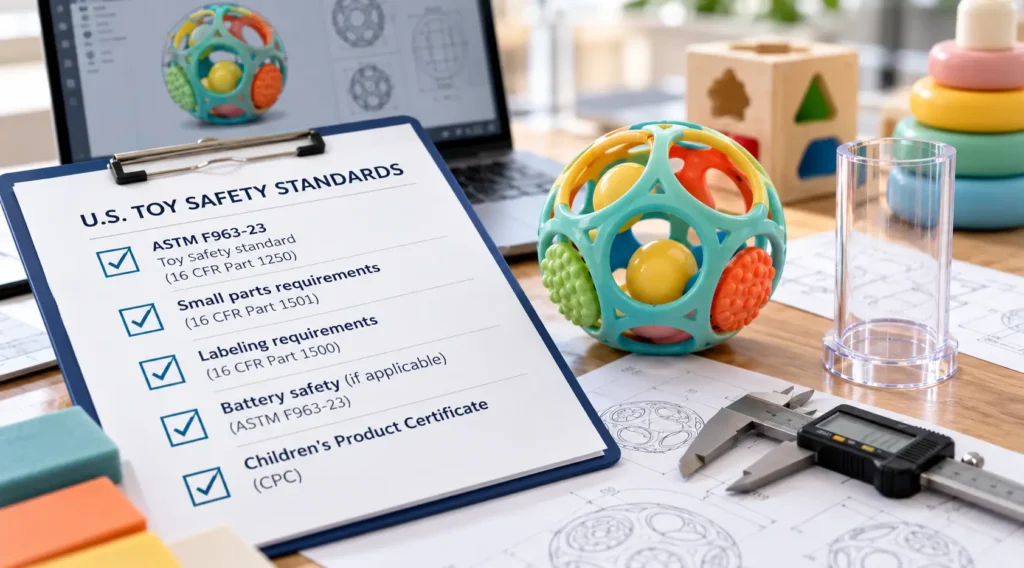
This is the section that makes or breaks a baby toy. Get the rules right at the design stage, and testing is a formality; get them wrong, and you’re paying for a redesign.
- Toy standard—ASTM F963-23: the mandatory U.S. toy standard (effective April 2024), codified in 16 CFR Part 1250. Part 1250 now covers more than F963—CPSC added water beads (§1250.4, effective March 12, 2026) and neck floats (§1250.5, effective June 15, 2026). The neck-float rollout is a warning for new brands: CPSC had to push the testing-and-certification deadline out 60 days to August 16, 2026 for makers who already submitted a product sample, because too few third-party labs were accredited in time. A brand-new rule can outrun lab capacity.
- Small parts—a ban, not just a label: for a baby toy (under 3), 16 CFR Part 1501 bans small parts, tested with the cylinder plus use-and-abuse. The separate warning label at 16 CFR 1500.19 covers only toys aimed at ages 3 to under 6 (and small balls and marbles to under 8). A baby toy lives under the ban.
- Button and coin-cell batteries—not Reese’s Law: toys are exempt. 16 CFR 1263.1(c) carves out any plaything for under-14s that meets Part 1250’s battery rules, so a baby toy meets its battery obligations through ASTM F963-23, not Part 1263. Design for a secured battery compartment—not “child-resistant,” which is a packaging term.
- Testing and the CPC: third-party testing and a Children’s Product Certificate are required for a covered children’s product. The importer issues the CPC for imported toys; the domestic manufacturer or private labeler issues it for US-made ones.
Not sure which rules your toy triggers? Talk to a Gembah expert.
How to find a baby toys manufacturer that can actually make it
Not every toy factory can make a compliant baby toy. You want a baby toys manufacturer that’s new-brand friendly, has strong prototype quality, and has passed U.S. baby-toy testing before—not one that treats compliance as your problem.
The red flags are easy to spot once you know them: a factory that can’t name the standards your toy must meet, won’t share past test reports, or quotes a price that only works if testing gets skipped.
Questions to ask before committing to a first run
A short checklist separates a serious quote from a hopeful one. Ask about MOQ, safety-testing support, tooling, lead time, total landed cost, and compliance documentation—and get the answers in writing.
What’s a realistic minimum order quantity for a custom baby toy?
Custom baby toy MOQ usually runs from a few hundred to a few thousand units, depending on materials, tooling, and the factory. A lower MOQ costs more per unit; a higher one ties up more cash up front. Match it to your validated demand, not your optimism.
How can I verify a baby toys manufacturer can meet U.S. safety requirements?
Ask for recent third-party test reports against the current ASTM F963 revision incorporated in 16 CFR part 1250, confirm they work with a CPSC-accepted lab, and have them walk through how they’d certify your specific toy. A capable factory answers in specifics; a risky one gets vague.
Private label vs. your own design
Two routes, different trade-offs:
- Private label baby toys: faster and lower-risk—you adapt a proven product and skip most of the design and tooling spend. The cost is differentiation and IP: you don’t own a unique product.
- Your own design: slower and pricier up front, but you own the IP and stand apart on the shelf.
Verdict: start with private label baby toys when speed and low risk matter most; go custom when a differentiated, ownable product is the whole point.
Budgeting a first baby toy
Plan for product-side costs: design, prototyping, tooling, third-party testing and certification, and the first production run. Testing and tooling are the two that surprise first-timers, and neither is optional for a compliant toy. Build them in before you set a retail price, not after.
Myth vs. Reality
Myth: “Any toy factory can make a compliant baby toy.”
Reality: baby-toy compliance is specialized; the wrong factory can lead to failed testing, delays, or a recall.
How Gembah Helps You Ship a Compliant Baby Toy
The riskiest version of baby toy development is five vendors who don’t talk to each other while the safety requirements slip through the gaps. Gembah handles design, prototyping, sourcing, and quality control under one roof, with a network of vetted factories and in-process and final inspections. That means you only need one partner to take a baby toy from concept through a compliant first run and into Market Validation, Pre-Launch, Crowdfunding, and Launch.
That means the toy is designed to pass testing and made by a factory that can prove it. See how baby toy development and baby products come together.
From Idea to a Baby Toy That Passes: Your Next Move
Baby toy development and manufacturer choice are the same decision—a toy is only as good as the factory that can legally make it. Design around the real rules, vet for proven compliance, and budget testing and tooling in from the start. Do that, and your first run ships instead of failing a test.
Ready to develop a baby toy a factory can actually make? Get a quote from Gembah—or contact the team.
FAQs
I have a baby toy idea—what steps take it from concept to a manufacturable product?
Baby toy development runs through five stages: concept and design, prototyping, safety testing, sourcing, and production. Design around the applicable safety rules from the start, and pick a factory that can prove it meets them.
Can one company handle baby toy design, prototyping, and manufacturing, or do I need separate partners?
One accountable partner can run the whole chain and keep safety requirements connected across stages. Separate vendors cost less per step but add risk, because no one owns the problem when a test fails.
How do I find a baby toy manufacturer willing to work with a new brand?
Look for a baby toys manufacturer that’s new-brand friendly, shares past third-party test reports, and can name the standards your toy must meet. Avoid any factory that treats compliance as your problem or prices as if you can skip testing.
What questions should I ask a baby toy manufacturer before a first production run?
Ask about MOQ, safety-testing support, tooling, lead time, total landed cost, and compliance documentation—in writing. The answers separate a serious quote from a hopeful one.
How can I verify a baby toy manufacturer can meet U.S. safety requirements?
Request recent third-party test reports against the current ASTM F963 revision incorporated in 16 CFR part 1250, confirm they use a CPSC-accepted lab, and have them explain how they’d certify your specific toy. Specific answers signal capability; vague ones signal risk.
Should I start with a private label baby toy or my own design?
Choose private label baby toys for speed and lower risk when you can adapt a proven product. Choose your own design when you want a differentiated, IP-owned product and can absorb the extra time and cost.