Starting a baby product business begins with a hard truth: the most expensive product you can make is the one nobody buys. In baby, a miss costs twice—you lose the build spend, and you lose trust with a parent who won’t give a safety product a second chance.
That’s why validation is cheap insurance. Before you spend on design, tooling, or testing, prove people actually want it. This is a demand-validation playbook for Amazon sellers and founders deciding what to launch next. Gembah helps brands validate and build, and baby product development turns a proven idea into a real product.
How do you validate demand for a baby product before building it? Read the demand signals first—search volume, Amazon Best Seller Rank, and gaps in competitor reviews. Then test with real buyers through a pre-sell page, a small batch, or a waitlist. Price safety testing and certification into the math, and build only once the demand is proven.
Summary
Don’t tool a baby product on a hunch. Read the demand signals—keyword volume, Amazon Best Seller Rank, and what one-to-three-star reviews complain about—then test the idea with real buyers before you spend. Price safety testing and certification into the go/no-go math, because in baby those costs are real. Build only what validates, then turn the same research into your launch copy. Guessing is what makes a baby launch expensive; measured demand is what makes it survivable.
Key Takeaways
- Validate before you tool—baby’s returns and trust risk make guessing expensive.
- Gaps beat trends: find what’s underserved, not what’s hot this quarter.
- Amazon Best Seller Rank and review gaps are free market research.
- Safety and testing costs are part of the go/no-go math, not an afterthought.
- Your validation research doubles as your launch copy.
Also Read
- Private Label Baby Products: A Starting Point for New Brands
- Baby Product Manufacturers: How to Find and Vet the Right Partner
- How to Build a Product Roadmap
Why validation matters more in baby than almost anywhere
Baby buyers lead with trust, not price. A weak launch doesn’t just lose a sale—it earns a one-star review that warns off the next parent, and in a safety category, that damage sticks to your brand, not only the SKU.
Returns hurt more here too. A product that disappoints a tired parent comes back fast and gets talked about. Validation is how you avoid paying for that lesson at tooling scale.
Where the real gaps are right now
The US baby products market reached about $58.5 billion in 2025 and is projected to hit $81.55 billion by 2033, per Grand View Research—but that growth isn’t coming from more babies. US birth rates keep falling. It’s coming from parents spending more per child on premium, organic, and non-toxic products.
So aim at the underserved premium buyer, not the trendiest category. The open gaps sit in premium and clean-label products, direct-to-consumer and subscription models, and niches the big brands ignore.
How to read demand signals before you build
You don’t need a research budget to measure demand—the data is mostly free.
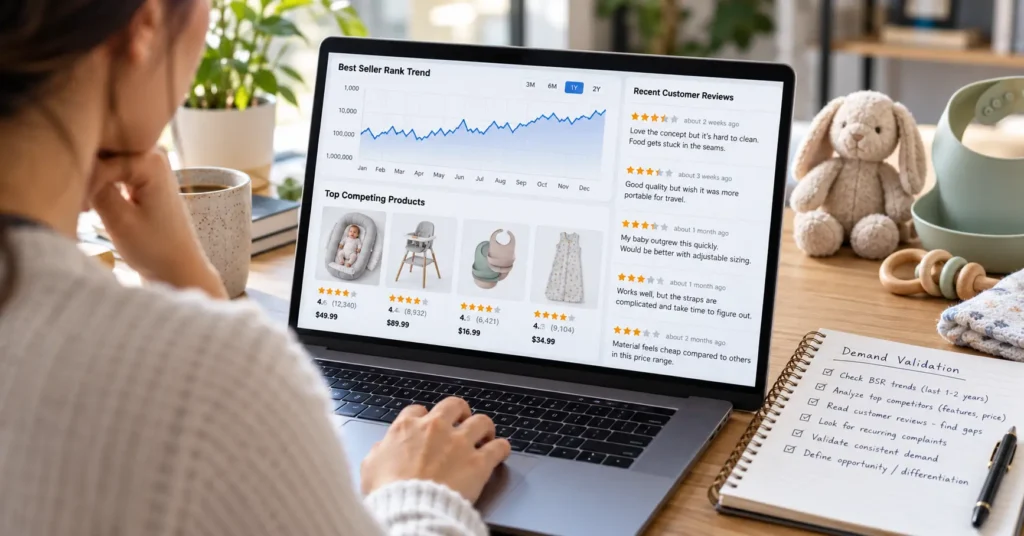
- Search and keyword demand: check whether parents are actually searching for the problem you solve, and in what volume.
- Amazon Best Seller Rank (BSR): a steady BSR in your subcategory shows real, repeat demand, not a one-week spike.
- Review-gap mining: read the one-to-three-star reviews on the top competitors. The complaints that repeat—a strap that breaks, a part that stains—are your opening.
- Competitor gaps: note what every top listing does the same, and where none of them serve a specific parent.
Sitting on a shortlist and not sure which to build? Talk to a Gembah expert.
What should an Amazon seller launch next in baby and infant?
Start where the data already points: a subcategory with steady Best Seller Rank, repeated complaints in competitor reviews, and a premium or clean-label angle that’s underserved. Launch the product that fixes a complaint buyers keep making, not the one with the flashiest idea.
Validate with real buyers—cheaply
Signals tell you there’s interest. Real buyers tell you they’ll pay.
Run a pre-sell or landing-page test to measure clicks and sign-ups against real ad spend. Order a small test batch to put the product in actual hands. Survey caregivers, and build a waitlist—a list of people who gave you an email is far stronger proof than a “cool idea” comment. If none of that converts, you just saved yourself a tooling bill.
Price in the safety and testing cost before you commit
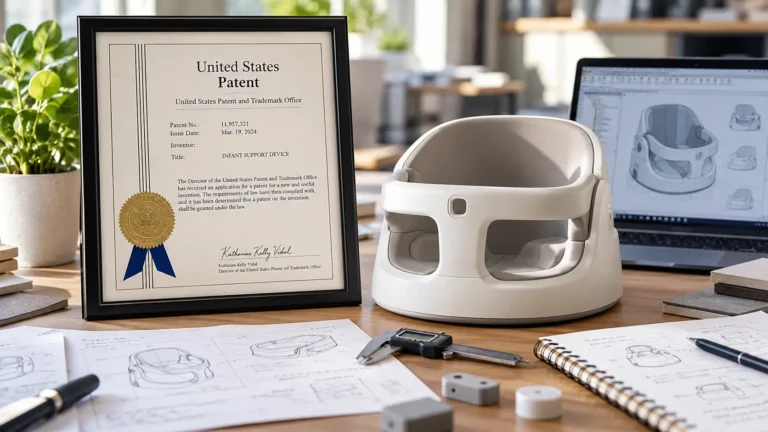
Here’s the number first-timers forget: safety testing and certification. A baby product covered by a children’s product safety rule needs third-party testing at a CPSC-accepted lab and a Children’s Product Certificate (CPC) before it can sell—issued by the importer for imported goods, or the domestic manufacturer for US-made ones.
Put those costs in your validation math, not after it. A product that pencils out at your target price with testing included is validated; one that only works if you skip certification isn’t a business.
Not sure your margins survive certification? Get a Gembah sourcing quote.
How to start a baby product business without betting on a guess
Once you validate the idea, starting a baby product business becomes a sequence, not a gamble. Lock the specs, price the unit economics with testing and certification included, choose a manufacturer who can pass U.S. safety testing, and plan the first run to a volume your validated demand supports.
This is also where marketing baby products starts—not after the product ships. Map your launch sequence and your channel (direct-to-consumer, Amazon, or retail) while the product is still in development, so day one has momentum.
Turn validation into launch messaging
The best part of validation research is that it writes your launch copy for you. Every complaint you found in competitor reviews is a pain point your product solves—so copywriting for baby products means leading with that exact pain, in the parent’s own words.
Match the message to the product. Baby washing marketing is a clear case: a bath product leans on safety and gentleness; a travel product leans on one-handed ease. Pair the pain you solve with safety proof and social proof, and the launch sells the research you already did.
Myth vs. Reality
Myth: “If I love the idea, it’ll sell.”
Reality: demand you can measure beats conviction you can’t.
How Gembah Helps You Launch What Buyers Already Want
Validation only pays off if you can actually make what you validated. Gembah runs research and ideation, concept validation, and design through sourcing and manufacturing as one team. We also take it through Market Validation and into the Pre-Launch, Crowdfunding, and Launch stages—so the product you proved demand for is the product that reaches the shelf, at a cost your numbers support.
That means no gap between a validated idea and a manufacturable one. See how baby product development works end to end.
Validate First, Then Build: Your Next Move
Starting a baby product business isn’t about the best idea—it’s about the idea you can prove. Read the demand signals, test with real buyers, price safety and testing in, and build only what validates. Do that, and your first launch rides measured demand instead of hope.
Ready to put real demand behind your next baby product? Get a quote from Gembah—or contact the team.
FAQs
What should an Amazon seller launch next in the baby and infant category?
Launch into a subcategory with steady Best Seller Rank and repeated complaints in competitor reviews, with a premium or clean-label angle that’s underserved. Fix a problem buyers keep naming rather than chasing the hottest trend.
What baby product should I launch next?
The one your data supports: real search demand, a steady BSR, and a gap competitors leave open. Validate it with a pre-sell test or waitlist before you commit to tooling.
How do I validate demand for a baby product before building it?
Read demand signals (search volume, Amazon BSR, review-gap mining), then test with real buyers through a landing page, small batch, or waitlist. Price safety testing into the math, and build only what converts.
How do I start a baby product business?
Validate demand first, build unit economics that include testing and certification, choose a compliance-capable manufacturer, and plan a first run sized to proven demand. Start the marketing while the product is still in development.
How do I market a new baby product?
Lead with the exact pain your validation research surfaced, in the parent’s words, backed by safety proof and real reviews. Match the message to the product, and sequence the launch across your best channel before day one.
What market gaps exist in baby and infant products right now?
Growth is value-led—premium, organic or non-toxic, and subscription or direct-to-consumer models—rather than driven by birth numbers. The gaps sit where safety-conscious buyers are underserved at a premium price point.