

Shopify hands you a blank rich-text box. That freedom is why most stores end up with one product described in loving detail and forty-nine described in a sentence and a half. The hero SKU gets written the week you launch; the rest get written the night before the collection goes live.
A template fixes that, but only if you build it as blocks rather than as a paragraph. A 200-SKU catalog needs a structure your team can repeat without re-deciding the format every time.
Below is the six-block Shopify product description template, a filled example, the SEO layer underneath it, and the honest limit of what any description can do.
Also Read
- How to Create a Product on Shopify (Without Getting Lost in Settings)
- Maximize Your Amazon Listing Optimization With 7 Basic Rules
- How to Manufacture a Product With the Right Factory
The Short Version
Every Shopify description should carry six blocks: a one-line hook that names the outcome, a short paragraph on the problem and who has it, three to five scannable benefit bullets, a specification list with dimensions and materials, a fit-and-compatibility block that prevents returns, and a care-and-guarantee close. Write the outcome first and the specs second. Then handle the SEO layer separately: a unique title tag, a meta description in the 120 to 160 character range, descriptive alt text, and Product structured data. Do not paste the manufacturer’s copy into any of it.
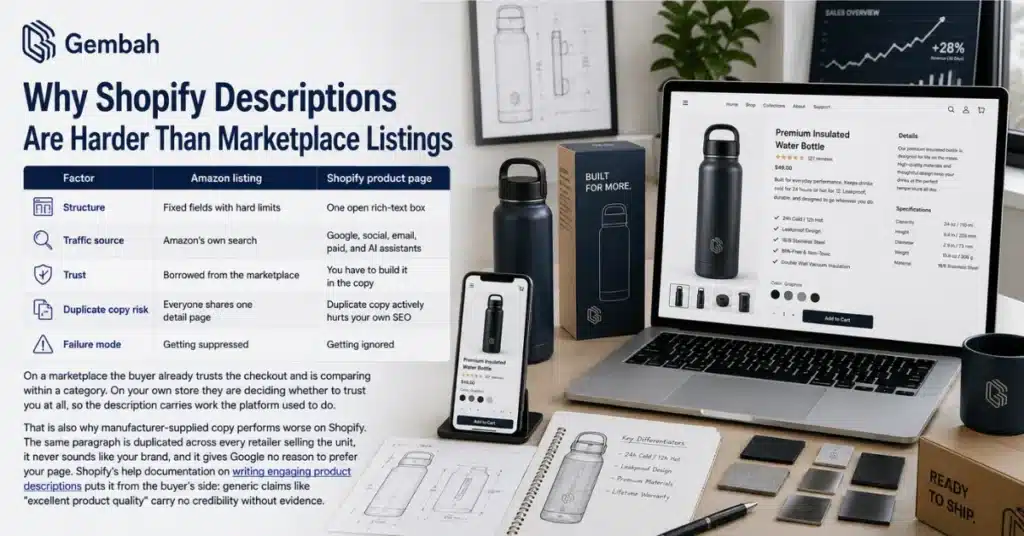
Why Shopify Descriptions Are Harder Than Marketplace Listings
Sellers moving from Amazon expect the writing to get easier. It gets harder.
| Factor | Amazon listing | Shopify product page |
|---|---|---|
| Structure | Fixed fields with hard limits | One open rich-text box |
| Traffic source | Amazon’s own search | Google, social, email, paid, and AI assistants |
| Trust | Borrowed from the marketplace | You have to build it in the copy |
| Duplicate copy risk | Everyone shares one detail page | Duplicate copy actively hurts your own SEO |
| Failure mode | Getting suppressed | Getting ignored |
On a marketplace the buyer already trusts the checkout and is comparing within a category. On your own store they are deciding whether to trust you at all, so the description carries work the platform used to do.
That is also why manufacturer-supplied copy performs worse on Shopify. The same paragraph is duplicated across every retailer selling the unit, it never sounds like your brand, and it gives Google no reason to prefer your page. Shopify’s help documentation on writing engaging product descriptions puts it from the buyer’s side: generic claims like “excellent product quality” carry no credibility without evidence.
Block 1: The Hook
One sentence, before anything else, naming the outcome rather than the object: the shortest true sentence about what changes for the person who buys this.
Formula: [Outcome the buyer gets] without [the tradeoff they expect].
Worked example: A 24-hour cold tumbler that still fits your cup holder. The buyer expects better insulation to mean a wider body, and the hook kills that tradeoff in eleven words.
This line gets pulled into search snippets, social previews, and AI-generated summaries, so it has to stand alone without the photo above it.
Block 2: The Problem Paragraph
Two to four sentences on the situation the buyer is in before they own this. You are not selling the object yet; you are proving you understand the annoyance that sent them searching.
Name the person, not the demographic. “If your commute is 45 minutes and your coffee is cold by minute 20” beats “for busy professionals,” because the first is falsifiable and the second is filler. Then end on the turn: what changes once they have it.
Most stores skip this block, and it is what separates a description from a spec sheet. A spec sheet answers what the thing is; this answers why now.
Block 3: Benefit Bullets
Three to five bullets, each one a feature translated into a consequence. A feature is triple-wall vacuum insulation; a consequence is ice at 6pm. Buyers pay for the second one.
Formula: [Benefit in 2 to 4 bolded words] [the feature that causes it] [the number or material that proves it].
Bold the front of each bullet. Baymard Institute’s research on scannability and highlighting text online explains why: many web users scan content instead of reading it, and bold “immediately catches the eye” because the higher contrast works like a magnet for eye gaze. Unbolded uniform text gives a scanner nothing to land on.
Keep the bullets parallel in length. Three of roughly one line each read as a considered set; one long bullet followed by two fragments reads as an afterthought.
Block 4: The Specification List
Dimensions, weight, materials, capacity, power draw, and anything measurable, in a plain list or small table. This block is evidence, not persuasion. Give two unit systems wherever it matters: a buyer who has to open a converter tab is a buyer who leaves.
Baymard Institute’s study of product descriptions across e-commerce sites found that missing information is a direct cause of abandonment. Users often abandon a product when important detail is absent, and some abandon the site itself after deciding it is not legitimate. The same research is blunt about compatibility-dependent products, noting that users’ desire and ability to “fill in the blanks” is virtually nonexistent when compatibility specs are incomplete. Any doubt kills the purchase.
Make the list skimmable: Baymard’s work on spec sheet scannability found that titled sections, a single column, and row shading all help users trace a line.
Say what is not in the product as well as what is. “BPA-free,” “no added fragrance,” and “nickel-free” answer questions people will never email you to ask. They will just close the tab.
Block 5: Fit and Compatibility
This block pays for itself in avoided returns. It is also the one most likely to be missing, and what it contains depends on the category:
- Apparel: measurements per size, model height and size worn, how the garment runs against expectation, fabric stretch and recovery.
- Hard goods: what it fits, what it does not fit, and what the buyer supplies separately.
- Consumables and parts: model numbers and years, stated explicitly rather than implied by the title.
Be specific about the negative case. “Does not fit 2015 and earlier models” saves more money than any conversion-rate tweak, because it removes a return, a restock, and a refund.
A buyer who is 90 percent sure the part fits does not buy at a 90 percent rate. They do not buy at all.
Block 6: Care, Shipping, and Guarantee
Two to four lines closing the loop: how to care for it, what ships when, and what happens if it is wrong. Short, factual, and in the same place on every page.
Keep it in the description rather than only on a policy page. A buyer deciding on the page does not open a second tab; they see the answer or assume it is bad.
This block is nearly identical across your catalog, which is exactly why it belongs in the template. Write it once and stop retyping warranty language into two hundred rich-text boxes.
A Filled Example
Here is the Shopify product description template filled in for one SKU. Read it as the page itself, not as notes about it.
Ridge 32 oz Insulated Tumbler
A 24-hour cold tumbler that still fits your cup holder.
Most 32 oz tumblers solve insulation by getting fatter, which means they end up living on your desk instead of in your car. This one holds a full day of ice in a body that clears a standard 3.4-inch cup holder, so the drink you filled at 7am is still cold on the drive home.
- Cold for 24 hours. Triple-wall vacuum insulation, tested at 24 hours with ice in a 72 degree room.
- Fits your car. 3.35-inch base, sized against standard US cup holders.
- No condensation ring. The vacuum wall keeps the exterior dry on the desk and in the bag.
Specifications
- Capacity: 32 oz / 946 ml
- Height: 9.1 in / 23.1 cm
- Base diameter: 3.35 in / 8.5 cm
- Weight: 15.2 oz / 431 g empty
- Body: 18/8 stainless steel
- Lid: Tritan, BPA-free
Fit and compatibility
Fits standard US cup holders up to 3.4 inches. Does not fit narrow European console holders. Straw sold separately, 10 mm diameter.
Care, shipping, and guarantee
Hand wash the body. The lid is top-rack dishwasher safe. Ships in 2 business days. Lifetime warranty on the seal.
That page runs about 150 words and answers every question a tumbler shopper has before checkout.
Get a product worth writing six blocks about
Tolerances, materials, and tested performance claims come out of development, not out of a copywriting session. Talk to a Gembah expert about turning a product idea into a spec you can publish.
The SEO Layer Underneath the Template
The description and the search-facing metadata are different jobs. Write for the buyer first, then handle keywords deliberately.
Place your target term once in the URL handle, once in the product title and H1, once or twice naturally in the body, and once in image alt text. That is the whole placement strategy, and going further is keyword stuffing. Shopify’s guidance on SEO product descriptions follows the same pattern, down to plain-language alt text such as “Bottle of squalane vitamin C rose oil.”
Long-tail beats broad, and that same article shows why. Narrowing “face oil” to “squalane vitamin C rose oil” describes the product by category and ingredient, is easier to rank for, and reaches shoppers who already know what they want.
Write a unique title tag and meta description for every product. Shopify’s guidance on how to write meta descriptions puts the desktop cutoff around 150 to 160 characters and mobile closer to 120, so the 120 to 160 band is the safe target. Front-load the important half.
Then check your structured data. Product schema is built into many Shopify themes, including the free flagship theme Dawn, according to Shopify’s ecommerce schema guide, which makes it theme-dependent rather than guaranteed. Google’s documentation on Product structured data covers the fields behind price, availability, and review displays, and running a live URL through Google’s Rich Results Test tells you whether the page is eligible.
Length is the one thing this layer does not decide; that follows buyer awareness. A commodity restock needs three lines, a first-of-its-kind product all six blocks.
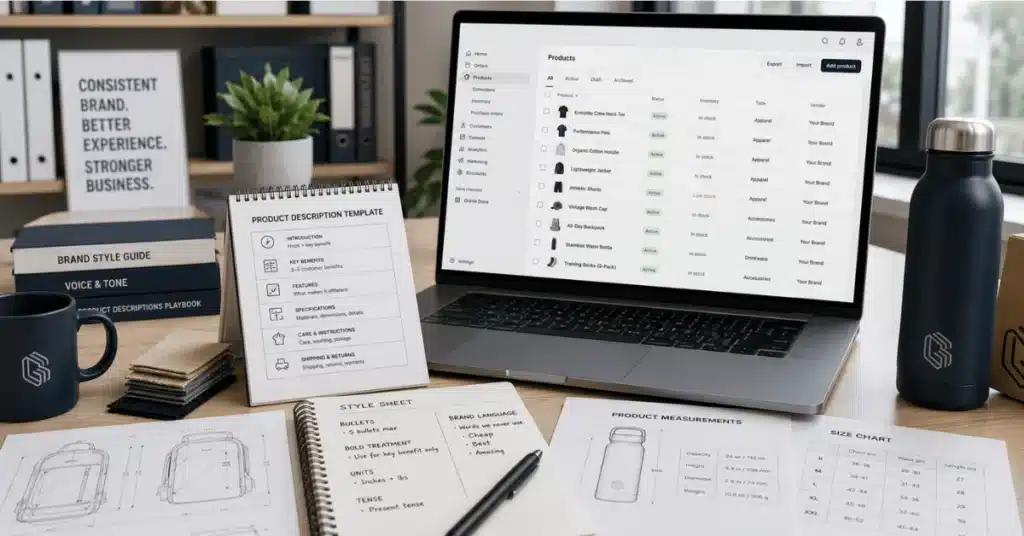
Keeping 200 Products Consistent
A Shopify product description template pays off at scale, so the real question is how to run it across a full catalog without a copy team.
Store the boilerplate blocks once. Care instructions, warranty language, and shipping copy do not need rewriting per SKU, and doing it anyway is how you end up with three different return windows on three pages.
Use metafields for anything structured and repeated. Shopify’s help documentation on metafields covers this exact use case, including care instructions, detailed measurements, and size charts, rendered the same way on every page by a theme that supports dynamic sources. Your dimensions live in one field, not two hundred hand-formatted boxes.
Build a short internal style sheet and hold the team to it: bullet count, bold treatment, unit format, tense, and the two or three words your brand never uses.
If you use Shopify’s AI description tools, treat the output as a first draft against this template. Shopify’s help page on automatically generating product descriptions warns that generated text can include unsupported claims or facts pulled from similar products, and that you remain responsible for what you publish. Generic is the failure mode the template exists to prevent. Our walkthrough on creating a product on Shopify covers where each field lives in the admin.
Make one description, then make two hundred
The template scales once the product data underneath it is real, consistent, and yours. Talk to a Gembah expert about development, sourcing, and getting the specs right the first time.
The Part a Template Cannot Fix
Every block above has a slot for a number: the dimension, the fabric weight, the tested performance claim, the compatibility range. Without them the description collapses into adjectives, and adjectives are what shoppers scroll past.
They come out of the product development file, not the writing session. A tech pack is where dimensions, materials, and tolerances get fixed, and it is the document a good description is quietly reading from.
There is a harder version of this problem. If your product is the same white-label unit five competitors sell under different logos, the description is not the constraint. Differentiation is.
For brands still deciding what to build, our product launch guide covers the sequence, and the Shopify go-to-market plan covers the 90 days after the page goes live.
How Gembah Fits
Gembah’s product development services run research, design, and engineering, which is where the specifications and the point of difference that make a description writable get decided. The six blocks are downstream of that work.
A vetted factory network across China, Vietnam, India, and Mexico, gets matched to your product and volume, so the spec you publish is the spec that ships. Project managers handle the factory back-and-forth.
For DTC brands moving off a white-label catalog, Gembah handles the development path from an off-the-shelf product to something you can honestly claim as yours.
Quality control in process and at final inspection protects the claims in your specification block. That is where returns and chargebacks start when the page and the delivered unit disagree.
Common Questions About Shopify Product Descriptions
How long should a Shopify product description be?
Length follows buyer awareness rather than a word count. Shopify ties it to complexity, suggesting roughly 50 to 100 words for simple, low-cost items and 200 to 300 or more for complex ones. A commodity restock can work in three lines; a new product category needs all six blocks.
Can I use the manufacturer’s description?
You can, and it is the most common reason a product page never ranks. That copy is duplicated across every retailer selling the unit, so search engines have no basis for preferring your version. Use the manufacturer’s spec sheet as source data for Block 4, then write the other five blocks yourself.
Where do keywords actually go on a Shopify product page?
Four places: the URL handle, the product title and H1, the first sentence or two of the body, and image alt text. Shopify’s help documentation on adding keywords for SEO points to page titles, meta descriptions, alt tags, and body content, and recommends natural readable phrasing rather than keyword lists.
Should I use Shopify’s AI description generator?
Use it for a first draft, not a finished page. Shopify states that you remain responsible for the accuracy of everything you publish, and that generated text can include unsupported benefit claims or facts borrowed from similar products. The generator has no access to your tolerances, tested numbers, or compatibility list, which is what makes a page convert.
Putting the Shopify Product Description Template to Work
A Shopify product description template earns its keep on the fiftieth product, not the first. The point is not that one page gets better; it is that your team stops re-deciding the format.
Six blocks, written for the buyer, with the SEO layer handled separately and every number pulled from a real spec.
Need the product itself to be worth describing?
The best description in your category still loses to a better product with an adequate one. Talk to a Gembah expert when you are ready to build something the six blocks can do justice to.