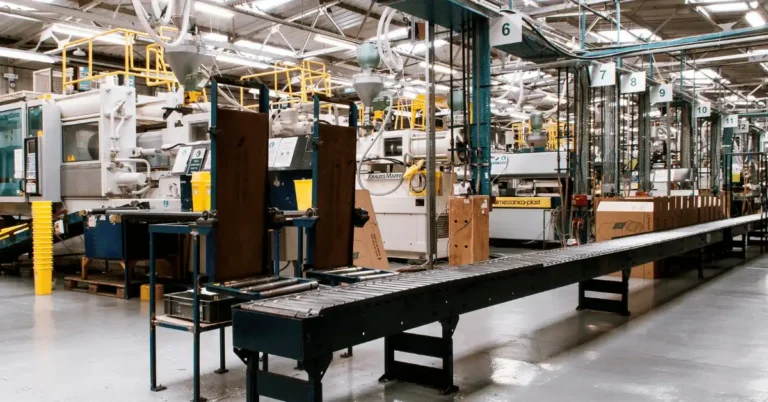
Here is the trap hiding inside a search for plastic manufacturers: the results look interchangeable, and they are not. A shop running high-volume injection molding is a completely different business from one that rotomolds a kayak or extrudes tubing. Picking the wrong process is one of the more expensive mistakes to unwind, because by the time you notice, you have usually paid for tooling.
The category is genuinely enormous. The global injection molded plastic market alone was estimated at about $362 billion in 2025 by Grand View Research, and injection molding is only one of several ways plastic gets made. In the United States alone, the plastics industry supported more than a million jobs and about $519 billion in shipments, according to the Plastics Industry Association. This guide breaks down the main plastic manufacturing processes, how to match a resin to your product, what tooling actually costs, and how to vet plastic manufacturers before you commit a run. At Gembah, matching products to the right molder by process and volume is part of what our factory network is built for.
Also Read
- China vs Mexico Manufacturing: Where to Build in 2026
- Product Manufacturing for Ecommerce Brands
- Private Label vs Custom Manufacturing: Which Fits Your Brand?
TL;DR
Choosing among plastic manufacturers starts with the process, not the factory. Match your product to the right molding method, whether that is injection, blow, extrusion, thermoforming, or rotational, then pick a resin that fits the mechanical and regulatory demands. Budget realistically for tooling, which is where first-timers get surprised, and only then shortlist and vet factories on samples, material certifications, tolerances, and capacity. The right plastic manufacturer is the one whose process and volume range fit your product, not simply the one with the lowest quote.
The Five Ways Plastic Gets Made
Most plastic products come out of one of five processes, and knowing which one your product needs tells you which factories to even approach. This is the single most useful thing to figure out before you contact a supplier.
Injection molding forces melted resin into a steel mold, and it is best for complex, precise, high-volume parts like housings, caps, connectors, and toys. Blow molding inflates molten plastic inside a mold to form hollow parts such as bottles and jugs. Extrusion pushes resin continuously through a die to make tubing, pipe, sheet, film, and weatherstripping. Thermoforming heats a plastic sheet and forms it over a mold, which suits trays, clamshells, and panels. Rotational molding tumbles and heats resin inside a rotating mold to produce large, durable hollow parts like tanks, kayaks, and bins.
|
Process |
Best for |
Tooling cost |
Volume fit |
Example products |
|
Injection molding |
Complex, precise parts |
High |
High (thousands+) |
Housings, caps, toys |
|
Blow molding |
Hollow containers |
Moderate |
Medium to high |
Bottles, jugs |
|
Extrusion |
Continuous profiles |
Low to moderate |
High |
Tubing, sheet, film |
|
Thermoforming |
Sheet-formed parts |
Low to moderate |
Low to high |
Trays, clamshells |
|
Rotational molding |
Large hollow parts |
Low |
Low to medium |
Tanks, kayaks, bins |
Picking the Right Resin
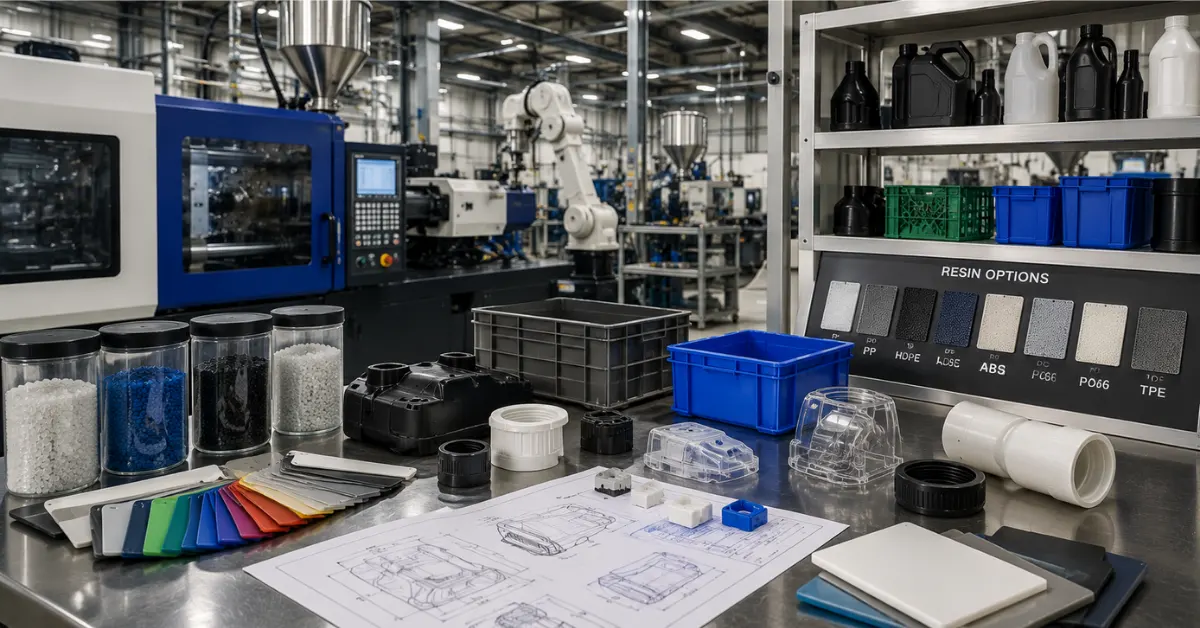
The resin decides how a part performs, so specify it before you request a single quote. “Plastic” is not a spec, and a factory that has to guess the material will guess wrong.
ABS is rigid, tough, and takes a clean finish, which makes it a workhorse for housings and consumer goods. Polypropylene is flexible, fatigue-resistant, and food-safe, ideal for living hinges and containers. Polyethylene, in both HDPE and LDPE grades, is chemical-resistant and low-cost, used for bottles, bags, and tanks. Polycarbonate brings high impact strength and optical clarity for lenses, eyewear, and safety parts. Nylon handles strong wear parts like gears, while TPU covers soft, elastic grips, seals, and wearables. The right choice is an engineering decision, not a cosmetic one, because it drives durability, compliance, and cost all at once.
Not sure which process or resin your product needs? Gembah’s product engineering services handle design for manufacturing, so your part is optimized for the molding process before tooling is cut. Talk to a Gembah expert.
Tooling: The Line Item That Surprises Everyone
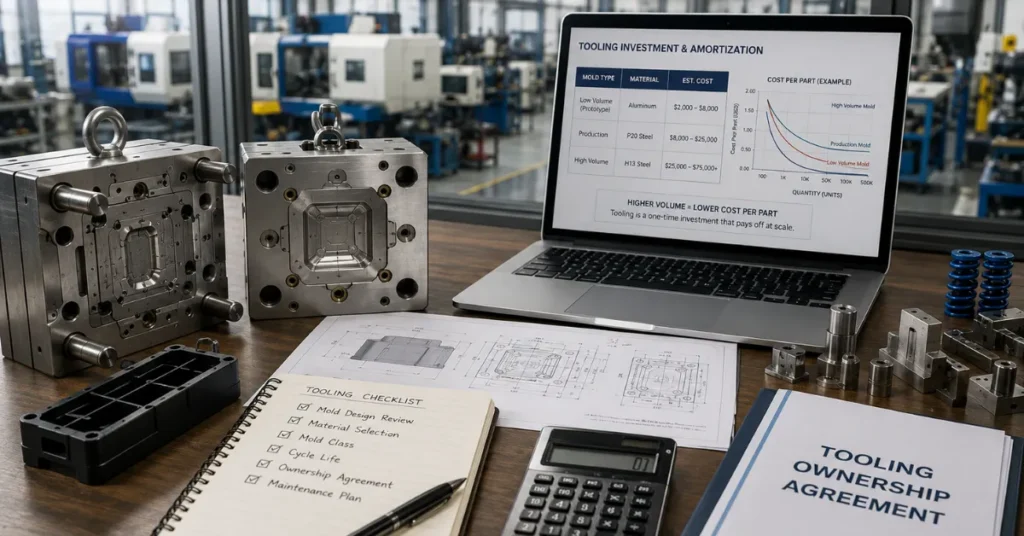
Injection molds are a capital cost, not a per-unit fee, and that surprises nearly every first-time founder. A simple single-cavity mold can start in the low thousands, while complex multi-cavity steel tooling reaches the tens of thousands.
Mold class matters as much as price. A low-volume aluminum mold is cheaper but wears out, while a hardened steel production mold costs more and lasts for hundreds of thousands of cycles. Because tooling amortizes over volume, injection molding only makes financial sense above a certain quantity; below it, CNC machining or 3D printing is cheaper for validating a design. This front-loaded cost is also why design decisions carry so much weight: research on design-stage cost estimation has long shown that choices made early lock in roughly 70 to 80 percent of a product’s eventual cost. One practical rule sits above all of this: get tooling ownership in writing, because it determines whether you can move factories later.
Prototype Before You Cut a Mold
Because tooling is the expensive, irreversible step, validate the design before you commit to a mold. Prototyping lets you hold, test, and fix a part while changes are still cheap, and it is the single best insurance against a costly tooling rework.
CNC machining cuts a part from solid stock and produces accurate, functional prototypes in production-like plastics, which makes it strong for fit and mechanical testing. 3D printing, whether FDM for quick form checks or SLA and SLS for finer detail and functional resins, is faster and cheaper for early iterations and complex geometries. The rule of thumb is simple: prototype until the design is frozen, then cut steel. Catching a wall-thickness or draft-angle problem on a printed part costs a fraction of catching the same problem in hardened tooling.
Where Plastic Gets Made in 2026
Geography still matters, and 2026 reopened the question. China remains the dominant hub for injection molding and electronics-adjacent plastics, with deep tooling expertise and competitive pricing, which is why Gembah maintains teams for manufacturing in China. Nearshore and domestic options in Mexico and the United States trade higher unit cost for shorter lead times, smaller minimums, and lower tariff exposure.
Tariffs are the variable that actually moved. After the February 2026 Supreme Court ruling that struck down the IEEPA tariffs, the administration rebuilt rates through other authorities, and the Tax Foundation’s tariff tracker now puts the effective rate on many Chinese goods around 35 percent, with the structure still shifting. That volatility shows up in the trade data: US goods imports from China fell to about $308 billion in 2025, down nearly 30 percent, according to the Bureau of Economic Analysis and U.S. Census Bureau trade figures. The takeaway for a plastics project is to run total landed cost rather than defaulting to the lowest unit price.
Weighing where to mold your product in a shifting tariff year? Gembah runs total landed cost across China, Mexico, and the US, tariffs included, so you choose on real numbers instead of the lowest sticker price. Talk to a Gembah sourcing expert.
Sustainability and the New Rules on Plastic
Plastic sourcing in 2026 is not only an engineering decision, it is increasingly a compliance one. A wave of extended producer responsibility laws is shifting the cost of packaging waste onto the companies that create it, and the requirements are becoming concrete rather than aspirational.
California’s SB 54, whose permanent regulations took effect in 2026, requires that by 2032 all single-use packaging sold in the state be recyclable or compostable, that 65 percent of single-use plastic packaging actually be recycled, and that single-use plastic packaging be cut by 25 percent. Comparable laws are advancing in other states. For a product brand, that turns resin choice and recycled content into a forward-looking decision: designing for recyclability, considering post-consumer recycled (PCR) resin where the application allows, and checking your packaging plan against every state you sell into. A plastic manufacturer already fluent in PCR grades and compliant materials is worth more than one that treats sustainability as an afterthought.
Vetting a Plastic Manufacturer
Once you have a process, a resin, and a rough geography, vetting separates a real molder from a broker. Confirm the process and volume fit first, because a prototype shop and a high-volume production molder are different businesses, and you want the one that matches your stage.
Request material certifications to verify the resin grade and any food-contact or regulatory compliance your market requires. Check tolerance capability by asking what tolerances the factory can actually hold, then confirm it on a sample rather than a spec sheet. Finally, order a golden sample and audit capacity, because a physical sample plus a look at the floor tells you whether the quote is real. Across all of it, the factories worth shortlisting are the ones that answer specifically and let you verify.
Match Your Product to the Right Process
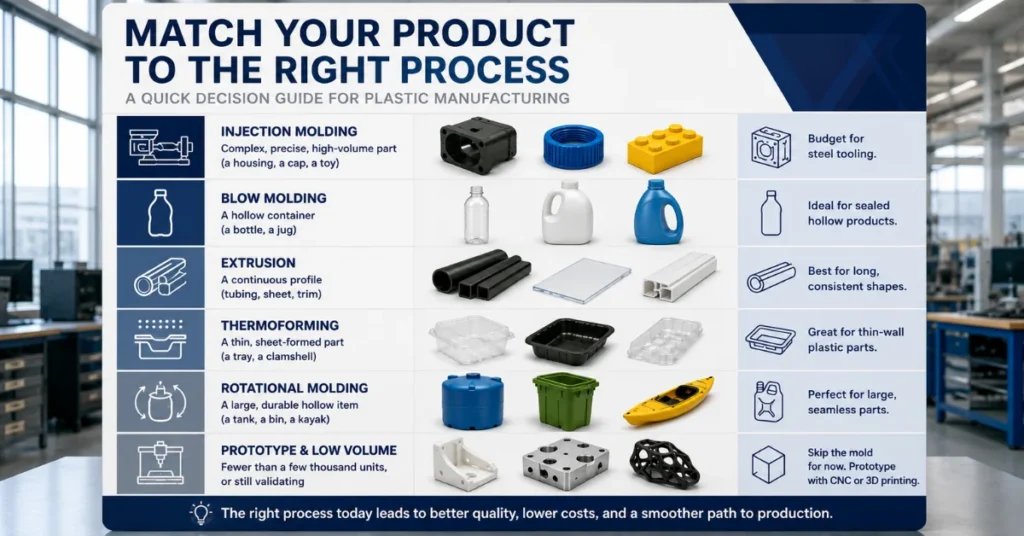
If you want a fast gut-check before you start contacting plastic manufacturers, run your product through this quick decision guide.
- Complex, precise, high-volume part (a housing, a cap, a toy): injection molding, and budget for steel tooling.
- A hollow container (a bottle, a jug): blow molding.
- A continuous profile (tubing, sheet, trim): extrusion.
- A thin, sheet-formed part (a tray, a clamshell): thermoforming.
- A large, durable hollow item (a tank, a bin, a kayak): rotational molding.
- Fewer than a few thousand units, or still validating: skip the mold for now and prototype with CNC machining or 3D printing.
Answer that one question honestly and you have already narrowed thousands of plastic manufacturing companies down to the handful built for your product.
How Gembah Finds Your Plastic Manufacturer
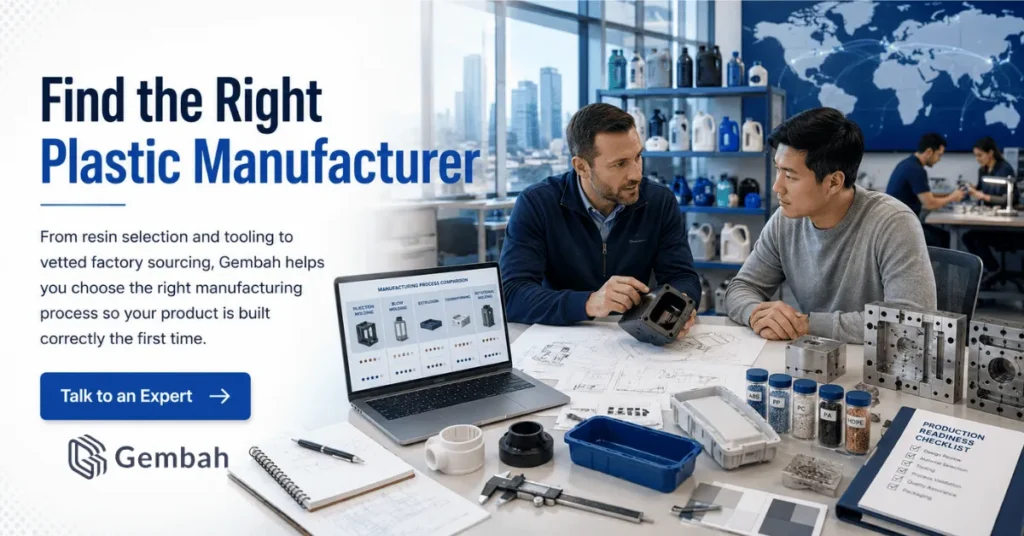
Working through process, resin, tooling, and vetting alone is doable, but it is where most of the early cost and risk hides. Gembah’s product manufacturing services match you to vetted plastic manufacturers by process, resin, and volume, drawn from a network of more than 2,000 factories, so you are not cold-emailing shops that cannot make your part.
Because engineering sits alongside sourcing, your part gets optimized for the molding process before tooling is cut, which is exactly where most cost is locked in. Gembah then manages sampling, material verification, tooling, and in-process quality control, so the first run matches the spec in your tech pack rather than arriving as a surprise. It is the difference between hoping a factory understood you and knowing it did.
Conclusion
The right plastic manufacturer is defined by process, resin, and volume fit, not by the lowest quote. Get the process right first, specify the resin, budget honestly for tooling, and vet on samples and certifications, and you keep unit cost, tooling, and field performance under control. That sequence is what turns an overwhelming search into a short, confident shortlist.
Ready to get matched with the right plastic manufacturer? Tell Gembah what you are building and get matched to a vetted molder with the tooling and quality handled. Get a sourcing quote from Gembah.