Summary
Activewear manufacturing is harder than basic apparel because the fabric is the product. Everything downstream follows from the fabric decision: GSM and blend determine opacity, compression, recovery, and hand-feel; four-way stretch requires flatlock and coverstitch machinery and a factory that grades stretch garments properly; and fabric mill minimums, not sewing minimums, usually set your real MOQ. Plan on a few hundred to a thousand pieces per style per colorway overseas, expect fabric to be the largest single cost line at roughly 50 to 70 percent of garment cost, and confirm PFAS compliance before your factory applies any water-repellent finish.
Grand View Research puts the global activewear market at USD 440.4 billion in 2025 and estimates USD 477.6 billion for 2026, on 9.0 percent annual growth. North America held the largest regional share at 38.1 percent of 2025 revenue, which is why the category keeps pulling in new brands.
It is also where new brands most often stall, because the skills that make a good cotton tee do not transfer. Stretch fabric moves under the needle, grades unpredictably across a size run, and shows every construction shortcut the first time someone squats in it.
This guide covers what active wear manufacturing actually requires: the fabric spec, the development sequence, realistic minimums and costs, where activewear gets made, and the compliance rules that changed at the start of 2025.
Also Read
- Find the Best Manufacturer for Your Product
- How To Launch A New Product (A Guide For Established Brands)
- How to Manufacture a Product With the Right Factory
Why Activewear Is Harder Than the Rest of Apparel
The fabric is the product. Buyers judge activewear on moisture management, opacity, compression, and recovery, and every one of those is a property of the material rather than the design. You can draw a beautiful legging and still ship a bad one if the knit is wrong.
Stretch construction needs specific machinery. Flatlock seams that sit flush against skin and coverstitch hems that do not roll require dedicated machines and operators who run them daily. A factory without them substitutes an overlock seam, and your product feels like a knockoff the first time a customer picks it up.
Grading is genuinely hard here. A pattern that fits at size M does not scale linearly across a stretch size run, and the fit failures surface at XS and 2X, where you have the least sample data and the loudest reviews.
Opacity is a spec, not a hope. The squat test is the category’s pass or fail, and GSM and knit structure decide it long before anyone sews a seam. Dye lots vary too, and a bra and legging bought as a set that do not match is a return, so lab dips and lot control matter more here than in most categories.
The Fabric Spec: GSM, Blend, and Stretch
Before you contact a factory, write your fabric spec in numbers. GSM, or grams per square meter, drives opacity, compression, drape, and durability. Treat the ranges below as a starting point for a mill conversation.
| Garment | Typical GSM | Typical blend | Stretch |
|---|---|---|---|
| Tees and tanks | 130 to 180 | Poly/spandex or tri-blend | Two-way or four-way |
| Yoga and fashion leggings | 180 to 220 | Nylon/spandex | Four-way |
| Compression and performance leggings | 220 to 280 | Nylon/spandex, higher spandex content | Four-way |
| Sports bras | 220 to 280 | Nylon or poly/spandex | Four-way |
| Shorts and joggers | 200 to 260 | Poly/spandex, often with woven shell | Two-way or four-way |
| Swim | 180 to 220 | Chlorine-resistant poly/spandex | Four-way |
| Shapewear and strong compression | 250 to 320 | Nylon or poly/spandex, high spandex | Four-way |
Blend sets feel and cost. Nylon/spandex gives a smoother hand, better abrasion resistance, and a more premium finish, and it is what most of the leggings your customers compare you to are made from. Poly/spandex costs less, resists chlorine and UV better, and dries faster, but reads stiffer against the skin.
Spandex content typically runs 3 to 20 percent, and the number matters. The 15 to 20 percent range is where you get real compression and recovery; below roughly 8 percent you have a comfort-stretch garment, not a performance one. Two-way stretch extends in one direction. Four-way stretch extends in both width and length, and any form-fitting athletic garment requires it, because the body loads fabric in both axes at once.
Specify the fabric the way a factory can buy it: fiber blend by percentage, GSM, knit structure, stretch direction, stretch and recovery percentages, and finish. “Performance fabric” is not a spec; sending it to three factories gets you three different products. “78% nylon / 22% spandex, 240 GSM, warp knit, four-way stretch, moisture-wicking finish” is a spec, and it gets you three comparable quotes.
Get the fabric spec right before you collect quotes
A vague spec produces quotes you cannot compare. Gembah’s design and engineering team writes factory-ready fabric and construction specs for performance apparel. Talk to a Gembah expert.
The Development Sequence
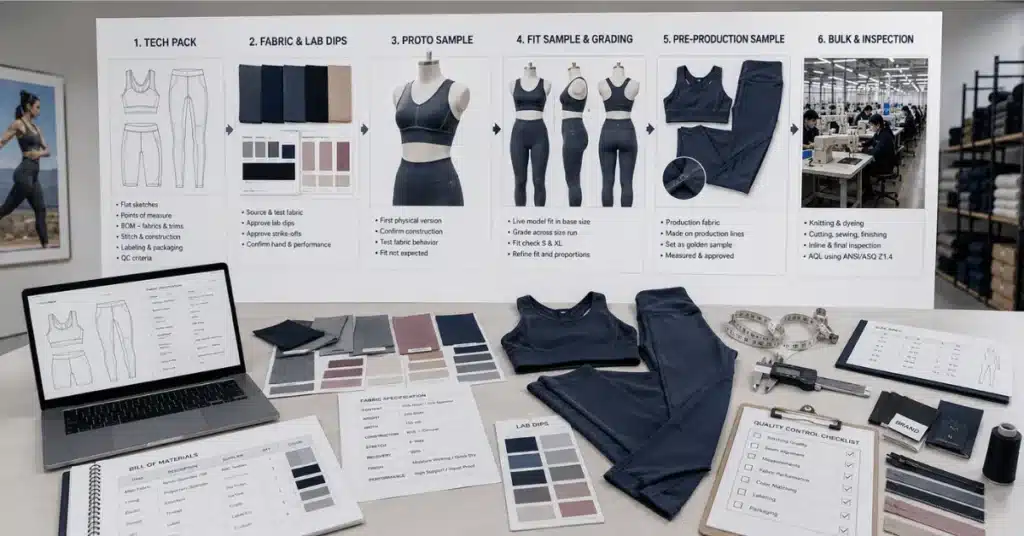
Activewear development runs through a fixed sequence, and skipping a step costs more than the step would have.
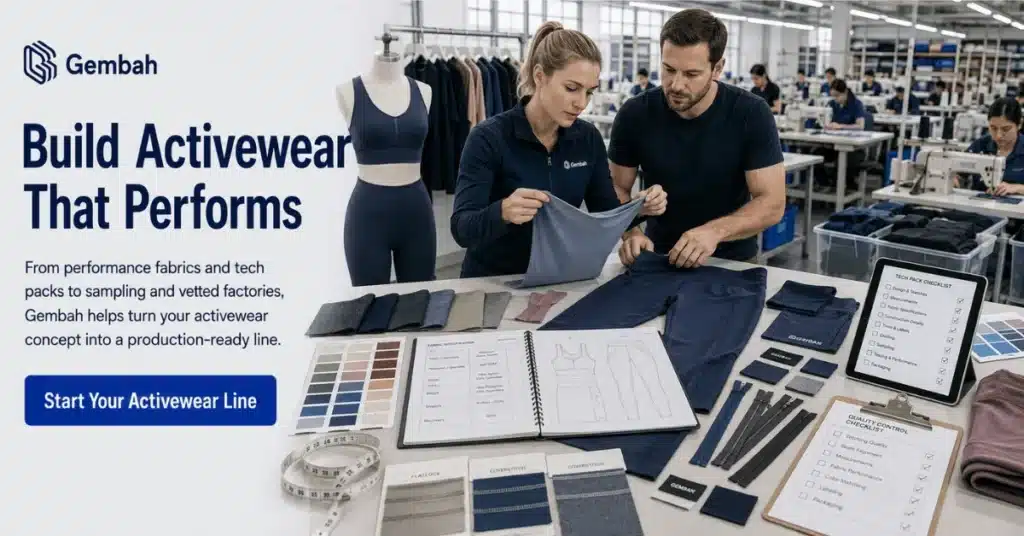
- Tech pack. The factory-ready specification: flat sketches, points of measure per size, fabric and trim bill of materials, seam and stitch callouts, labeling, and QC criteria. Our tech pack guide covers each section.
- Fabric sourcing and lab dips. Source and test the specified fabric, then approve lab dips for color and strike-offs for prints. Do this before proto sampling, because changing fabric invalidates every fit decision made after it.
- Proto sample. The first physical version, made to confirm the construction is possible and the fabric behaves as expected. It will not fit correctly, and is not supposed to.
- Fit sample and grading. Fit on a live model in your base size, then grade across the size run and fit-check at least the smallest and largest sizes. Most new brands underfund this stage, and it is the one that sets their return rate.
- Pre-production sample. The golden sample, made on production machinery with production fabric. Every unit is measured against it, and nothing enters bulk until it is signed off.
- Bulk and inspection. Knitting and dyeing, cutting, sewing, finishing, then inline and final inspection against a defined AQL using a standard sampling plan such as ANSI/ASQ Z1.4, the acceptance sampling standard for inspection by attributes.
A realistic timeline from approved tech pack to delivered first run is five to eight months overseas for a straightforward style, and eight to twelve months for technical compression pieces with custom fabric development. Most of that variance sits in fabric development and fit rounds, not in sewing.
MOQs and What Actually Drives Them
Overseas activewear factories commonly quote 100 to 1,000 pieces per style per colorway, and where you land depends far more on the fabric than on the factory. Domestic cut-and-sew can go lower, often 50 to 200 pieces per style, at meaningfully higher unit cost.
The sewing MOQ is usually not your binding constraint. Fabric mills carry their own minimums per color, and that is what forces you into more units than you wanted. When a factory quotes 300 pieces and the mill’s color minimum covers 800, the mill wins.
The practical workaround is colorway discipline. One style in four colors multiplies your fabric minimum by four; two styles in the same two colors share it. Ask whether a candidate knits its own fabric or buys it, because a vertically integrated mill-and-sew operation can flex minimums a cut-and-sew shop cannot.
Fabric is almost always the largest single line in garment cost, commonly cited at 50 to 70 percent of the total. Panel count, seam count, trims, and print method decide most of the rest, so if your unit economics are not working, the fix usually sits in fabric or panel count.
Where Activewear Gets Made
Active wear manufacturing is concentrated in a handful of countries, and each trades cost against capability, speed, and risk.
- China. The deepest performance-knit base, the widest trim availability, and the most engineering support. Still the default for technical constructions.
- Vietnam. Strong synthetic-knit capability and the most common China alternative for performance apparel, and it appears in nearly every diversification plan. See our Vietnam manufacturing overview.
- Sri Lanka. Specialized in technical intimates and performance apparel, particularly bras and molded cups, with strong compliance credentials.
- Bangladesh. Highest volume and lowest cost, weighted toward cotton and simpler knits. Best once your volumes are large and your constructions have settled.
- Turkey and Portugal. Faster turns and shorter lead times for European-facing brands, at higher unit cost.
- Mexico. Nearshore, with the shortest lead time to the US market, and useful for replenishment programs where speed beats unit price.
- United States. Fastest sampling and smallest minimums, highest unit cost, and the right answer for pilot runs and brands whose positioning depends on domestic production.
Vet a second-source candidate in a different country while you qualify your primary. US tariff policy on apparel imports has moved more than once in the past two years, and single-country dependence is the exposure that punishes hardest.
Compliance: What Changed and What It Means for Your Fabric
PFAS restrictions now govern what your factory can put on a fabric. California’s AB 1817 has covered new textile articles since January 1, 2025, and its definition of regulated PFAS has two prongs: PFAS intentionally added for a functional or technical effect, banned at any concentration, or PFAS at or above 100 parts per million as total organic fluorine. That threshold drops to 50 ppm on January 1, 2027. Do not read 100 ppm as a safe harbor: an intentionally applied finish is non-compliant no matter how little of it tests. New York’s ban on intentionally added PFAS in new apparel also took effect January 1, 2025 under Environmental Conservation Law section 37-0121, with a numerical threshold due by January 1, 2027.
Outdoor apparel gets a delay, not an exemption: gear for severe wet conditions is covered from January 1, 2028, with a “Made with PFAS chemicals” disclosure required in the interim, including on online listings. The practical effect on activewear is the DWR finish. If your shells or stain-resistant treatments rely on fluorinated chemistry, interrogate that spec with your mill now and collect the certificate of compliance California requires rather than an assurance.
FTC labeling is non-negotiable and cheap to get right. Under the Textile Fiber Products Identification Act rules, every garment needs fiber content by generic name and percentage in descending order, country of origin, and the manufacturer or dealer identity as a company name or an FTC-issued RN. A permanent care label is required separately under the Care Labeling Rule, which also requires reliable evidence behind the instructions you print.
Certifications are worth naming in the tech pack. OEKO-TEX STANDARD 100 tests finished textiles against a list of over 1,000 harmful substances and aligns with REACH and CPSIA. bluesign works upstream at the chemical-input level, screening what enters the process rather than what survives in the cloth. The Global Recycled Standard from Textile Exchange backs recycled-content claims through chain of custody. Hangtag sustainability language also has to survive the FTC’s Green Guides, last revised in 2012 and unchanged as of August 2026; the FTC has reviewed them without issuing a revision, so the 2012 text is the standard your claims are judged against.
Confirm compliance before bulk, not after
PFAS certificates, labeling, and certification documents are cheaper to sort out during sampling than at the port. Gembah’s sourcing and project management teams handle that paperwork with the factory. Talk to a Gembah expert.
Choosing an Activewear Factory: The Questions That Separate Them
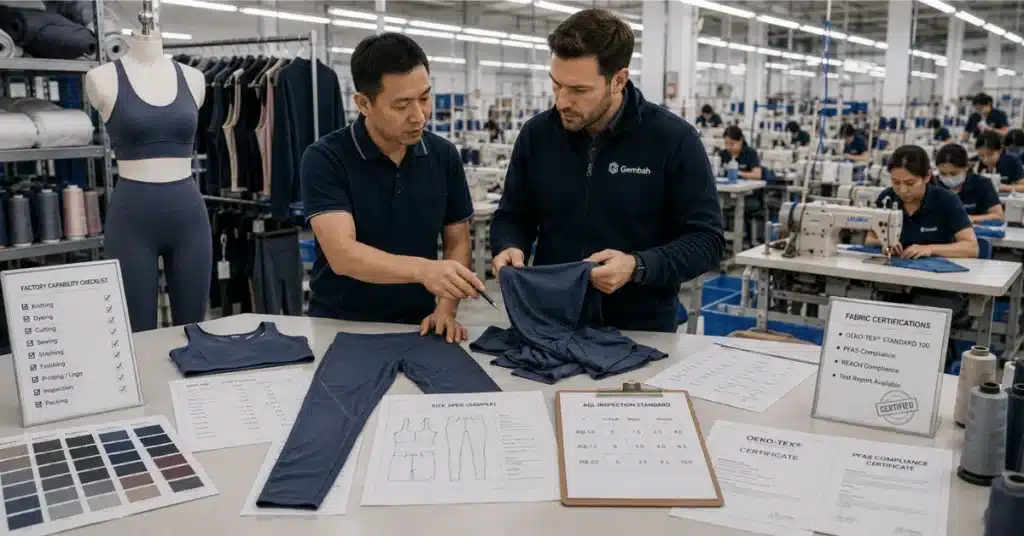
Most factory conversations open with price and capacity, which tells you little here. These questions tell you a lot, because a factory that produces activewear well answers them quickly and specifically.
- Do you knit your own fabric, or buy it? If you buy it, from which mills, and what are their minimums per color?
- Which stretch machinery is in this building: flatlock, coverstitch, bartack, elastic attach? Which steps go out to subcontractors?
- Which activewear brands have you produced for at my volume, and can I speak to three of them?
- Who does the grading, and can I see a graded spec across a full size run for a comparable garment?
- What AQL do you inspect to, and will you accept my third-party inspector inline as well as pre-shipment?
- Can you provide OEKO-TEX or equivalent documentation for the specific fabric, and a PFAS compliance certificate for the finish?
Refusal to allow a factory audit is a disqualifier, not a negotiating position.
How Gembah Supports Activewear Brands
Gembah’s textile and apparel manufacturing practice connects brands with vetted factories for activewear, apparel, accessories, and soft goods, with support for organic cotton, bamboo, and performance blends. The factory network spans India, Vietnam, China, and Mexico, matched to your construction and volume, and supports both small pilot runs and long-term production programs.
Gembah’s sports and outdoor expertise covers athletic apparel and footwear alongside fitness and recovery products, which matters when you are building a line rather than a single SKU. Design and engineering support covers fabric selection, patterns, trims, and tech pack creation with design-for-manufacturing built in, which reduces the sample rounds that eat an activewear launch budget.
Aira Basics used Gembah to take a soft-goods concept from idea to a production-ready launch, described in the Aira Basics case study, and our textile product manufacturing guide covers the broader sourcing and cost picture.
Activewear Manufacturing FAQs
What is a good GSM for leggings?
For yoga and fashion leggings, 180 to 220 GSM is the usual range, and compression or performance leggings run 220 to 280 GSM. Lighter than about 180 GSM and you risk failing the squat test on opacity, especially in light colors and prints. Heavier than 280 GSM and the garment starts to feel like shapewear.
What MOQ should I expect for an activewear line?
Overseas factories commonly quote 100 to 1,000 pieces per style per colorway; domestic cut-and-sew shops often start at 50 to 200 pieces at a higher unit price. The number usually reflects the fabric mill’s minimum per color rather than the sewing floor’s capacity, so cutting your colorway count is the fastest way to bring it down.
How long does it take to develop an activewear line?
Plan on five to eight months overseas for a straightforward style and eight to twelve months for technical compression pieces with custom fabric development. Fabric development and fit rounds account for most of that. Adding a fit round early is almost always cheaper than finding a grading problem in bulk.
Getting Active Wear Manufacturing Right From the Start
Activewear manufacturing rewards specificity. Write the fabric spec in numbers rather than adjectives, budget for the fit rounds, plan colorways around fabric minimums, and confirm PFAS and labeling compliance before bulk rather than after the container ships. The brands that ship a good first run treated the fabric decision as the product decision, because in this category that is what it is.
Take your activewear line from spec to first production run
Tell Gembah about the line you are building and get matched with vetted performance-apparel factories, with project managers handling fabric sourcing, sampling, and compliance documentation. Talk to a Gembah expert.