Vetting a manufacturing partner is seven verifications run in order: confirm they are a real factory and not a broker, confirm they already make something structurally like your product, confirm their quality system exists on paper and in practice, confirm their compliance and forced-labor exposure, confirm what you were told with your own eyes through an audit and a golden sample, confirm the commercial terms including tooling ownership and IP, and confirm all of it with three references in your category. Skip any one of them and you are betting a production run on a sales call.
Most founders vet a factory the way they hire: a good conversation, a confident deck, a competitive quote. Then the first run arrives 30 percent out of spec and the season is gone. The mistake is treating vetting as one judgment when it is seven verifications that each fail differently, so a single “do your research” step does not help.
2026 added two layers most guides ignore: forced-labor enforcement that can detain a shipment regardless of your contract, and a tariff picture that moved three times this year, changing which country the math favors. What follows is the working process for how to vet a product manufacturing partner.
Also Read
- Find the Best Manufacturer for Your Product
- What Is a Tech Pack? A Complete Guide for Product Founders
- How To Launch A New Product (A Guide For Established Brands)
Stage 1: Confirm They Are Who They Say They Are
Establish whether you are talking to a factory or a trading company. Both can be legitimate, but you need to know which you have, because a broker’s quote hides a margin you cannot see and a broker’s promises are not made by the people building your product.
Ask for the business license and read the registered business scope: it should cover manufacturing in your category, not just trade or import and export. Confirm the registered address matches the production address; a mismatch is not disqualifying, but you want it answered before money moves. Ask which processes happen in this building and which are subcontracted: subcontracting is normal, undisclosed subcontracting is a control problem. Then check how long they have operated and whether ownership changed recently: a factory that sold last year has a quality history belonging to somebody else.
Stage 2: Confirm Capability, Not Just Capacity
Capacity is how much they can make. Capability is whether they can make yours, and factories rarely volunteer the difference. Ask what they currently produce that is structurally similar to your product, not similar in category: a factory making rigid injection-molded housings is not one making soft-goods assemblies, though a directory lists both as consumer products.
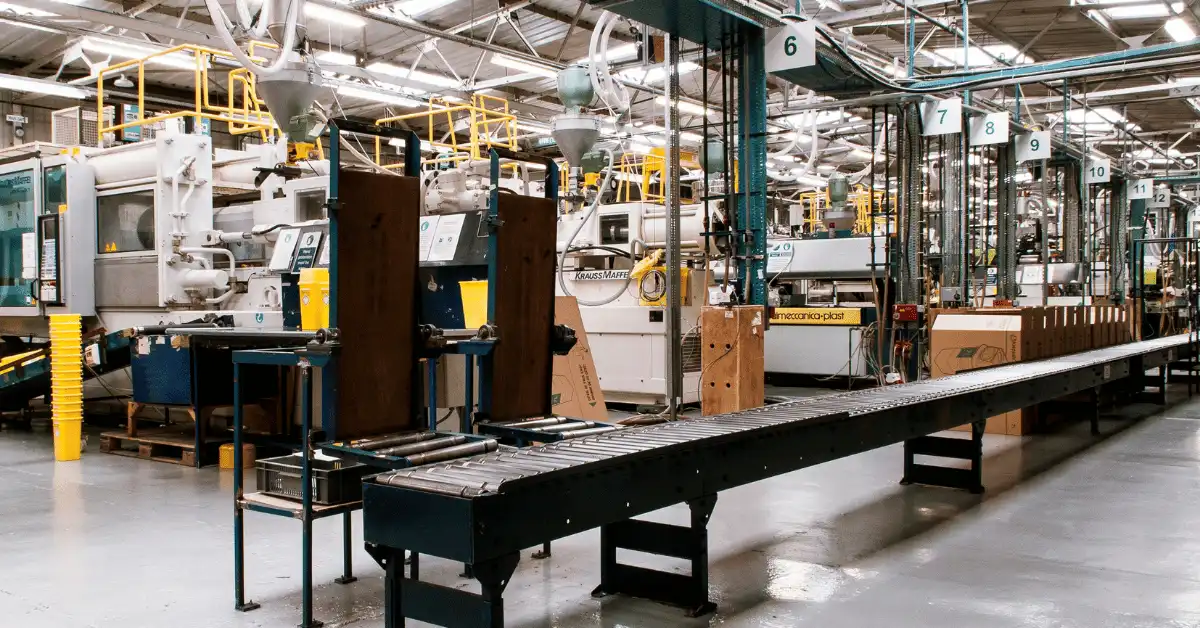
Get the equipment list and match it to your process steps. If a step on your bill of materials has no machine behind it, it is going to a supplier you have not vetted. Ask about their smallest and largest recent runs: a factory whose economics are built on 50,000 units will treat your 2,000-unit first run as an interruption. Then confirm engineering support: a partner who tells you which tolerance is expensive and which is free beats one who quotes whatever you send.
Stage 3: Confirm the Quality System Exists in Practice
Ask which quality standard they are certified to, get the certificate number, and verify it with the issuing body rather than the emailed PDF. Certificates are easy to fake and often expired.
ISO 9001:2015 is the baseline quality management certification. It tells you a documented system exists, not that the output is good, so treat it as a floor. ISO’s catalogue lists the 2015 edition as flagged for revision, with the next edition expected around September 2026 and a transition period once it publishes. Ask what their transition plan is: the answer tells you whether the certification is live or a wall decoration.
Then ask what AQL they inspect to and at what stage. ANSI/ASQ Z1.4 is the standard sampling framework for inspection by attributes, setting the inspection levels and acceptance numbers, and a partner who cannot name theirs is not running a real inspection. Ask their defect rate on a comparable product and what they do with rejects: “we have no defects” is a red flag, not a reassurance. And confirm who inspects: in-house QC reporting to the production manager is a conflict of interest, and the most common reason quality reports look nothing like the shipment.
Start from a shortlist that already cleared the first four stages
Gembah’s project managers verify identity, capability, quality, and compliance before a factory reaches your shortlist. Talk to a Gembah expert.
Stage 4: Confirm Compliance and Forced-Labor Exposure
Category compliance comes first. Confirm the certifications your market requires, whether Consumer Product Safety Commission rules for children’s products, FDA rules for food-contact items, or FCC authorization for electronics, and that this factory has produced to them before. Social compliance audits such as amfori BSCI, Sedex SMETA, and WRAP for apparel cover labor conditions; ask for the most recent report and corrective action list, not just the certificate.
Under the Uyghur Forced Labor Prevention Act, US Customs and Border Protection applies a rebuttable presumption that goods produced wholly or in part in Xinjiang, or by listed entities, are made with forced labor and barred from entry. The burden of proof sits with you as the importer, and CBP sets the standard for overcoming it at clear and convincing evidence.
That makes input traceability a vetting question, not a paperwork question. Ask for the tier-two supplier list: where the fabric, resin, cells, or metal actually originate. A partner who cannot map their own inputs cannot help you clear a detention. Check the current UFLPA Entity List against your supplier and their named upstream suppliers before committing tooling money; the Homeland Security task force that maintains it added 43 more companies at the end of July 2026, so a check from six months ago is not a check.
Stage 5: Confirm It With Your Own Eyes
Order samples first, and be explicit that you are approving a golden sample: the physical reference every production unit will be measured against, signed and held by both parties. Without that reference, “out of spec” becomes an argument rather than a comparison.
Run or commission a factory audit. If you cannot go, a third-party auditor is the substitute, and refusing audit access is the single clearest disqualifier here. Watch the gap between the showroom and the floor: clean sample rooms attached to chaotic production areas are a pattern, not a coincidence. Where budget allows, buy a paid pilot run first: samples get built by the best technician in the building and production does not. Then confirm they accept in-process and pre-shipment inspection by your inspector: a partner who allows only final inspection controls what you see.
Stage 6: Confirm the Commercial Terms Before They Are Leverage
Get an itemized quote with unit price, tooling, sampling, freight, and duties as separate lines. A blended number cannot be compared across candidates or negotiated down in parts. Settle tooling ownership in writing before you pay for tooling, because tooling you funded but do not own is how a factory holds your next run hostage.
Negotiate MOQ, payment terms, lead time, and remedies for defects as one package. Remedies are the term everyone skips and the only one that matters when the run is wrong. Put IP protection in place before you send detailed drawings: in China that means a bilingual NNN agreement, covering non-disclosure, non-use, and non-circumvention, enforceable in Chinese courts rather than a US-style NDA. Then ask what capacity headroom they have in your season: a factory at 95 percent utilization in Q3 will deprioritize your order the moment their anchor client calls.
Stage 7: Confirm With People Who Have Already Paid Them
Ask for three references, ideally US brands in a similar category and at a similar volume. A reference ordering ten times your quantity describes a service level you are not buying.
Ask them the specific questions: what went wrong on the first run, how long the fix took, who paid for it, and whether they reordered. A reference who will not discuss a problem has either not had one, which is unlikely, or is not a real reference. Cross-check what you hear against what the factory told you in stage two: discrepancies are more informative than either story alone.
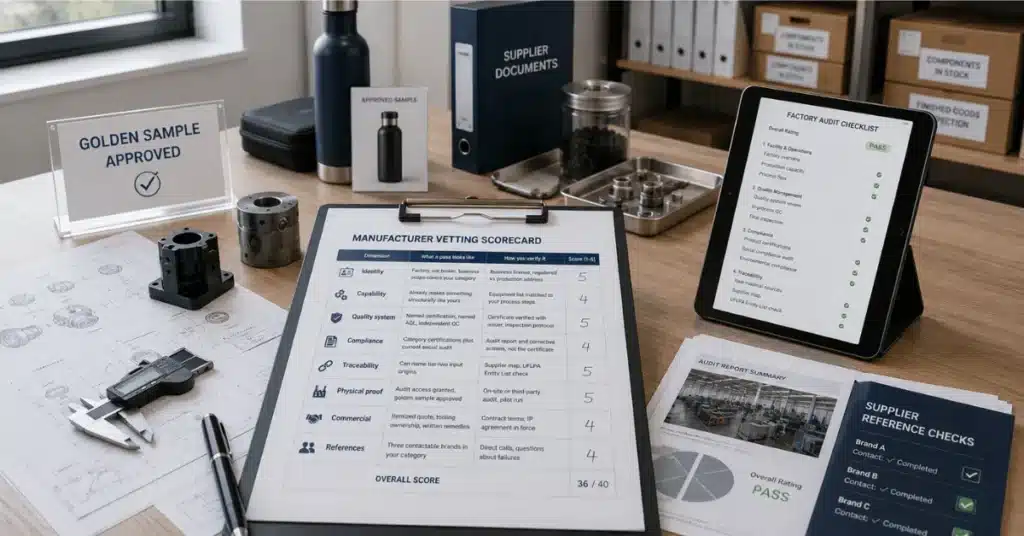
The Vetting Scorecard
Keep this as the running record for how to vet a product manufacturing partner across candidates.
| Dimension | What a pass looks like | How you verify it |
|---|---|---|
| Identity | Factory, not broker; business scope covers your category | Business license, registered vs production address |
| Capability | Already makes something structurally like yours | Equipment list matched to your process steps |
| Quality system | Named certification, named AQL, independent QC | Certificate verified with issuer, inspection protocol |
| Compliance | Category certifications plus current social audit | Audit report and corrective actions, not the certificate |
| Traceability | Can name tier-two input origins | Supplier map, UFLPA Entity List check |
| Physical proof | Audit access granted, golden sample approved | On-site or third-party audit, pilot run |
| Commercial | Itemized quote, tooling ownership, written remedies | Contract terms, IP agreement in force |
| References | Three contactable brands in your category | Direct calls, questions about failures |
Red Flags That Show Up Before You Sign
Each appears during courtship, the easiest moment to walk away and the hardest moment to believe you should.
- Refusing or repeatedly delaying an audit visit.
- A quote materially below every other bid, which usually means an undisclosed material substitution.
- Vague answers on capacity, lead time, or which steps are subcontracted.
- Pressure for an unusually large deposit, or pressure to skip the sample stage to “save time.”
- A broker who will not name the actual factory.
- Communication that degrades after the quote.
The last one matters most: how a supplier behaves while courting you is the best version of that relationship you will see.
Know what a factory is really quoting you
Landed cost, tooling ownership, and inspection rights decide whether a low unit price is actually a low price. Talk to a Gembah expert.
The 2026 Layer: Why Where Still Matters
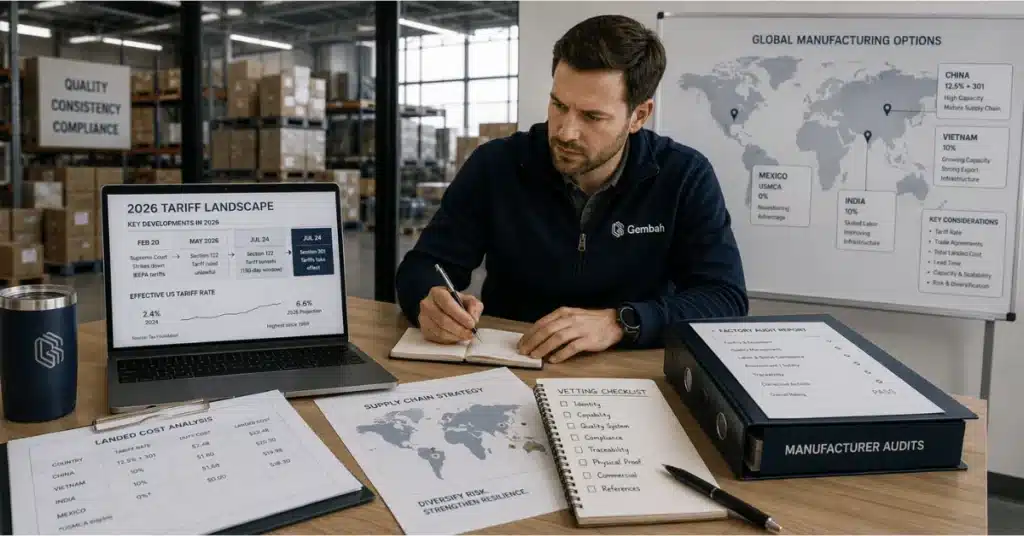
Where you build is part of how to vet a product manufacturing partner, not a separate decision. On February 20, 2026, the Supreme Court ruled 6 to 3 in Learning Resources, Inc. v. Trump that the International Emergency Economic Powers Act does not authorize tariffs, striking the IEEPA duties on China, Canada, and Mexico plus the reciprocal tariffs. Refunds opened, but the Court left remedies to the lower courts, the government appealed the refund order in June 2026, and eligibility is unresolved across the roughly $165 billion the Tax Foundation counts as collected.
Duties were rebuilt through other authorities, and those were contested too. A temporary Section 122 universal tariff of 10 percent was ruled unlawful by the Court of International Trade in May 2026, stayed on appeal days later, and collected until it sunset on July 24, 2026 at the end of its 150-day window.
The same day that surcharge lapsed, a larger action replaced it. USTR opened Section 301 investigations in March 2026 into 60 economies over their failure to prohibit imports made with forced labor, proposed rates on June 2, and took final action in July. Under the resulting Federal Register notice, tariffs of 10 or 12.5 percent apply to goods entered on or after 12:01 a.m. Eastern on July 24, 2026, across partners accounting for 99.4 percent of US imports. China is covered at 12.5 percent, on top of its 2018 Section 301 exposure under Lists 1 through 4a.
The Tax Foundation’s tariff tracker projects a 2026 average effective US tariff rate of roughly 6.6 percent, the highest since 1969, against 2.4 percent in 2024.
So the landed-cost math has moved three times this year. Run it on current rates, check the date on any tariff figure you are quoted, and vet a second-source candidate in a different country alongside your primary, because single-country dependence is what this volatility punishes. Our guide to finding a manufacturer to make your product covers building the shortlist that feeds this process.
What Getting It Wrong Actually Costs
The unit price you saved is rarely the number that matters. The costs that hurt are stranded tooling, re-tooling, air freight to recover a missed season, and inventory you cannot sell.
A defective first run also costs the thing you cannot re-buy: the review scores and retail relationships a launch depends on. That is the argument for learning how to vet a product manufacturing partner properly rather than quickly. Total landed cost is the correct comparison across candidates: unit price, tooling, freight, duties, expected defect rate, and your own management time.
If you are earlier in the process, our guides on how to manufacture a product and sell it and getting an invention made cover the steps before vetting, and the product creation guide covers the full sequence.
How Gembah Runs This For You
Gembah’s global sourcing team maintains a network of 2,200-plus vetted factory partners, so the shortlist you start from has already cleared stages one through four. Teams on the ground in China, Vietnam, India, and Mexico run the audits and factory visits a US founder cannot do in person.
Gembah manages sampling, in-process inspection, and final inspection, so the golden sample you approve is the standard production is measured against. Gembah negotiates MOQ, tooling, and remedies as a party that has done it many times with these factories, a different negotiation than a first-time buyer gets, and runs the landed-cost comparison across countries on current tariff exposure, not last year’s assumptions.
Vetting Questions Founders Ask Us
How do I tell a factory from a trading company?
Read the registered business scope on the business license: a manufacturer’s names production in your category, a trading company’s names trade or import and export. Then request the equipment list and video of the line running your process steps, where trading companies go quiet.
Is ISO 9001 certification enough on its own?
No. ISO 9001 confirms a documented quality management system exists and has been audited, not that your product will be built correctly, because the standard governs process discipline rather than outcomes. Use it as a screening floor, then ask about AQL, defect rates, and QC independence.
Do I need to visit the factory in person?
Not necessarily, but somebody working for you does. A third-party audit or a sourcing partner with in-country staff covers the same ground. What is not optional is that someone independent sees the production floor before you commit tooling money.
Who owns the tooling if I paid for it?
Whoever the contract says, which is why this belongs in writing before the first tooling payment. Paying for a mold does not automatically make it yours in most jurisdictions, and a factory holding tooling it owns has a hold on every future run.
How to Vet a Product Manufacturing Partner: What to Do Next
Vetting a manufacturing partner is seven verifications, not one impression, and the founders who lose a season compressed the first three into a phone call.
Run them in order, write down the answers, and treat audit access and reference calls as non-negotiable.
Skip the cold outreach and start from a vetted shortlist
When you are ready to compare real factories on capability, compliance, and current landed cost, tell Gembah what you are building. Talk to a Gembah expert.