The Product Life Cycle: 5 Stages Every Brand Should Know (2026 Guide)
The product life cycle describes the path a product travels from the day it is introduced to consumers until the day it is pulled from shelves. There are five main stages: development, introduction, growth, maturity, and decline. Even the most successful products eventually move through them. Take Apple. The iPod was a category-defining hit for almost two decades after its 2001 launch, then Apple discontinued it in 2022 . The original Macintosh sold 250,000 units in its first year in 1984 , and is now a collector item. What separates the brands that keep winning from the one-hit wonders is constant innovation.
When the iPod began to slow, Apple did not sit back hoping for a rebound. They were already deep into the iPhone and iPad. Consistent success comes from consistent product development. The best operators are experts at product life cycle management , meaning they know where each of their products sits in the cycle and continuously diversify the catalog around them. At Gembah we help SMBs navigate every phase of this cycle, from new product research to manufacturing to packaging refreshes that buy mature products another few years of growth.
Want a real plan for your product portfolio, not just a framework?
Every product moves through five stages: development, introduction, growth, maturity, and decline. The best brands treat development as continuous, not a one-time stage, and they actively manage the rest of the portfolio so a single product’s decline never sinks the business. Pair the product life cycle with the BCG matrix to decide where to invest, where to harvest, and where to retire. The teams that win build a habit of launching adjacent products before their hero product peaks.
Key Points
Five stages, not four. Development belongs on the list because the choices you make before launch determine whether a product ever reaches the growth phase.
Constant innovation beats one-off wins. Brands that diversify their catalog before their hero product peaks weather competitive shocks better than those that wait.
Set price strategy at introduction. Price penetration captures share fast; price skimming establishes premium positioning. Pick one deliberately, do not drift.
Growth invites competition. Plan your defensive moves (faster iteration, stronger brand, exclusive channels) before the lookalikes show up.
Maturity is when to prepare the next launch. Use the breathing room and cash flow of a mature product to fund the introduction stage of the next one.
Decline is not always inevitable. Strategic relaunches, packaging refreshes, and adjacent line extensions can buy a product several more years.
Pair the cycle with the BCG matrix. Life cycle tells you what stage; BCG matrix tells you what action: invest, harvest, divest, or rethink.
Watch external shocks. Pandemics, recessions, and tariff regimes can compress or stretch a product’s cycle. Re-evaluate quarterly, not annually.
What Is the Product Life Cycle?
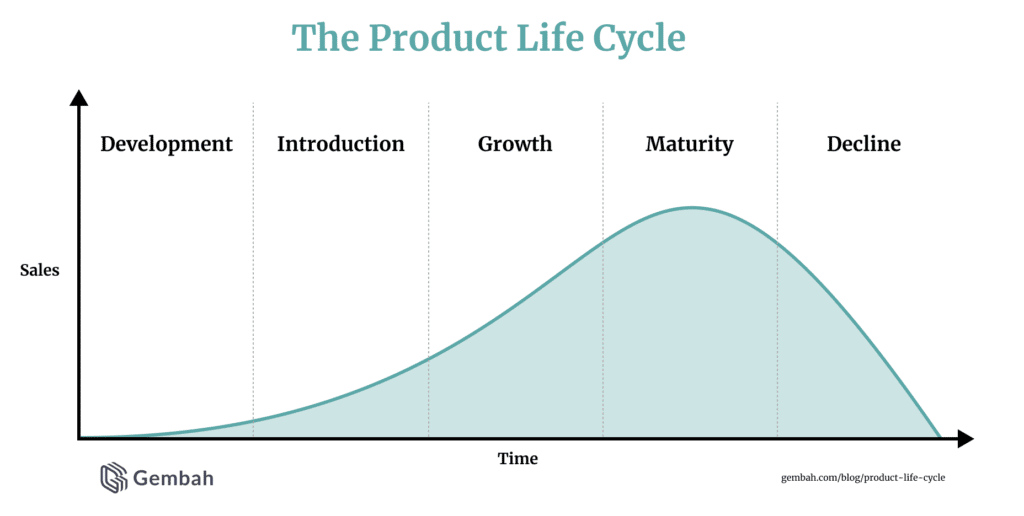
The product life cycle defines the stages a product moves through during its lifetime. The four commonly accepted stages are introduction, growth, maturity, and decline. At Gembah we add a fifth: development.
Before introducing a product to the market, you have to focus heavily on development as the primary stage. If development is wrong, the product may never see the growth stage. Treating development as a discrete phase rather than an ongoing habit is one of the most common reasons SMB launches stall, per Harvard Business Review research on launch failure rates .
Why the Product Life Cycle Stages Matter
Tracking the life cycle of your products is essential to running a future-proofed business. When you know where your top sellers sit, you can prioritize growth investment, marketing budget, or net-new product development accordingly.
Aggregate your sales and customer data so you can predict the next phase before it starts. External factors will affect the curve: economic policy, consumer sentiment, channel shifts, regulatory changes. The only constant you control is the development stage. Development is not just stage one; it is woven through every moment of a product’s life. The biggest brands in the world are always developing the next thing while harvesting the current one.
At Gembah, we are world leaders in product development processes, helping SMBs explore affordable development paths, teaching the value of this ongoing cycle, and making it repeatable across categories.
Why Product Development Should Be an Ongoing Process
Say you launched a successful product. Orders have flowed for months, the audience is real, the unit economics work. Congratulations.
You might be thinking: our product has taken off, why fix what is not broken? The honest answer is that every product has a life cycle, even when yours feels permanent today. Do not rely on a single product for company-level success. Do not let comfort kill your roadmap.
Continuously developing and launching new product lines is how you build on momentum and grow company value, whether you are heading toward an exit or building a long-term lifestyle business. The goal of ongoing development is to level up the company and diversify revenue.
Imagine a competitor launches a lookalike tomorrow with ten times your marketing budget. Imagine your category gets disrupted by a new technology, regulation, or consumer behavior shift. Ongoing development is how you blunt those risks. The lookalike still hurts; it just does not sink the entire business overnight.
What Are the Stages of the Product Life Cycle?
We have touched on each stage. Here is what each actually means and why development earns a dedicated spot.
1. Development Stage
Every business runs product development a little differently, but turning a concept into a commercial product follows a recognizable arc:
Opportunity assessment: how large is the addressable market?
Competitive analysis: who is competing today and how well are they executing?
Profitability analysis: is the product viable as a business, not just as a concept?
Target market research: what do potential customers actually think of what already exists?
From there you move into the prototyping and testing stages with confidence in market size, your right to win, and what customers want. As sales pick up, keep innovating: streamline production, reduce COGS, find new distribution channels.
Why the Development Stage Is So Important
Development is where you assess risk and mitigate failure. How well you understand the product, the industry, and the current market shapes everything downstream. SMBs that skip rigorous development consistently fail the minimum requirements for a successful launch:
Providing real value to customers
Solving a clear problem for a defined target market
Launch time. With the initial product researched, developed, and tested, it enters the introduction stage. Sales are low and slow at first.
Your goals are twofold. First, build awareness to win share and drive initial sales. Second, gather every piece of customer feedback you can, direct and indirect, so you can refine the product and the positioning.
Two price-setting strategies to choose between:
Price penetration: enter low to capture share, then raise prices as your base grows.
Price skimming: enter high to establish value and exclusivity, then lower as the base broadens.
3. Growth Stage
If the product meets the needs of the market, you move into growth. Sales start to climb exponentially. Demand grows. So does competition. As your product catches on, others enter the market alongside you.
With competition rising, comparing your product to competitors tells you how to fight for share and what to improve in the next version. According to McKinsey research on growth-stage product strategy , the brands that defend share in growth do it through faster iteration, sharper positioning, and exclusive distribution lockups, not through price competition.
4. Maturity Stage
Maturity usually brings a decline in sales growth (not necessarily a decline in sales volume). The consistent climb of the growth phase slows. Sales may go flat month over month, or even year over year for some lines.
Marketing intensity rises as competitors fight for share. Price cuts, promotions, and social campaigns all multiply. Customer loyalty matters more than ever. This is the right time to prepare for decline and the next cycle. Sometimes that means launching v2 of your hero product (Sony does this with PlayStation generations). If you have been operating in a constant state of development the whole time, maturity in one product simply clears the runway for others to grow.
5. Decline Stage
While not entirely inevitable (see Coca-Cola), the decline stage happens to most products. Sales fall, market share decreases. Reaching decline is not a cliff. Strategic marketing and product moves can extend the lifespan. A few tactics that work in the decline phase:
Cut low-performing distribution channels and geographic regions. Pull the underperforming SKU out of weak markets and replace it gradually.
Sell through to niche retailers wholesale to clear inventory and free up working capital for the next launch.
Launch Your Next Product Faster with Gembah
Thousands of vetted factories, designers, and experts are a few clicks away. Get started now .
Examples of the Product Life Cycle in Action
Plenty of real products show each stage clearly. Here are three.
The iPad
The iPad is an example of a category-defining product that competitors have not been able to copy cleanly. Personal digital assistants existed before, and Android tablets took some share, but the iPad has held its category lead for years. Since its 2010 release, it took roughly two years to reach maximum growth. Today, more than 15 years later, it sits firmly in the maturity stage .
How has the iPad sustained that maturity? Apple keeps revamping its branding and product line. From their early “Does more, costs less” positioning in 1993 through today, Apple has reshaped itself into an exclusive premium brand with deep cross-product compatibility. If you own an iPad, you probably own an iPhone and an Apple Watch too. Apple innovates and renovates nearly every product in their line every year. Software updates, hardware refreshes, marketing campaigns. Each cycle recharges interest and keeps the maturity phase running.
Livestrong Bands
Where the iPad is a complex piece of luxury tech, the Livestrong band is the opposite: a rubber wristband tied to a cancer-research campaign. The market took off immediately because:
You felt like you were doing good by donating to cancer research
It had a minimalist design that worked with any outfit
Nearly every celebrity wore one
It launched with limited runs and built-in exclusivity
The decline was rapid. About two years total, with a nine-month growth phase and almost no maturity. What went wrong? Nike did not sustain the “fight cancer” framing, did not iterate the product itself, and watched the market flood with lookalikes. New colors and sizes alone could not slow the fall.
Blow Dryer Brushes
Blow dryer brushes took off in the early 2020s and remain one of the cleanest examples of a product moving from introduction into the growth and now early maturity stages. The Cosmopolitan roundup lists 12 plus brands competing for the category, with Revlon, Dyson, and others fighting for share. Per Statista category data on home hair care appliances , the broader category is still growing in 2026. Expect this to shift into maturity over the next 18 to 24 months.
Product Life Cycle vs. BCG Matrix
The product life cycle and the BCG matrix both produce useful data about portfolio performance. They are not mutually exclusive. Using both together sharpens decisions about which products to invest in, which to harvest, and which to retire.
What Is the BCG Matrix?
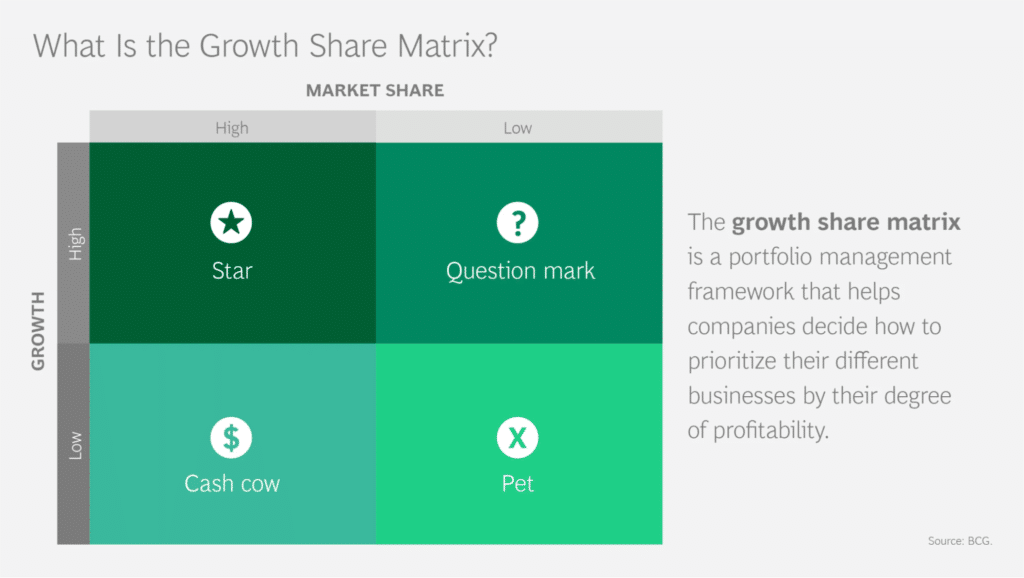
The BCG matrix is a four-celled matrix (Stars, Cash Cows, Question Marks, and Pets). Products land in each cell based on performance, helping owners decide where to push innovation, where to shift budget, and where to hold steady. The four cells:
Stars: generate high sales but also consume a large share of budget. They sit in high-growth markets and have potential to become Cash Cows.
Cash Cows: the most profitable products. They sell reliably without heavy reinvestment and are unlikely to grow beyond their current share.
Question Marks: small foothold, operating at a loss. They could become Stars or turn into Pets.
Pets: products that have overstayed their welcome. Sales and share are declining.
Using the BCG Matrix to Inform Life Cycle Decisions
Run a current-quarter snapshot of your portfolio and place each SKU in one of the four BCG cells. Then overlay the life cycle stage. The combinations tell you what to do:
A Star in the growth stage gets more investment, faster.
A Cash Cow in maturity gets harvested, and the cash funds the introduction of new SKUs.
A Question Mark in introduction gets one more deliberate test cycle, then a clear decision.
A Pet in decline gets retired or sold to a niche channel.
Both tools, used together, are how disciplined operators avoid the trap of letting an underperformer linger.
Advantages and Limitations of the Product Life Cycle
A product’s life cycle is rarely steady or predictable, but a life-cycle view paired with active management is one of the more useful frameworks for releases and refreshes.
Pros of using the product life cycle:
Helps you plan ahead and allocate budget
Gives you metrics to change marketing strategies as stages shift
Surfaces the pitfalls inside each stage so you can avoid them
Lets you compare your product to similar products at each stage
Helps you spot trends and mistakes early and respond fast
The honest downside: the traditional product life cycle does not account for every variable. A pandemic, a recession, a sudden tariff shift, a viral social moment, all of these can stretch or shorten a cycle. Do not treat the stage recommendations as binding rules. A dip in sales might be seasonality, not the start of decline. Without further analysis, a product manager who pulls the product on the first dip creates a self-fulfilling decline that closer examination would have avoided.
5 Product Life Cycle Moves Every Brand Should Know
A short list that compresses the practical advice into something you can share on LinkedIn or with your team:
Build the next product while the current one is still growing. Waiting for decline to act is how brands die.
Decide the price strategy before you launch. Penetration or skimming, not “we will figure it out.”
Use the maturity stage to fund the next introduction. Cash flow is the asset; do not let it idle.
Pair life cycle stage with BCG quadrant. The combination tells you what action to take.
Re-evaluate quarterly. External shocks compress or stretch the cycle faster than annual planning can catch.
Save this list. Tape it above your roadmap.
Conclusion
Innovation belongs at the core of any product business. The product life cycle works best as a diversification system. If too many of your lines are in maturity or nearing decline, you risk a rapid drop that could shut the business down. If too many are stuck in development or introduction, you may run out of runway before any of them turns into a cash generator. The right portfolio mix is half the discipline; the other half is the willingness to act on what each stage tells you.
Ask the question: which innovations could you make right now that would revitalize a product approaching decline? A hardware refresh? A new version? Complementary products that extend the hero product’s utility for existing customers? The answer determines whether the next quarter looks like growth or harvest.
At Gembah, we offer the tools to do it all. No matter what stage a product is in, we deliver an all-in-one platform that acts as your product development hub. The platform pairs a workflow engine, product research engine, and expert database that helps you identify the optimal strategy for your team and your stage.
Henrik not only co-founded and leads Gembah, but he is a former CEO and co-founder of several venture startups, most recently Boundless, a $100M promotional products company and platform. When he isn’t focusing on building Gembah, you can find him trail running or eating Mexican food.
Resource Center
Related Content
Learn more about every step of the product development journey with our library of helpful
resources. View the latest ebooks, webinars, blogs, and case studies from Gembah’s Experts.
After the Supreme Court struck down IEEPA tariffs and USMCA hit its 2026 review, the China vs Mexico math has shifted again. Here is a category-by-category guide grounded in what is actually possible for small and mid-sized consumer brands.
Private label sits between white label and custom manufacturing. You get some customization without starting from zero. But when is that enough, and when do you need full custom? Here is the breakdown.
White label gets you to market fast with someone else's product and your logo on it. Custom product development is slower and more expensive, but you own the IP and the differentiation. The right path depends on what you're trying to build.
Manage Consent
To provide the best experiences, we use technologies like cookies to store and/or access device information. Consenting to these technologies will allow us to process data such as browsing behavior or unique IDs on this site. Not consenting or withdrawing consent, may adversely affect certain features and functions.
Functional
Always active
The technical storage or access is strictly necessary for the legitimate purpose of enabling the use of a specific service explicitly requested by the subscriber or user, or for the sole purpose of carrying out the transmission of a communication over an electronic communications network.
Preferences
The technical storage or access is necessary for the legitimate purpose of storing preferences that are not requested by the subscriber or user.
Statistics
The technical storage or access that is used exclusively for statistical purposes.The technical storage or access that is used exclusively for anonymous statistical purposes. Without a subpoena, voluntary compliance on the part of your Internet Service Provider, or additional records from a third party, information stored or retrieved for this purpose alone cannot usually be used to identify you.
Marketing
The technical storage or access is required to create user profiles to send advertising, or to track the user on a website or across several websites for similar marketing purposes.