Most founders treat the question of how to find a manufacturer for my product as a single search box. You type the phrase, you get a wall of factories, and you start emailing. Then the samples come back wrong, the quotes do not compare, and the first run either blows the budget or shows up unusable.
Finding a manufacturer is a sequence, not a search, and the founders who get it right treat every step as its own decision. This guide walks the full path, from getting your product production-ready to pressure-testing the final price, and it accounts for how much the 2026 tariff picture has changed the domestic-versus-overseas math. At Gembah, we run this exact process for brands every week, so what follows is the practical version, not the textbook one.
Also Read
- Best Product Manufacturing Platforms Compared
- Choosing the Right Product Manufacturing Platform
- Product Manufacturing Platforms: What to Look For
The Short Version
Finding a manufacturer is a five-move process. Define your product on paper so a factory can actually quote it, build a shortlist from the right channels, decide domestic versus overseas on total landed cost rather than unit price, vet each candidate hard with samples and audits, then negotiate MOQ, tooling, and payment terms before you commit a run. The founders who end up with a bad match almost always rushed the first move. Learning how to find a manufacturer for your product is really about slowing down at the front so the back half goes fast.
Start With a Spec, Not a Search
A factory cannot quote what you cannot describe. Before you look for a single supplier, you need a specification: dimensions, materials, tolerances, finish, packaging, and target quantity. Without it, every quote you get back is a guess, and no two guesses are comparable.
For anything past a plain commodity, that means a tech pack, the document a factory expects you to arrive with. It covers your CAD or drawings, a bill of materials, and the quality criteria the finished product has to meet. A tech pack is the difference between a factory building your product and a factory building its interpretation of your product.
Set your MOQ tolerance and budget up front, too. The factory that fits a 500-unit first run is rarely the one built for 50,000 units, so knowing your volume narrows the field before you start. Decide which specs are fixed and which can flex, because that flexibility becomes your negotiating room later without compromising the product.
Get your product production-ready before you shop for factories. Gembah’s engineering and design teams turn a rough concept into a manufacturable, documented spec, so the quotes you collect are real and comparable. Talk to a Gembah expert.
Where the Good Factories Actually Are
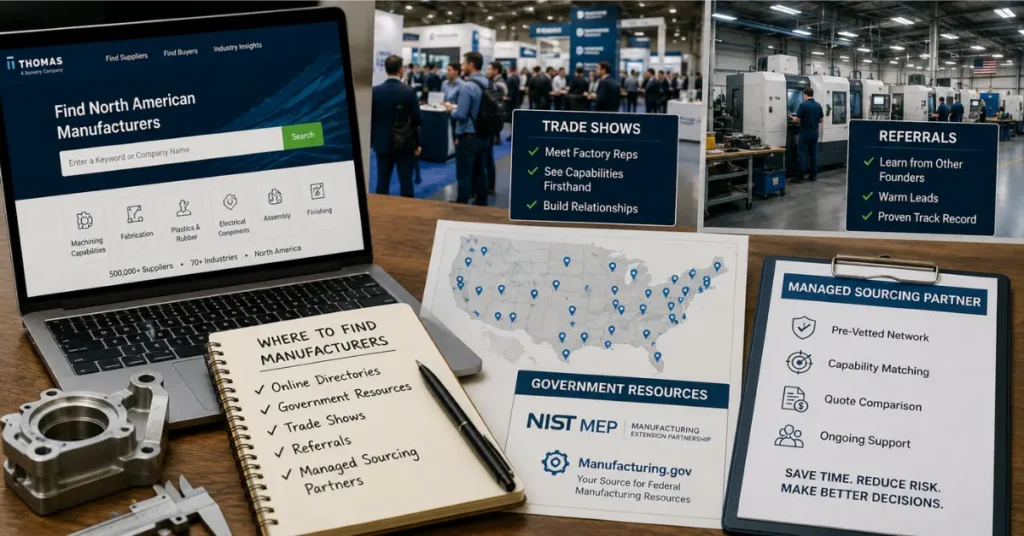
Once your spec is ready, the channel you use to find a manufacturer for your product depends on what you are building and where you want to build it. One thing works in your favor: the overwhelming majority of US manufacturers are small businesses, according to the SBA Office of Advocacy, so a domestic shop willing to take on a modest first run is more common than founders expect.
Online directories are the default for domestic sourcing. Thomasnet lists more than 500,000 North American suppliers and lets you filter by capability, which is a strong starting point for US manufacturing. Overseas marketplaces exist too, but they mix vetted factories with trading companies, so the signal is noisier.
Government resources are underused and free. The NIST Manufacturing Extension Partnership runs centers in every state that connect small and mid-sized companies with domestic manufacturers, and the federal Manufacturing.gov hub aggregates sourcing tools in one place.
Trade shows and referrals carry the highest signal. A category-specific trade show puts you in front of factory reps in person and shortcuts a lot of vetting. Other founders in your category are even better: a factory already shipping a product like yours is a warm lead with a track record you can check. And a managed sourcing partner replaces months of cold outreach with a pre-vetted shortlist, which is the practical difference between guessing and choosing. Our breakdown of a product development company versus a sourcing agent covers which model fits which situation.
Protect Your Product Before You Share It
Finding a manufacturer means handing your design to people you have just met, so decide what protection you want in place before the first tech pack goes out. For an original product, that can mean filing a provisional patent application with the USPTO to lock a priority date, and registering your trademark, before you circulate specs to factories you have not yet vetted.
Stage your disclosure, too. Share enough for a factory to quote intelligently, not your full bill of materials and source files, until a candidate is vetted and working under a signed non-disclosure or non-use agreement. Factories worth working with will not blink at reasonable confidentiality terms, and the ones that push back have told you something useful before you risked anything.
Domestic or Overseas: A 2026 Decision, Not a Rule
Where to build is product-specific, and 2026 made it a live decision rather than a default. Overseas manufacturing in China, Vietnam, or India usually wins on unit cost and tooling. Domestic and nearshore options in the United States and Mexico win on lead time, communication, smaller minimums, and lower tariff exposure.
The tariff piece is the part that actually moved. In February 2026 the Supreme Court ruled that the president could not use the International Emergency Economic Powers Act to impose tariffs, striking down the steep 2025 China duties. The administration rebuilt rates through other authorities almost immediately, layering a 10 percent Section 122 baseline on top of existing Section 301 and Section 232 tariffs. As of mid-2026, the Tax Foundation’s tariff tracker puts the effective rate on many Chinese consumer goods around 35 percent, with some categories far higher, and the structure is still shifting under active legal challenge.
That volatility is why diversification keeps winning. US goods imports from China fell to about $308 billion in 2025, down nearly 30 percent from the year before, according to the Bureau of Economic Analysis, and reshoring momentum is still building per Deloitte’s 2026 Manufacturing Industry Outlook. The domestic pull is measurable: reshoring and foreign direct investment announced roughly 244,000 US manufacturing jobs in 2024, with tariffs now the leading motivator, according to the Reshoring Initiative. A “China plus one” hedge across Vietnam, Mexico, and India is the mainstream response, not a fringe one.
|
Factor |
Domestic / Nearshore (USA, Mexico) |
Overseas (China, Vietnam, India) |
|
Unit cost |
Higher |
Lower |
|
Tooling cost |
Higher |
Lower |
|
Lead time |
Shorter |
Longer |
|
Typical MOQ |
Lower |
Higher |
|
Tariff exposure (2026) |
Lower |
Higher, and moving |
|
Communication and oversight |
Easier |
Needs a plan or partner |
Not sure whether to build at home or overseas? Gembah runs the domestic-versus-overseas math on total landed cost, including 2026 tariff exposure across China and Mexico, so you decide on real numbers. Get a sourcing quote from Gembah.
How to Vet a Factory Before You Commit
Vetting is where most of the risk actually lives, and it is the step rushed founders skip. Order samples first. A golden sample tells you more than any capabilities deck, and you should never place a production order off a photo.
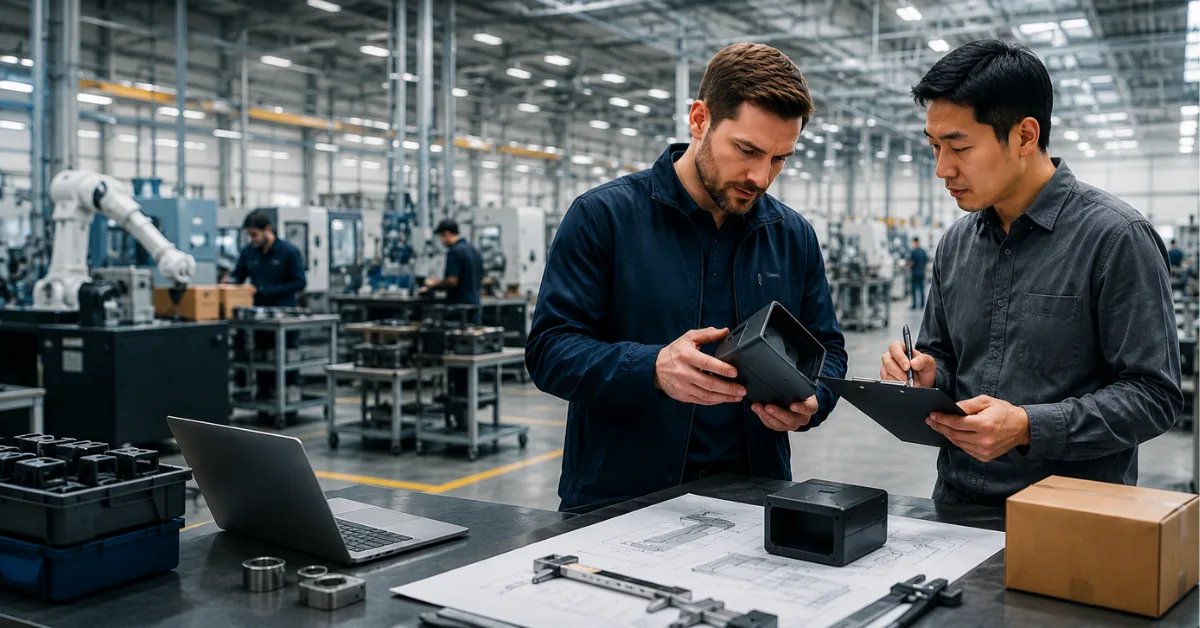
Run or commission a factory audit. You want to verify capacity, equipment, quality systems, and that the factory genuinely makes what it claims, ideally with someone on the ground rather than over email. This is also where a partner with local teams earns its keep, because a report from the factory floor is worth more than a glossy PDF.
Check certifications and compliance for your specific market. Confirm the standards your category requires, whether that is ISO for quality systems or rules from the CPSC or FDA for regulated products, before you commit a dollar. Then call references. Ask for other brands in your category and actually contact them about quality, communication, and on-time delivery. A factory that will not connect you with a reference is telling you something.
Pricing the Deal on Total Landed Cost
The cheapest quote is rarely the cheapest project. To compare candidates honestly, get itemized quotes that separate unit price, tooling, freight, and duties, so you are comparing the same things across factories rather than a bundled number.
Negotiate the full package, not just the per-unit price. MOQ, tooling ownership, payment terms, and quality remedies all matter as much as the headline figure, and tooling ownership in particular affects whether you can move factories later. Then judge everything on total landed cost: unit price plus tooling, freight, duties, expected defects, and your own management time. That last line, your time, is the one first-timers forget, and it is often what makes a slightly pricier, better-managed factory the cheaper choice.
How Long Finding a Manufacturer Takes
Founders consistently underestimate the calendar, so build a realistic timeline into your launch plan from the start. Getting the spec and tech pack production-ready is usually two to four weeks of focused work. Building a shortlist and collecting comparable quotes takes another two to six weeks, longer if you are sourcing overseas and working across time zones.
Samples are the step that stretches. A first sample round commonly runs three to eight weeks, and most products need two or three rounds before a golden sample is approved. Add tooling lead time for molded or cut-and-sew products, and the honest answer is that going from idea to a first production run typically takes three to six months, sometimes more. The reason a managed partner compresses that timeline is straightforward: parallel workstreams and pre-vetted factories remove the two slowest links, cold outreach and unvetted sample loops.
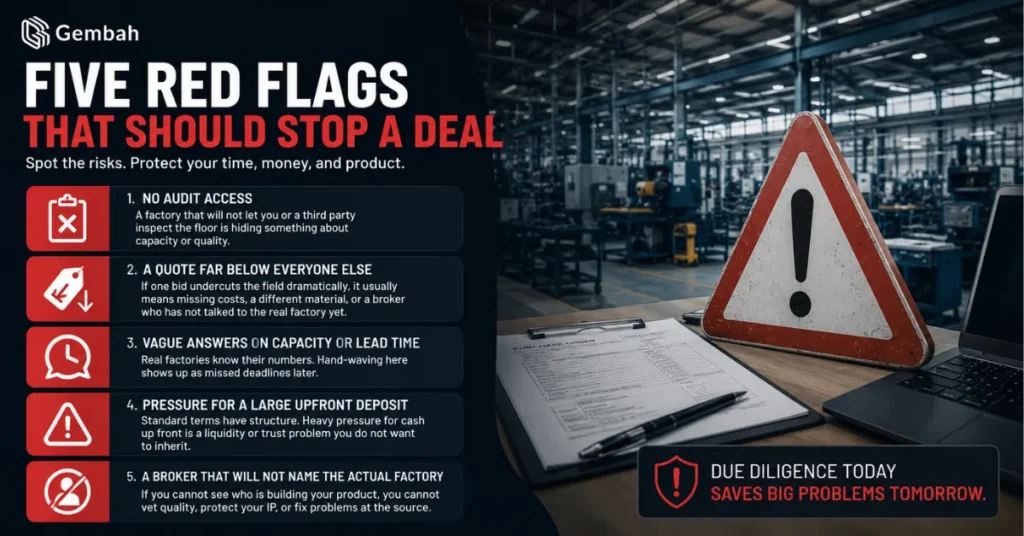
Five Red Flags That Should Stop a Deal
Some warning signs show up again and again. Any one of these is a reason to slow down and dig before you send money.
- No audit access. A factory that will not let you or a third party inspect the floor is hiding something about capacity or quality.
- A quote far below everyone else. If one bid undercuts the field dramatically, it usually means missing costs, a different material, or a broker who has not talked to the real factory yet.
- Vague answers on capacity or lead time. Real factories know their numbers. Hand-waving here shows up as missed deadlines later.
- Pressure for a large upfront deposit. Standard terms have structure. Heavy pressure for cash up front is a liquidity or trust problem you do not want to inherit.
- A broker that will not name the actual factory. If you cannot see who is building your product, you cannot vet quality, protect your IP, or fix problems at the source.
How Gembah Matches You to the Right Factory
Working through all of this alone is possible, but it is slow, and the expensive mistakes tend to surface after the money is spent. Gembah’s product manufacturing services match you to the right factory from a network of more than 2,000 vetted factories, so you skip months of cold outreach and unvetted samples.
The global sourcing side covers factory discovery, audits, and negotiation, with teams on the ground in China, Vietnam, India, Mexico, and the United States for real oversight rather than remote guesswork. For brands weighing where to build, Gembah runs the total-landed-cost comparison, tariffs included, instead of defaulting to the lowest unit price. And because quality control is managed in process and at final inspection, the first production run comes back usable rather than as a surprise.
Conclusion
Finding a manufacturer is a sequence: define the product, look in the right places, decide where to build on real cost, vet hard, and negotiate the whole package before you sign. Treat each step as its own decision and the bad-match problem mostly disappears. That is the entire point of learning how to find a manufacturer for your product the deliberate way rather than the fast way.
Ready to find the right factory for your product? Let Gembah match you to a vetted manufacturer and handle the vetting, pricing, and quality control, so your first run is one you can sell. Get started with Gembah.