Learning how to design and manufacture a kitchen appliance starts with a distinction that costs founders months when they miss it. A silicone spatula and a countertop blender sit in the same aisle, and they’re not the same project. The moment your product has a cord, it stops being a housewares item and becomes an electrical one, with a safety standard, a certification lab, and a test schedule sitting squarely on your critical path.
That’s what first-time appliance founders underestimate. It isn’t the design, and it isn’t finding a factory, which is a solvable problem. Certification takes months, costs real money, and can send you back into tooling if the design wasn’t built for it. At Gembah, kitchen and home is a named category rather than a side project, and we treat the compliance path as a design input rather than a paperwork step at the end.
Also Read
- How to Manufacture Kitchen Accessories
- Regulatory Compliance in Product Manufacturing
- A Guide to Electronic Prototypes
TL;DR
Designing and manufacturing a kitchen appliance involves five decisions, in order. Classify the appliance first, because whether it heats, spins, or generates RF energy determines which safety standard your lab follows. Design around what breaks appliances: heat management, motor duty, and food-contact materials. Book certification before you cut tooling, since a safety listing, a CPSC certificate that now has to be filed electronically at import, and sometimes an FCC filing all take longer than founders expect. Then tool, sample, and choose a country with the component depth your appliance actually needs.
Key Points
- A cord changes the project. A powered appliance needs a mark from a nationally recognized testing laboratory, and most retailers and insurers won’t stock a product without one.
- The US standard is probably not the international one you’ve read about. Small kitchen appliances still certify to legacy UL standards by function, and the IEC 60335 series matters most when you export.
- Certification is a schedule item, not a checkbox. Testing, failures, redesign, and retesting are normal, which is why it belongs on the timeline before tooling, not after.
- Anything touching food is an FDA question. Every food-contact component needs a documented regulatory status, and “food grade” from a supplier isn’t the same as compliance you can evidence.
- Adding Wi-Fi changes your FCC position twice over. The radio needs its own certification, and the appliance loses an exemption it had while it was dumb.
- Your import paperwork is now a filing, not a document. Since July 2026, certificate data goes to Customs electronically at entry.
- Tooling is the point of no return. Every design change is cheap before the mold is cut and expensive after it.
Building a countertop appliance and not sure what applies? We map the standards before the design freezes. Talk to a Gembah expert.
Start by Classifying What You’re Actually Building
Sort your product by what it does, not by what it’s called. Heating appliances, motor-driven appliances, and RF appliances each certify to a different standard with a different test plan, and the US system splits them more finely than most founders expect.
Coffee and beverage brewers go to UL 1082, Household Electric Coffee Makers and Brewing-Type Appliances, now in its 6th edition and revised in July 2024. Its scope reaches percolators, urns, kettles, and carafes, essentially anything that heats liquid above 115°F and gets lifted to pour.
Motor-driven food preparation, meaning blenders, food processors, and choppers, goes to UL 982, Motor-Operated Household Food Preparing Machines, 8th edition, revised April 2024. Worth knowing: UL 982 is written for short-duty household use, and a unit with a heating element gets evaluated against UL 982 plus the applicable cooking requirements rather than one or the other.
General cooking and food-serving appliances go to UL 1026, 6th edition, revised in June 2026 to add requirements for electric pressure cookers. Read its scope carefully, because UL 1026 doesn’t cover everything you’d expect. It expressly excludes skillets and frying-type appliances, coffee makers, and microwave appliances. Those frying-type products land in UL 1083 instead, which covers frying pans, griddles, deep fryers, woks, waffle makers, and contact grills.
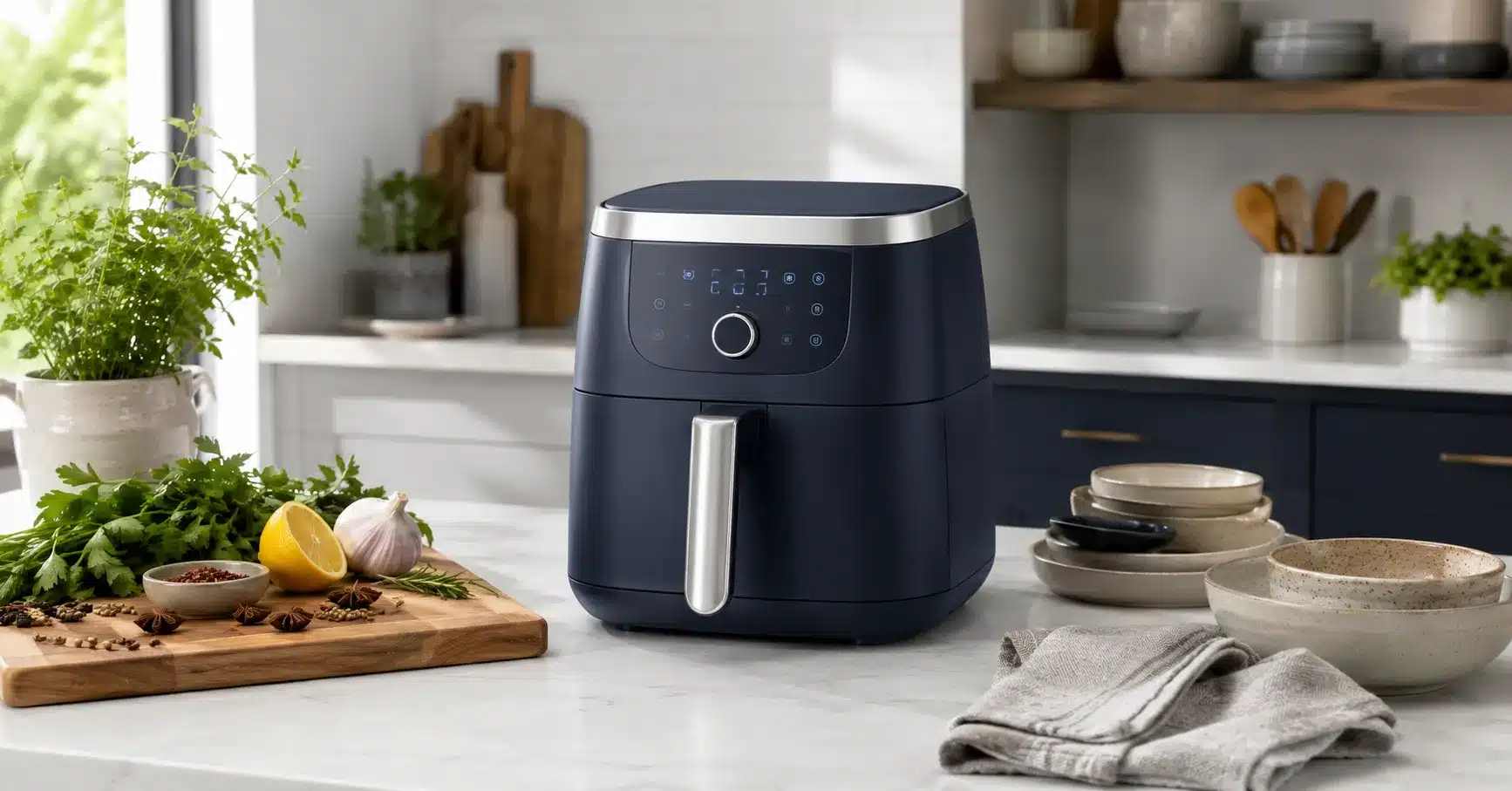
Here’s the honest answer on the category everyone asks about: no published standard names “air fryer.” A basket-style unit reads as a frying-type appliance and tends toward UL 1083, while an air-fryer toaster oven reads as a cooking appliance and tends toward UL 1026. Your certifier makes that call against your specific product, so ask them before design freeze rather than assuming you know.
What about UL 60335-1?
You’ll see the IEC 60335 series referenced constantly, and it’s worth knowing why it usually isn’t your US path. UL 60335-1 reached its 7th edition in December 2025, adopting IEC 60335-1 Edition 6.0, and it’s harmonized with Canada through CSA C22.2 No. 60335-1:25. Note that it’s bi-national, not tri-national; the older tri-national edition that included Mexico’s ANCE standard was superseded back in 2016.
More importantly, 60335-1 is a Part 1 general standard. It works alongside a Part 2 particular standard for your product type, and the US has never adopted Part 2 particulars for coffee makers, kitchen machines, or frying appliances. So for a countertop appliance sold domestically, the legacy UL standards above are the path. The 60335 series becomes central the moment you export, because most other markets run on it.
Design Around Heat, Motors, and Food Contact
Thermal management drives material selection more than aesthetics do. Plastics near a heating element need the right temperature rating, and a wrong resin choice surfaces during safety testing rather than in CAD. Our overview of working with plastic manufacturers covers how resin selection interacts with tooling.
Design the failure, not just the function. Safety labs test what goes wrong: a blocked vent, a stalled motor, a dry boil, or a user reaching where they shouldn’t. A product designed only for correct operation tends to fail abnormal-operation tests.
Every part that touches food needs a documented regulatory status. The FDA’s framework gives you five routes. A component can be covered by a listed regulation under 21 CFR parts 174 through 179, be prior-sanctioned under part 181, or hold GRAS status under parts 182, 184, or 186. The remaining two routes are a Threshold of Regulation exemption under 21 CFR 170.39 and an effective Food Contact Notification. The FDA lays this out in its guidance on determining the regulatory status of components of a food contact material.
“Food grade” from a supplier is a starting point, not a document. Ask for the specific citation covering the resin, coating, gasket, or adhesive, because you’ll need it in your own file when someone asks.
California’s Proposition 65 applies to what’s inside the appliance as well as what touches food. OEHHA administers it under Health and Safety Code sections 25249.5 through 25249.13, with the warning rules in Title 27 of the California Code of Regulations, and it applies to businesses with ten or more employees. The practical risk driver isn’t the state agency. It’s the private right of action, which lets any person sue in the public interest within 60 days of serving notice, and that’s what drives the volume of appliance-industry claims.
Compliance problems found after tooling are tooling problems. We build the requirements into the design. Get a Gembah sourcing quote.
Book Certification Before You Cut Tooling
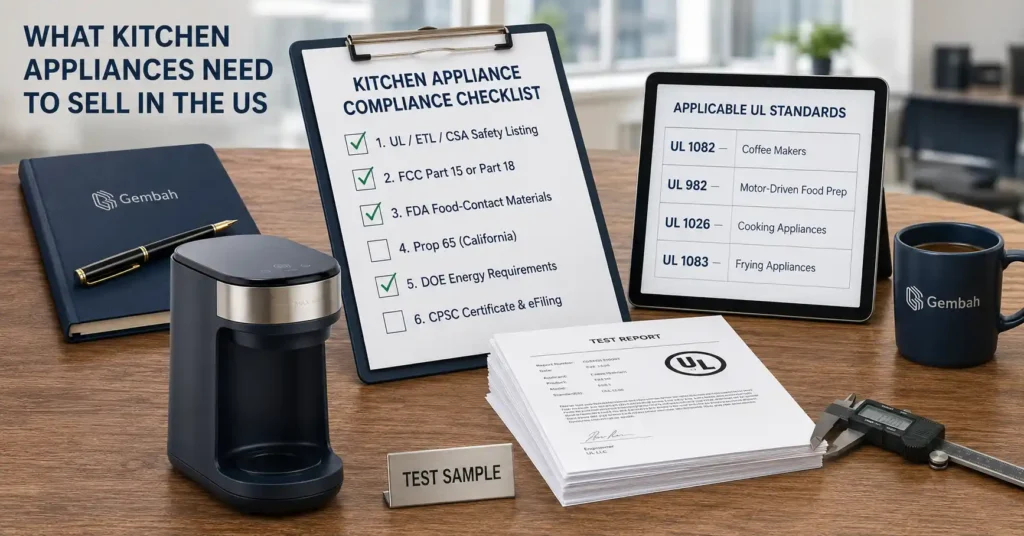
A mark from a nationally recognized testing laboratory is the practical gate to retail. UL, ETL from Intertek, and CSA are the marks buyers look for, and the listing is what gets your product onto a shelf and through a big-box vendor portal.
Alongside that sits a separate obligation that falls on you as the importer. Under 16 CFR 1110.11, a finished product subject to a CPSC rule needs a certificate carrying seven required elements. Those cover product identification, each applicable rule, the certifier’s details, who holds the test records, the date and place of manufacture, the date and place of testing, and a signed attestation. The regulation calls it a finished product certificate; you’ll also hear it called a General Certificate of Conformity.
One recent change matters more than the rest. Since 8 July 2026, importers must file that certificate data electronically with Customs at the time of entry, through the ACE system, under 16 CFR 1110.13. The rule was published as Certificates of Compliance at 90 FR 1800, and goods entered from a foreign trade zone follow in January 2027.
It applies to imports rather than domestic production, and it turns a document people used to produce on request into a filing that gates your shipment. Repeat importers shipping the same SKU can preregister in CPSC’s Product Registry to file a shorter three-element reference at entry (Product ID, Certifier ID, Certificate Version ID) instead of transmitting all seven elements per shipment.
If your appliance uses or emits RF energy
Microwave ovens and induction cooktops are industrial, scientific, and medical equipment under FCC Part 18, because they use RF energy to do the actual cooking. Under 47 CFR 18.203, consumer ISM equipment “must be authorized under either the Supplier’s Declaration of Conformity or the certification procedure,” so you have two routes rather than one. Induction ranges get named explicitly in 47 CFR 18.305, with out-of-band field-strength limits of 1,500 µV/m below 90 kHz and 300 µV/m at or above it, measured at 30 meters.
If your appliance connects
This is where founders get caught, and the mechanics are worth stating precisely. A plain appliance benefits from an exemption at 47 CFR 15.103(d), which covers “a digital device utilized exclusively in an appliance.” Add a Wi-Fi or Bluetooth module and two things happen at once. The module is an intentional radiator that needs its own FCC certification through a telecommunications certification body, which was always true and has nothing to do with the appliance exemption. And under 15.103(i), equipment containing more than one device isn’t exempt unless every device qualifies, so the host’s digital circuitry loses the shelter it had while the product was dumb.
None of that is a reason to skip connectivity. It’s a reason to price and schedule it deliberately instead of treating an app as a software decision.
Tool, Sample, and Prove It Before You Scale
Tooling is usually the largest single pre-production cost, because a countertop appliance typically needs several molds for housings, bezels, lids, and internal structure.
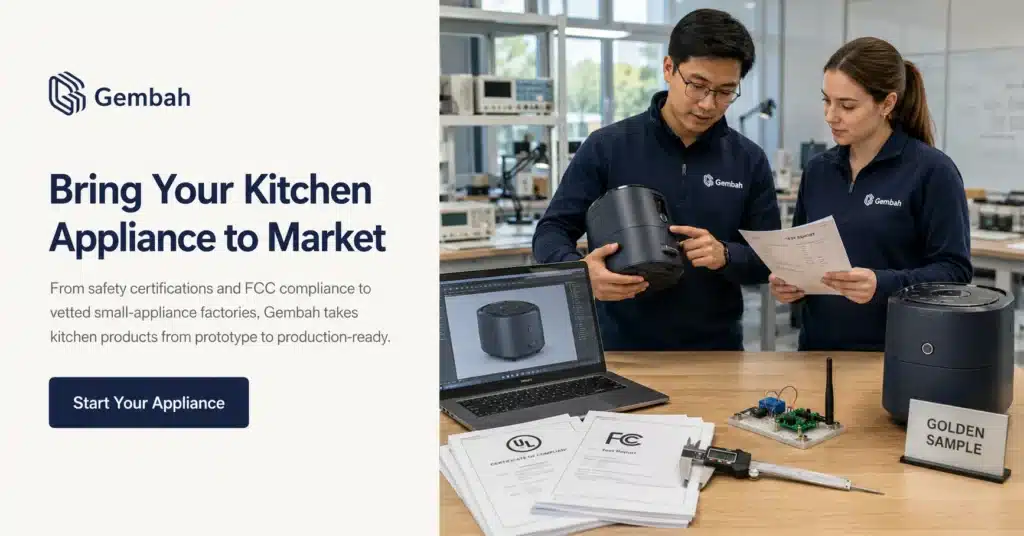
Get a golden sample built on production-intent tooling before you approve a run. A 3D print tells you about proportions and almost nothing about how a housing behaves at temperature. Send your certification samples from production-intent tooling too, since testing a hand-built unit and then changing the mold is how a passing report stops describing what you actually ship.
Lock one approved revision for production. A sample built from one file version, a quote written against another, and a factory told “final” is the quiet way appliance projects go sideways. And settle tooling ownership in writing before you fund tooling, because a mold you paid for but don’t own sets the price of your next run.
Ready to move from design to a real sample? Talk to the Gembah team about your appliance.
Where Kitchen Appliances Get Built
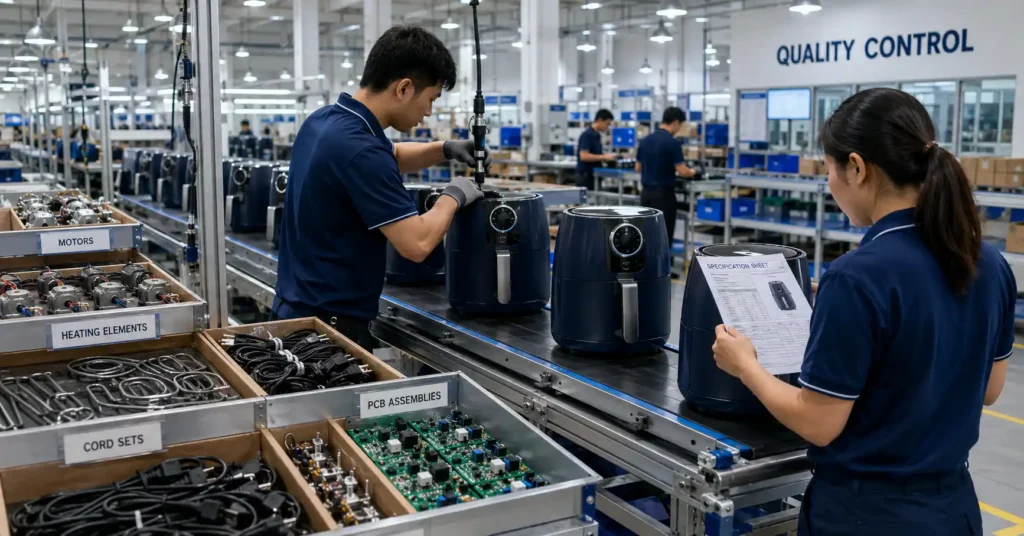
Component depth matters more than headline unit price on an appliance. Motors, heating elements, thermostats, PCBs, and cord sets all have to come from somewhere close to the assembly line, and a cheap quote from a factory that’s importing half your bill of materials isn’t really cheap.
China carries the deepest small-appliance supplier base, which is why most countertop categories still start there when a product has many electrical components. Vietnam has become a working alternative for assembly, though category depth varies and component sourcing sometimes still routes back through China. India is worth evaluating on category fit, particularly where domestic appliance manufacturing already runs at scale. Mexico is the nearshoring answer when lead time and factory access matter most, with shorter transit and visits you can realistically make.
Two trade items belong in your landed-cost model, and both moved in 2026. The USMCA was not renewed in its current form at the joint review on 1 July 2026. USTR’s statement is explicit that it “remains in force pending resolution of these issues or until the Agreement’s termination.”
Separately, Section 232 duties on steel and aluminum run at 50% for covered articles and derivatives under Proclamation 11021, effective April 2026, and that proclamation applies the duty to the full customs value regardless of metal content rather than to the metal portion alone. There’s no blanket USMCA exemption. On a stainless or aluminum-heavy appliance, check your own classification against the current annexes rather than assuming a rate.
Whatever the country, ask whether the factory has already certified an appliance to your standard. One that has passed safety testing before is a materially different partner from one learning it on your product.
Three Things Founders Get Wrong About Appliance Certification
Myth: Certification happens at the end, once the design is done.
Reality: It’s a multi-month sequence of sample submission, testing, remediation, and retest, and it’s the single item most likely to move a launch date. Build the schedule backward from the lab.
Myth: A passing test on a prototype covers the product.
Reality: A report describes the unit that was tested. Change the mold afterward, and the report no longer applies to what ships, which is why certification samples should come off production-intent tooling.
Myth: Adding an app is a software decision.
Reality: Connectivity moves your product between FCC regimes, requires radio certification, and strips the appliance exemption from the rest of the electronics. It’s a compliance and cost decision that happens to involve software.
What End-to-End Means for a Connected Appliance
Most sourcing partners stop at the hardware. That’s a problem for a modern kitchen appliance, because the app is not a separate project from the product.
When there’s a physical product involved, Gembah manages firmware, app, and cloud development alongside it. We take connected appliances end to end rather than handing the electronics to one vendor and the software to another, and our technology and consumer electronics practice covers smart home devices, wearables, and connected products specifically. In practice, that means the people writing your firmware and the people specifying your PCB and enclosure are inside the same project, so the FCC question above gets answered once rather than argued between two vendors.
On the hardware side, kitchen and home is a named category covering cookware, gadgets, small appliances, and household appliances. Design, engineering, and sourcing sit in one project, which is what keeps certification requirements inside the design instead of arriving after it. Sampling and tooling run as a managed stage with golden samples and pre-production inspection before a run is committed. And the factory network is named rather than vague: China, India, Mexico, and Vietnam, with in-country teams who visit the buildings.
The market is worth the trouble. Grand View Research estimates the US small kitchen appliances market at USD 5.54 billion in 2025, reaching USD 6.84 billion by 2030 at a 4.3% compound annual growth rate, with air fryers the fastest-growing segment at 7.2%.
FAQs
What certifications does a kitchen appliance need to sell in the US?
A safety listing from a nationally recognized testing laboratory is the practical gate to retail, with UL, ETL, and CSA the marks buyers look for. The applicable standard depends on the appliance type: UL 1082 for coffee makers and brewing appliances, UL 982 for motor-driven food preparation, UL 1026 for general cooking and food-serving appliances, and UL 1083 for frying-type appliances. On top of the safety listing, importers must file certificate data electronically with Customs at the time of entry under 16 CFR 1110.13, effective 8 July 2026. Products with wireless connectivity add FCC requirements, and parts that touch food need documented FDA-compliant status.
Do air fryers need UL certification?
Yes, but which standard applies depends on the design. A basket-style air fryer reads as a frying-type appliance and tends toward UL 1083. An air-fryer toaster oven reads as a cooking appliance and tends toward UL 1026. Because no published UL standard names “air fryer” specifically, your certifier makes that determination against your specific product, so confirm it with them before design freeze rather than assuming.
What’s the difference between UL, ETL, and CSA marks?
All three are safety certification marks from nationally recognized testing laboratories, and all three carry the same weight with US retail buyers and insurers. UL is issued by UL Solutions, ETL by Intertek, and CSA by CSA Group. The choice usually comes down to lab cost, turnaround, and which lab your factory has worked with before, rather than any difference in what the mark signals to a buyer.
Do I need FDA approval to sell a kitchen appliance?
The FDA doesn’t approve appliances, but every part that touches food needs a documented regulatory status under the FDA’s food-contact framework. That means each resin, coating, gasket, or adhesive has to be either covered by a listed regulation under 21 CFR parts 174 through 179, prior-sanctioned under part 181, GRAS under parts 182, 184, or 186, exempt under a Threshold of Regulation determination at 21 CFR 170.39, or covered by an effective Food Contact Notification. “Food grade” from a supplier is a starting point, not a document; ask for the specific citation, because you’ll need it in your own file when someone asks.
Does adding an app or Wi-Fi to my appliance require FCC certification?
Yes, and it changes the FCC picture for the whole appliance. A plain appliance benefits from an exemption at 47 CFR 15.103(d) for digital devices used exclusively in an appliance. Adding a Wi-Fi or Bluetooth module makes the module an intentional radiator that requires its own FCC certification through a telecommunications certification body, and under 15.103(i), the host’s digital circuitry loses its exemption because the appliance now contains more than one device. Using a pre-certified radio module is the single biggest cost lever available, because it moves most of the certification burden onto a part somebody else already qualified.
Can I manufacture a kitchen appliance in the US instead of overseas?
You can, but component depth is the constraint most founders underestimate. Motors, heating elements, thermostats, PCBs, and cord sets all have to come from somewhere close to the assembly line, and US assembly with a bill of materials imported from overseas isn’t really domestic manufacturing. The countries with the deepest small-appliance supplier bases are China, Vietnam, India, and Mexico, in that rough order of category depth. Mexico is the closest thing to a nearshoring answer, with shorter transit and factory visits you can realistically make, but check whether the specific components your appliance needs are available in-country before you commit.
Conclusion
A kitchen appliance rewards founders who respect the order of operations. Classify the product, design for the failure modes as much as the features, get the lab involved before the mold shop, then tool, sample, and prove it. Done in that order, certification is a scheduled step. Done out of order, it’s a redesign trigger.
The shelf is crowded, and the category is growing, which means the distance between a good idea and a shipped product is mostly discipline about sequence. That’s a solvable problem, and it’s a lot cheaper to solve on a whiteboard than in a mold shop.
Gembah runs that sequence with you, from classification and design through certification planning, tooling, and the factory floor, including the firmware and app when your appliance connects.
Building a countertop or connected kitchen appliance? We’ll map the design, certification, and sourcing path with you. Get a quote from Gembah.