We’re on the vendor side of the table, so we’ll say the thing our side doesn’t always volunteer. When you hire a product development agency, the most expensive mistake in the whole process is finding out at the factory that your finished design can’t actually be built at your price. The worst part is that it’s usually knowable months earlier, if you know what to watch for.
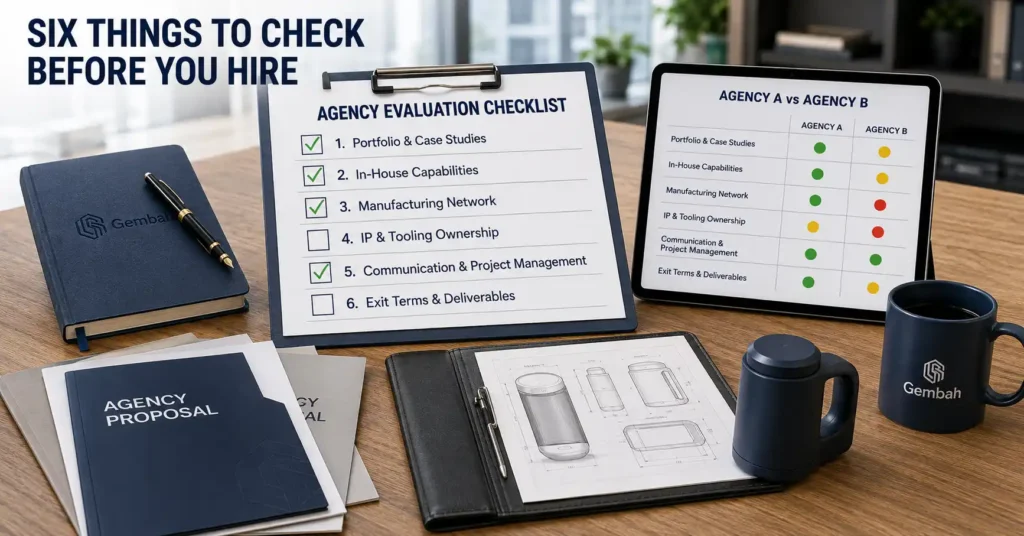
Founders ask some version of “how do I tell whether my agency is doing good work” constantly, and the honest answer is that you can’t judge it by whether the renders look good. Renders always look good. What predicts whether the thing survives contact with a factory is something else, and none of it requires you to read a CAD file. At Gembah, design, engineering, and sourcing sit inside one project, which is why these six questions are answerable in the first place. Here they are, along with what a good answer sounds like.
Also Read
- Design for Manufacturing (DFM): What It Is and Why It Matters
- Questions to Ask a Manufacturing Partner
- Product Development Company vs. Sourcing Agent
In Plain English
You can’t evaluate a product development agency by its portfolio, because visual polish is the cheapest part of the job. Six things actually predict whether your product gets built at your price. Are they talking about manufacturing while the design is still open? Can they name what’s de-risked and what still needs a factory to confirm? Do they push back on you? Do they raise geography and IP early instead of at the end? Do you get a real prototype before committing to a run? And are there written approval gates with a clean way out? The ones doing good work welcome all six questions. The ones who flinch are telling you something.
1. They Talk About Manufacturing Before the Design Is Finished
This is the big one. If a partner treats “design” and “how it gets made” as two phases that happen in order, that’s your warning sign.
By the time a design is genuinely finished, most of your unit cost is already committed. The part count, the materials, how it snaps together, the tolerances: those are set during design, and a factory brought in afterward can trim a few percent rather than fix the economics.
You’ll hear the difference without having to ask. Someone who knows what they’re doing mentions wall thickness, draft angles, and assembly steps unprompted and early, back when changing things is still free. Someone who doesn’t will talk about the product’s look for six weeks and then hand it to a factory to sort out.
The quiet risk here is specialization. Plenty of talented industrial designers have never watched a product get made, and it doesn’t show up in the renders. It shows up in the quote.
Wondering whether your current design is manufacturable? A design-for-manufacturing review costs a fraction of a tooling change. Talk to a Gembah expert.
2. They Can Name What’s De-Risked and What Still Needs a Factory
Ask a partner what they’ve de-risked and what still needs a real manufacturer to confirm. That single question sorts people fast.
A partner who’s building something manufacturable answers cleanly: here’s what we’re confident about, and here’s the part we’re guessing on until a factory weighs in. A partner who’s making it pretty waves it off, or offers a vague reassurance that it’ll be fine. The good ones know exactly where their own uncertainty lives, and they’ll point at it without being pushed.
If you can’t read the files, three follow-ups still work. Is there a drawing, or only CAD? What are the tolerances, and who decided them? What process and material is this designed for?
You may not fully follow the answers, and that’s fine. You’ll notice whether you get one. A shrug is information. So is a partner who explains a tech pack without being asked what one is.
3. They Push Back on You
The best partners tell you when your idea will cause a problem downstream.
If everything you ask for gets a yes, one of two things is true. Either they aren’t the ones who’ll actually build it, or they aren’t paying attention. Both cost you later, and both feel great in the meantime.
Listen for the trade rather than the refusal. “We can do that, but it’ll double your tooling cost, and here’s a cheaper way to get the same result” is worth far more than a nod. Pushback early is a conversation. Pushback late is a redesign, and the feature that has to come out at the quoting stage is almost always the one somebody should have questioned at sketch stage.
Watch how they handle being told no, too. A partner who can absorb your pushback is usually one who’s willing to give it.
Want a partner who’ll tell you what your design will cost before you commit to it? Get a Gembah sourcing quote.
4. They Raise Geography and IP Early, and Treat Them as One Question
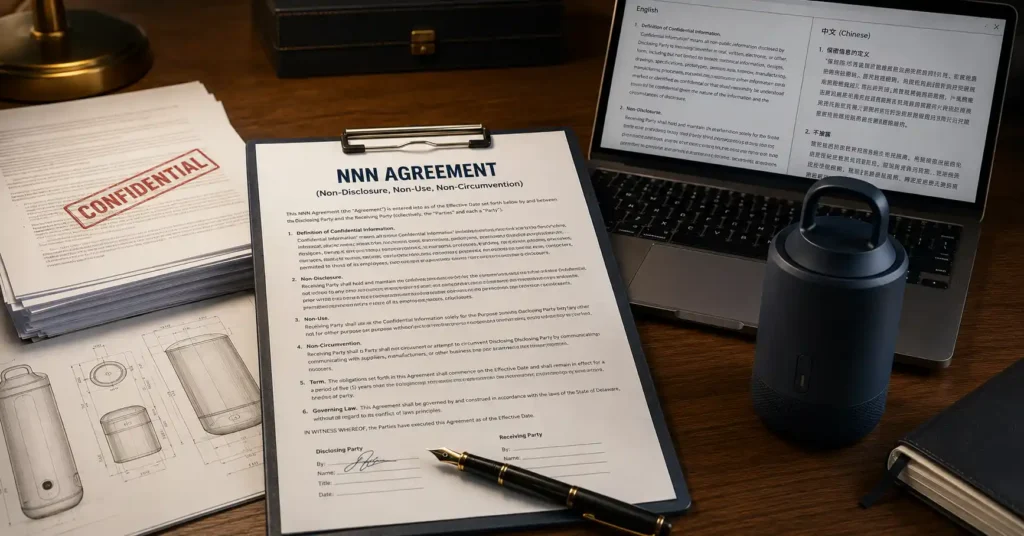
Where your product gets made drives unit cost, tooling, lead time, and IP exposure all at once, and it’s hard to unwind after the design is locked. It belongs in the first conversations, not the last.
A lot of first-time founders open by saying they’d rather keep production close to home. Sometimes that’s about jobs or tariffs. Often, when you dig into it, it’s about intellectual property: the fear that an overseas factory copies the product and sells it out the back door.
That fear is real, and it deserves a real answer. But the variable that actually moves it isn’t the country. It’s who you’re working with. A lowest-bidder factory found on a marketplace is a completely different risk profile from a vetted factory you have a relationship with and an enforceable agreement against, and that difference dwarfs geography.
The instrument that does the work overseas is an NNN agreement, not a US-style NDA. NNN stands for non-disclosure, non-use, and non-circumvention, and to be worth anything it needs to be drafted in Chinese, governed by Chinese law, and enforceable in the factory’s own local court. It also has to name the factory’s correct registered Chinese entity, since an agreement against the wrong legal name is an agreement against nobody.
Firms that practice in this area, including Harris Sliwoski, are consistent that a foreign arbitration clause worries a Chinese counterparty far less than a local one does. It’s worth noting that “NNN” is an industry coinage rather than a category in Chinese statute, so treat it as recommended practice built on contract law, not as a magic phrase.
The point isn’t that overseas is automatically right. It’s that “where do I build this” and “how do I protect it” are the same early conversation, and a good partner walks you through the real tradeoffs instead of defaulting you somewhere and waving off the risk. Ours run that conversation against a named network: China, India, Mexico, and Vietnam, with in-country teams who audit the buildings in person.
That conversation should also cover what the country does to your landed cost, which means your classification in the Harmonized Tariff Schedule and the current state of trade policy. The USMCA, for instance, was not renewed in its current form at the joint review on 1 July 2026 and now operates under annual review, so a duty assumption from last year isn’t safe to carry forward.
On the filing side, a provisional application is the cheap first move while you decide. The USPTO fee schedule puts it at $325 for a large entity, $130 for a small entity, and $65 for a micro entity, and it holds a priority date for twelve months.
5. They Put a Real Prototype in Your Hands
There are two versions of how this goes, and the difference matters.
In the first, a partner designs in isolation, hands you a 3D-printed model of the outside, and calls it your prototype. A factory gets involved afterward and says the design needs to change anyway. In the second, the people who’ll actually manufacture the product are involved during design, so your prototype comes out closer to the real production process instead of a one-off print.
Either way, one rule holds. A render tells you what the product looks like. A prototype you can physically handle tells you what’s wrong with it, and there’s always something wrong with the first one.
The two most common surprises are worth naming, because founders describe them almost word for word. It feels cheap in the hand when the render looked solid. Or it assembles fine once by hand and won’t assemble a thousand times on a line.
Ready to see a sample instead of a render? Talk to the Gembah team about your product.
6. They Give You Approval Gates and a Way Out
Projects go wrong in a recognizable pattern. There was never a defined point to inspect the work and no clean way out once things started drifting, so the cost kept climbing while nobody had a natural place to say wait.
So ask two things, separate from how you’re billed. At each stage, what do I sign off on before we move forward? You want approved CAD, then a prototype or first sample that meets criteria you put in writing, before anyone commits to a production run.
And what happens if this isn’t working out? Can you pause, get a refund, and walk away owning what’s been done so far? A partner who’s confident in their work has clean answers to all three.
While you’re there, insist on one approved revision for production. Keep a single approved file set, a short list of critical dimensions, and a dated reference sample. Any later change becomes a new revision rather than an informal message, because a sample built from one version, a quote written against another, and a factory told “final” is a genuinely expensive way to lose a season.
Vagueness about gates and exits is the real warning sign. That’s the setup where a prototype turns into a production order before anyone has confirmed the product is right.
Signs You Picked the Wrong Partner
You usually find out at the quote. Here’s what it looks like earlier.
- Everything you propose gets a yes. Nobody tells you what your design will cost or offers a cheaper way to get the same result.
- You’ve seen renders but no drawing. No tolerances, no named material, no manufacturing process on paper.
- Manufacturing is described as a later phase. The factory is something that happens after the design is done, not during.
- Country hasn’t come up. Nobody has asked where you plan to build, or told you what that decision does to your unit cost.
- IP got a one-line answer. You were told an NDA covers you overseas, with no mention of an NNN, Chinese law, or the factory’s registered entity.
- Your prototype is a 3D print of the outside. It proves proportions and nothing about how the product gets built.
- Nobody can tell you what happens if you stop. No written approval gates, no exit, no clarity on who owns the work so far.
Any one of these is a conversation. Three or more is a pattern.
How We Answer These Six Ourselves
It’d be strange to publish this list without answering it, so here’s where Gembah lands on each.
Manufacturing enters at design, not after it, because sourcing and engineering are in the same project rather than handed between vendors. On de-risking, the Product Development Journey framework exists to say out loud which path a product is on and what that path still has to prove, so the confident parts and the open parts are named before drawing starts.
Pushback is the part clients notice most. Telling a founder that a feature doubles their tooling cost is a worse sales conversation and a much better project.
On geography and IP, we run that conversation early against a named network, China, India, Mexico, and Vietnam, and we’ll tell you which of those actually fits your category rather than defaulting you to the cheapest quote. On prototypes, sampling and tooling are a managed stage with a golden sample and pre-production inspection built in. On gates, each stage carries a deliverable you approve, from CAD and engineering documentation through that first sample.
FAQs
What’s the difference between a product development agency and a sourcing agent?
A sourcing agent finds you a factory and negotiates the buy. A product development agency does that plus the work that comes before it: industrial design, engineering, design for manufacturing, prototyping, and tooling management. If your product already exists and you need someone to make it, a sourcing agent may be enough. If it doesn’t exist yet, or exists only as sketches or a rough CAD file, you need the design and engineering work a development agency handles.
How much does a product development agency cost?
Cost depends more on the path your product is on than the agency’s rate card. White-label projects run the lowest because there’s no engineering. A Direct to Manufacturing project, where a proven architecture gets modified, sits in the middle. A blank-slate invention runs highest because it carries new industrial design, new engineering, and new tooling with no existing product to lean on. Agencies quote against scope, so a partner who prices your bill of materials while the schematic is still open is worth more than one who prices it after.
Who owns the tooling and IP when a product development agency builds a product for me?
Whoever the contract says, which is why settling both in writing before you fund tooling matters more than the fee itself. A mold you paid for but don’t own sets the price of your next production run, because moving to a different factory means paying to cut steel again. On IP, the working question overseas isn’t who holds the US patent; it’s whether you have an enforceable agreement against the factory’s registered legal entity in its own local court.
How do I protect my design when working with an overseas factory?
The instrument that does the work overseas is an NNN agreement, not a US-style NDA. NNN stands for non-disclosure, non-use, and non-circumvention, and to be worth anything, it needs to be drafted in Chinese, governed by Chinese law, and enforceable in the factory’s local court. It also has to name the factory’s correct registered Chinese entity, since an agreement against the wrong legal name is an agreement against nobody. The variable that moves your IP risk isn’t which country you build in; it’s whether you’re working with a vetted factory under an enforceable agreement or a lowest bidder off a marketplace.
Should I hire a product development agency or a freelance industrial designer?
The right answer depends on how much of the path to production you need covered. A freelance industrial designer can produce a beautiful concept and CAD file, but the question that determines whether your product survives contact with a factory is whether the designer is thinking about how it gets made. A designer who’s never watched a product get manufactured can hand you a file a factory will still redesign. An agency that keeps design, engineering, and sourcing inside one project catches manufacturability problems while changes are still free, back before the mold is cut.
What happens if I want to leave my product development agency mid-project?
Ask that question before you sign, not after things start drifting. A partner who’s confident in their work has a clean answer to three questions: at each stage, what do I sign off on before we move forward? What happens if I want to pause or stop? Do I own the work that’s been done so far? Vagueness on any of the three is a real warning sign, because that’s how a prototype turns into a production order before anyone has confirmed the product is right.
Conclusion
None of this requires you to be technical. It’s mostly about whether your partner is thinking about the whole path to a finished product or only the part directly in front of them.
The ones who are will welcome every one of these questions, because answering them is just describing how they already work. The ones who flinch are telling you something, and it’s far better to hear it now than at the quoting stage, when your options have narrowed to expensive ones.
Gembah has taken more than 1,000 customers from idea through production, with a network of over 600 designers and factory teams on the ground in the countries where the work actually happens. If you’re mid-project and trying to read the tea leaves, that’s a conversation worth having.
Want a partner who’ll answer all six before you sign anything? We’ll walk your product through the same questions. Get a quote from Gembah.