A forty-foot container from China to the US West Coast runs roughly $7,500 right now, according to the Freightos Baltic Index. That figure shouldn’t be a surprise in month nine of a hardware program, and yet it routinely is.
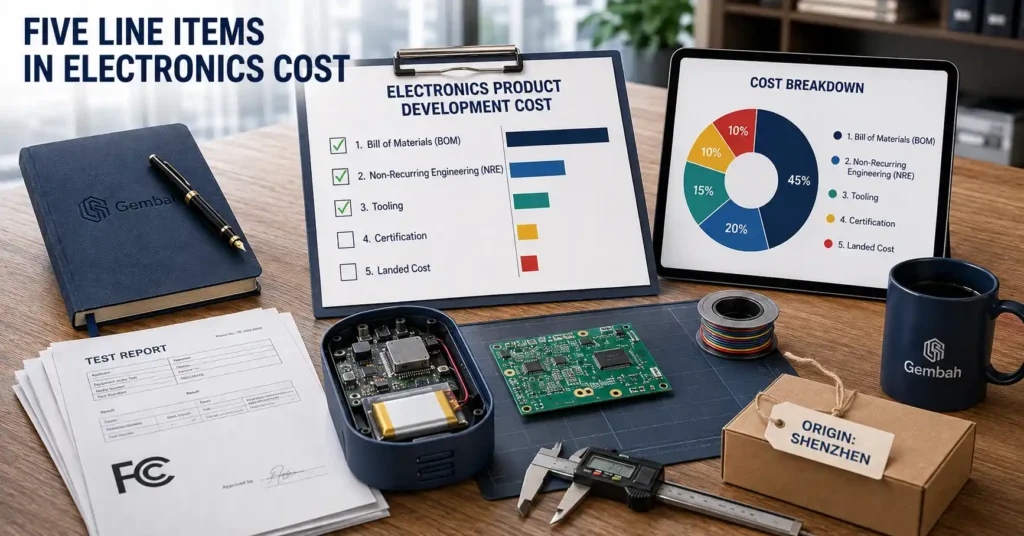
Electronics product development cost isn’t one number, which is why single-number budgets fail. It’s five numbers that behave differently: your bill of materials, your non-recurring engineering, your tooling, your certification, and your landed cost. One of them scales with every unit you build. You pay for three of them once and can’t unpay. One of them is a moving target set by trade policy that changed four separate times in 2026.
This is a breakdown by cost category rather than by project phase. If you want the phase-by-phase view, our guide to product development costs covers the timeline version, and this post picks up where it stops, with the line items an electronic product adds. At Gembah, we build connected products across consumer electronics, smart home, and wearables, so these are the five conversations we have most.
Also Read
- Product Development Cost Breakdown: How to Budget Wisely
- Prototype Engineering: From Concept to Working Model
- AI’s Role in Electronics Manufacturing
The Numbers in One Minute
Your electronics product development cost splits into five line items that behave nothing alike. The bill of materials is the only one that repeats on every unit, so a dollar there is worth a hundred dollars anywhere else at volume. Non-recurring engineering, tooling, and certification are one-time costs, but they’re one-time in the sense that a tattoo is one-time: changing them later means paying again from scratch. Landed cost, meaning freight plus duty plus fees, is the one nobody models early, and the one trade policy keeps moving. And your first-year volume assumption decides whether any of the other four make sense.
|
Cost |
Repeats per unit? |
What moves it most |
|---|---|---|
|
Bill of materials |
Yes |
Part count, component selection, order quantity |
|
Non-recurring engineering |
No |
Complexity, how many revisions you cause |
|
Tooling |
No, until you change the design |
Number of molded parts, cavity count, tolerances |
|
Certification |
Mostly no, plus recurring follow-up |
Whether it radiates, whether it’s powered, export markets |
|
Landed cost |
Yes |
Country of origin, classification, freight lane |
Trying to build a realistic budget before you commit? We’ll model the full stack with you. Talk to a Gembah expert.
Bill of Materials: The Only Number That Multiplies
Your BOM is every component in the product: the microcontroller, the passives, the PCB itself, the connectors, the enclosure, the fasteners, the cable, the packaging. It’s the one line item that repeats on every unit you’ll ever build, which is why engineering time spent here pays back harder than anywhere else.
Three things move it more than anything else.
Part count is the quiet multiplier. Every component carries a piece price, a placement cost, a sourcing risk, and a failure mode. Consolidating two parts into one doesn’t just save the price difference; it removes a placement, a line item, and something that can go out of stock.
Component selection is where over-specification hides. Engineers reach for the part they know, and the part they know is often a tier above what the product needs. A microcontroller with twice the flash you’ll use, a connector rated for ten times your mating cycles, a sensor with precision nobody will notice: each is defensible on its own and expensive in aggregate.
Order quantity changes the price of everything. Component pricing steps at quantity breaks, and the difference between the 1,000-unit and 10,000-unit price on a given part is routinely large enough to change your margin. This is where an honest volume forecast starts paying for itself.
The practical move is to get a real BOM cost early, before the design is finished, rather than treating it as a design output. A partner who can price your bill of materials while the schematic is still open is worth more than one who prices it after.
Non-Recurring Engineering: What You Pay Once, and Why It’s Never Once
NRE is the engineering work that happens once regardless of how many units you build. It covers schematic capture, PCB layout, firmware development, mechanical design, design for manufacturing, and test fixtures.
The reason NRE cost surprises people isn’t the initial estimate. It’s the revisions. Every board spin costs layout time, new fabrication, new assembly, and new bring-up, and most first-time hardware programs go through more spins than they planned. The spins usually trace back to the same causes: a requirement that arrived late, a component that went end-of-life mid-design, or a mechanical constraint nobody checked against the board outline.
Test fixtures deserve their own mention because they’re routinely forgotten. If your product needs to be programmed, calibrated, or functionally tested on the line, somebody has to design and build the thing that does it. That’s real engineering; it’s specific to your product, and it doesn’t exist until you pay for it.
The way to control NRE isn’t to negotiate the rate. It’s to reduce the number of times you have to redo the work, which means locking requirements before layout and getting manufacturing input while changes are still cheap.
Tooling: The Point of No Return
Tooling is usually the highest single one-time cost in a hardware program, and it’s what converts a design from changeable to expensive.
A production injection mold for a consumer enclosure is a machined steel tool. Its price scales with cavity count, part complexity, surface finish, and whether the geometry needs side actions or lifters to release. A device with a top housing, a bottom housing, a bezel, a button, and a light pipe needs a tool for each. That’s the arithmetic founders miss: they price “a mold” and then discover their product has six molded parts.
There’s a real decision here between bridge tooling and production tooling. A soft or aluminum bridge tool costs a fraction of a hardened steel one and produces a few thousand parts before it wears. It’s the right call when you’re validating demand and expect to change the design. It’s the wrong call when you already know your geometry and your volume, because you’ll pay twice.
Two rules save more money than any negotiation. Settle tooling ownership in writing before you fund the tool, because a mold you paid for but don’t own sets the price of your next run. And freeze one approved revision before you cut steel, since a sample built from one file version and a tool cut from another is an expensive way to learn about revision control.
Not sure whether you need bridge tooling or production tooling? It depends on volume and how settled the design is. Get a Gembah sourcing quote.
Certification: The Line Item Founders Forget
Certification is the cost most often missing from a first budget, and it’s the one most likely to move a launch date.
If it radiates, the FCC is involved. Any product with Wi-Fi, Bluetooth, or another radio is an intentional radiator. The FCC’s equipment authorization rules require such a device to be “properly authorized under Part 2 of its rules prior to their marketing or importation in the United States.” In practice, that means testing at an accredited lab, an FCC Registration Number, a Grantee Code, and a grant from a Telecommunication Certification Body. Using a pre-certified radio module is the single biggest cost lever available, because it moves most of that burden onto a part somebody else already qualified.
If it’s powered, a safety listing is the gate to retail. A UL, ETL, or CSA mark is what big-box buyers and insurers look for. The cost covers the test program, an initial factory inspection, and recurring follow-up visits that continue for as long as you ship. That last part catches people, because it’s an ongoing cost sitting in a budget line labeled one-time.
If it’s leaving the country, multiply. CE marking for Europe, UKCA for Britain, and equivalent schemes elsewhere are separate programs against separate standards. Building to one market and expanding later usually costs more than designing for both at the start.
Labs don’t publish price lists, and quotes vary widely with product complexity, so the honest guidance is to get a scoping quote from a lab before design freeze rather than budgeting a placeholder. What you can plan on is the calendar: sample submission, testing, remediation, and retest is a multi-month sequence, and it belongs on the schedule before tooling rather than after.
Landed Cost: Freight, Duty, and a Moving Target
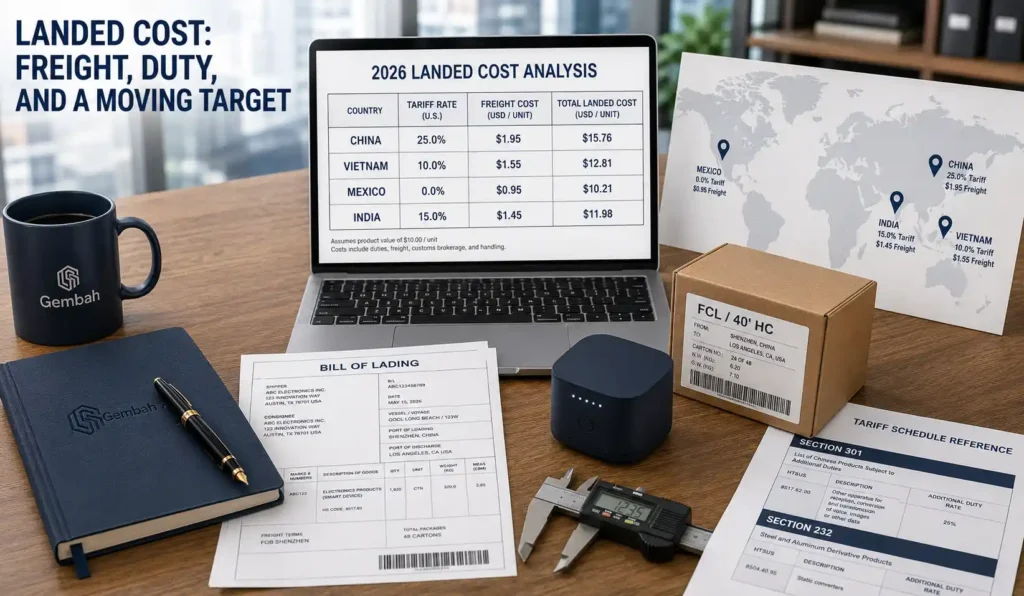
Landed cost is unit price plus freight plus duty plus fees, and it’s the number your margin depends on. It’s also the one that moved most in 2026.
Freight you can look up, but you have to look. The Freightos Baltic Index tracks live container rates by lane, and the China to North America West Coast rate (FBX01) has swung between roughly $2,100 and $7,000 per forty-foot container over the past year, driven by peak-season demand and Middle East shipping disruption. Pull the current lane rate the week you commit rather than a figure from last quarter, divide it across the units in the container, and you get a real per-unit number, usually smaller than founders fear and larger than they modeled.
Duty is harder, because it stacks. As of 24 July 2026, Section 301 forced-labor duties apply across 60 economies: 10% for a named list that includes India and Mexico, and 12.5% for the rest, China included. For China, that sits on top of existing Section 301 List 1 through 4a exposure rather than replacing it.
One item is easy to misread. Under USTR’s Section 301 semiconductor action effective 23 December 2025, the additional Section 301 duty on Chinese semiconductors was set at zero percent. That zero rate sits on top of the existing 50% Section 301 tariff carried over from the 2018 forced-technology-transfer action, not in place of it. It also covers 18 HTSUS subheadings across Chapters 28, 38, and 85, reaching beyond the 8541 and 8542 semiconductor headings alone. The additional duty is scheduled to increase on 23 June 2027 at a rate to be announced at least 30 days beforehand. If your BOM leans on chips from China, model the 50% base rate now, and treat the current relief as a window with a known closing date rather than duty-free sourcing.
Two more items belong in the model. Steel and aluminum content brings Section 232 into play at 50% for covered articles under Proclamation 11021, and since April 2026 that duty applies to the full customs value rather than the metal content alone. The overall picture is still unsettled: the Tax Foundation projects an average effective tariff rate around 6.6% for 2026, the highest since 1969.
Duty is a research task with a date attached, and any figure in your model needs re-checking before you commit to a country. Our global sourcing work starts there rather than with a unit price.
The One Number That Decides Everything
If you take one thing from this, take the question that sits underneath all five line items: what is your realistic first-year volume?
Not your ambitious number, and not the number you put in a deck. The number you’d bet your own money on. That single figure decides whether hardened steel tooling is prudent or wasteful, and whether your BOM lands on the 1,000-unit price break or the 10,000-unit one. It also decides whether a custom radio is worth its certification cost against a pre-certified module, and whether a container of inventory is a supply chain or a warehouse full of your cash.
Founders who inflate that number to make the unit economics look better don’t get better unit economics. They get tooling sized for a business they don’t have yet, a BOM quoted at a break they’ll never hit, and an inventory position that eats the runway they needed to find customers. The number that makes your spreadsheet look best is rarely the number that makes your program survivable.
Pick the honest figure, size everything to it, and build in the option to scale up. Tooling can be added. Cash that’s already in a mold cannot.
Where Gembah Fits in the Cost Stack
We don’t touch every line above equally, so here’s an honest map of where a partner like ours actually changes the number.
On BOM, the work is design-side: consolidating parts, catching over-specification, and pricing the bill while the schematic is still open rather than after it’s frozen. On NRE, it’s about reducing revisions rather than the rate, which happens when sourcing and engineering sit in the same project and manufacturing input arrives during design.
On tooling, we manage sampling and tooling as a stage with sign-offs, including golden samples and pre-production inspection, so the tool gets cut against a revision everyone has agreed to. On certification, we treat it as a design input, choosing pre-certified modules where they fit and building the test schedule backward from the lab.
On landed cost, our factory network spans China, India, Mexico, and Vietnam, with in-country teams who visit the buildings. Hence, a country recommendation comes with a real duty and freight picture attached rather than a unit price in isolation.
And because a connected product is hardware plus software, we manage firmware, app, and cloud development alongside the physical product. That matters to this list specifically, because when different vendors budget firmware and hardware, the integration work tends to land in neither estimate.
FAQs
How much does it cost to develop an electronic product?
Electronics product development cost splits into five line items that behave differently: bill of materials, non-recurring engineering, tooling, certification, and landed cost. The BOM is the only one that repeats on every unit, so a dollar saved there is worth a hundred dollars anywhere else at volume. NRE, tooling, and certification are one-time costs in the sense that a tattoo is one-time; changing them later means paying again from scratch. There’s no single dollar figure because the range depends on whether your product radiates, whether it’s powered, how many molded parts it has, and your first-year volume estimate.
What is NRE (non-recurring engineering) in electronics manufacturing?
NRE is the engineering work that happens once regardless of how many units you build. It covers schematic capture, PCB layout, firmware development, mechanical design, design for manufacturing, and test fixtures. The reason NRE surprises founders isn’t the initial estimate; it’s the revisions. Every board spin costs layout time, new fabrication, new assembly, and new bring-up, and most first-time hardware programs go through more spins than they planned. The way to control NRE isn’t to negotiate the rate; it’s to reduce how many times you have to redo the work.
How much does injection mold tooling cost for a consumer electronics enclosure?
Tooling cost scales with cavity count, part complexity, surface finish, and whether the geometry needs side actions or lifters to release. The arithmetic founders miss is that a single device with a top housing, bottom housing, bezel, button, and light pipe needs a tool for each, so pricing “a mold” isn’t the right question. There’s also a real decision between bridge tooling and production tooling. A soft or aluminum bridge tool costs a fraction of a hardened steel one and produces a few thousand parts before it wears; it’s the right call when you’re validating demand and expect to change the design, and the wrong call when you already know your geometry and your volume, because you’ll pay twice.
Do I need FCC certification for a Bluetooth or Wi-Fi product?
Yes. Any product with Wi-Fi, Bluetooth, or another radio is an intentional radiator, and FCC rules require it to be authorized under Part 2 before it can be marketed or imported in the United States. In practice, that means testing at an accredited lab, an FCC Registration Number, a Grantee Code, and a grant from a Telecommunication Certification Body. Using a pre-certified radio module is the single biggest cost lever available, because it moves most of that burden onto a part somebody else already qualified.
What are the current US tariffs on electronics imported from China?
Duty stacks, and any figure needs re-checking before you commit. Section 301 forced-labor duties effective 24 July 2026 apply 12.5% to China on top of existing Section 301 List 1 through 4a exposure. Chinese semiconductors carry the existing 50% Section 301 tariff from the 2018 forced-technology-transfer action; a separate additional Section 301 duty under the December 2025 semiconductor action is currently set at zero percent but scheduled to increase on 23 June 2027. Steel and aluminum content brings Section 232 into play at 50% under Proclamation 11021, applied to the full customs value rather than the metal content alone. The Tax Foundation projects an average effective tariff rate around 6.6% for 2026, the highest since 1969.
Is it cheaper to manufacture electronics in Vietnam or Mexico instead of China?
Sometimes, but headline unit price isn’t the number to compare. China still carries the deepest supplier base for most electronics categories, which matters when your product has many components and needs real tooling capability. Vietnam has become a working assembly alternative, though category depth varies and component sourcing sometimes routes back through China. Mexico is the nearshoring answer when lead time and factory access outweigh unit price, with shorter transit and visits you can realistically make. What determines whether a country move saves money is the landed-cost picture: unit price plus freight plus duty plus fees, checked against your specific classification in the Harmonized Tariff Schedule the week you commit.
Conclusion
Electronics product development cost defeats people because they budget it as one number and then get surprised five separate times. Break it into five, understand what moves each one, and most of the surprises turn into decisions you can make on purpose.
The founders who get through this aren’t the ones with the biggest budgets. They’re the ones who priced the BOM before freezing the design and sized their tooling to a volume they actually believed. They also put certification on the calendar before the mold shop, and re-checked their duty rate the week they committed rather than the quarter before.
Gembah has taken more than 1,000 customers through that math, with a network of over 600 designers and factory teams on the ground in the countries where the work actually happens. Getting the cost stack right early is the cheapest thing you’ll do all program.
Ready to put real numbers on your program? We’ll walk the BOM, tooling, certification, and landed cost with you before you commit to any of them. Get a quote from Gembah.