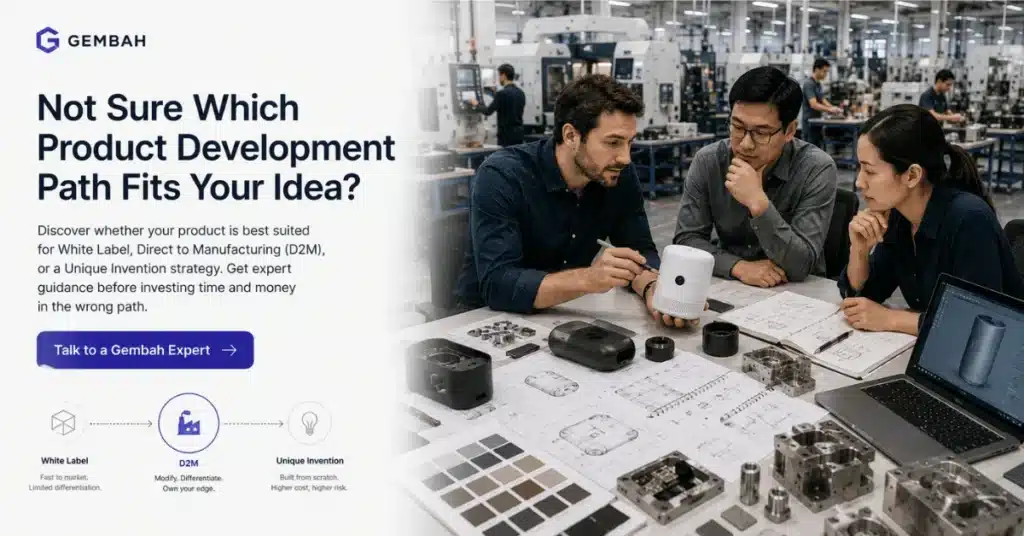
Most founders get handed a false choice. Launch fast with a white-label product that any competitor can order from the same factory, or sink a year and six figures into inventing something from a blank page. Direct to Manufacturing, or D2M, is the path that sits between those two, and it is worth knowing about before you assume those are your only options.
One thing to clear up first: D2M is not a standard industry term. It is a methodology Gembah developed and named, so you will not find it in a textbook. The idea behind it is straightforward, and a little counterintuitive. Instead of designing a product in a vacuum and then hunting for a factory that can build it, D2M starts with a product the factory already makes well, then customizes that existing product into something distinctly yours.
This guide covers what direct manufacturing actually is, why Gembah coined the term, how the process runs, how it compares to white label and to inventing from scratch, and when it is the right call.
Also Read:
- How to Manufacture a Product
- China Manufacturing Challenges
- Contract Manufacturing
- Product Manufacturing at Gembah
D2M in Plain English
Direct to Manufacturing (D2M) is a proprietary Gembah methodology, not a common industry phrase. It takes a product a factory already manufactures and uses factory-led engineering to modify that existing design, including its structures, components, and tooling, into a differentiated product of your own. Because you build on proven tooling and engineering instead of a blank slate, both development cost and the risk of problems at scale drop sharply. Gembah puts a D2M build at under half the cost and time of a fully original one. It sits between white or private label, where you put your brand on an unchanged product, and a unique invention, where you create an original product from scratch. If your idea is genuinely original and cannot build on any existing product, that is a unique invention journey, not D2M.
What D2M Actually Is, and Why It’s a Gembah Term
D2M stands for Direct to Manufacturing. It is a methodology Gembah’s president, Henrik Johanson, developed to give founders a real option between two extremes. It is not an industry-standard practice you can shop for at any agency, which is exactly why the term needs explaining rather than assuming.
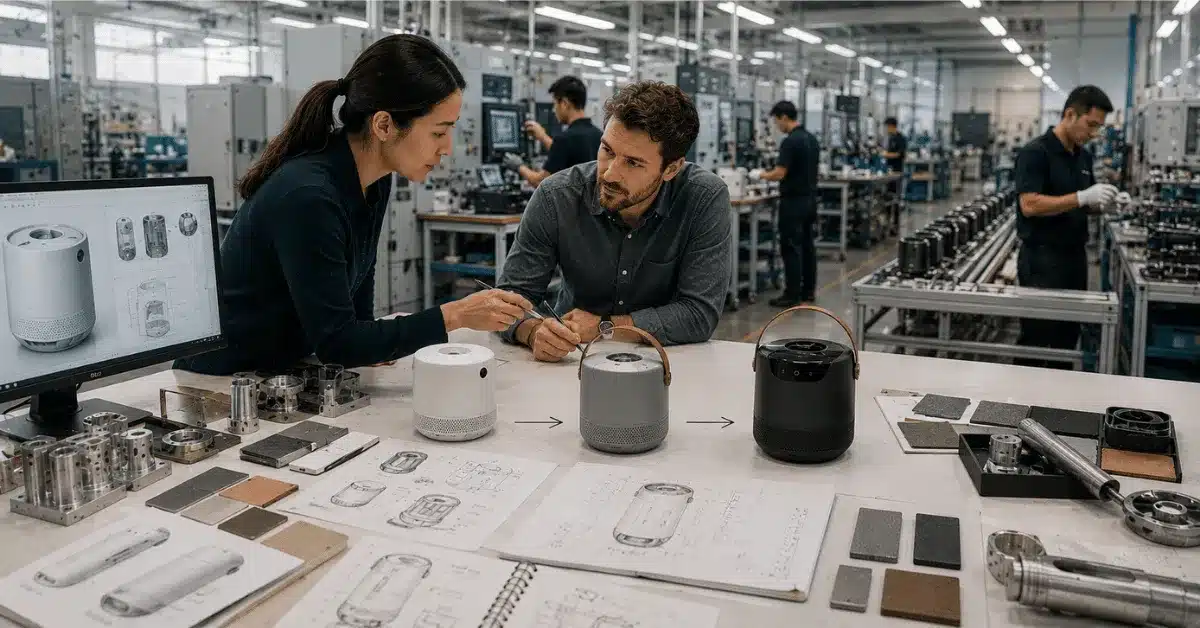
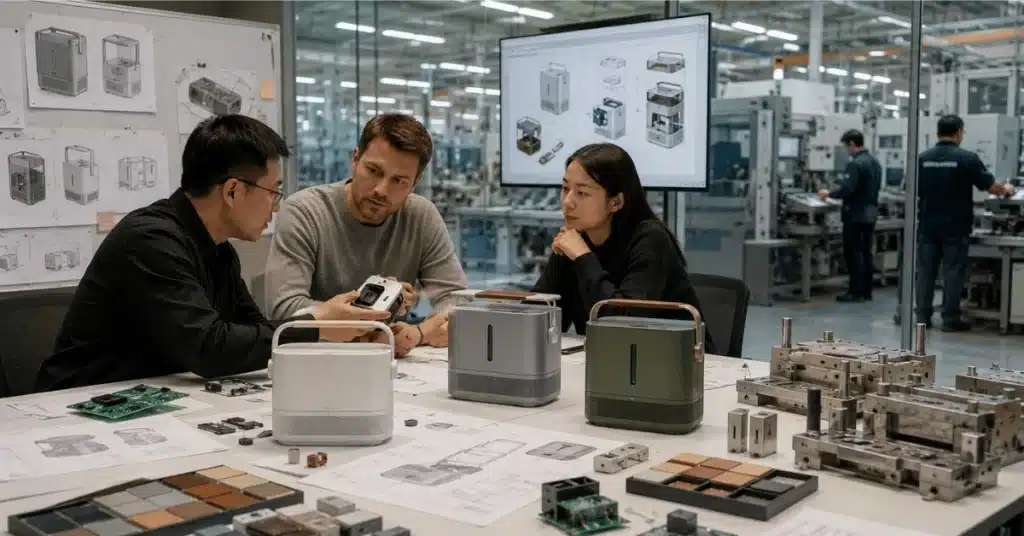
The core mechanism is what Gembah calls factory-led engineering. Rather than designing first and finding a factory second, D2M begins with the factory’s existing capabilities. Gembah’s factory network keeps catalogs of existing product architectures, the physical structures, component libraries, and tooling assets that factories already own and run reliably. D2M applies targeted, data-driven design changes on top of one of those existing architectures to create differentiation where buyers actually value it. You are customizing a real, existing product, not commissioning a new one.
That is what separates D2M from white and private label. White label puts your brand on a product that does not change at all, and private label allows only minor tweaks. D2M changes the product itself, enough to be genuinely differentiated from anything a competitor can pull off the same shelf, and in some cases enough to be patentable. It is also not a unique invention. The moment an idea cannot build on any existing product or architecture, it stops being a D2M project and becomes a unique invention journey instead.
How D2M Works, Step by Step
D2M follows a recognizable sequence, and each step is built to keep cost and risk down by leaning on what the factory already does well.
- Start from the factory’s catalog. Identify an existing product architecture the factory already manufactures reliably, the structures, components, and tooling it runs every day.
- Pin down the differentiation that matters. Use market and consumer data to find the specific features buyers will actually pay a premium for, so design effort goes where it counts.
- Apply factory-led engineering. The factory’s engineers modify that existing architecture to add those features, rather than designing a new product from nothing.
- Sample in fewer rounds. Because you are adapting proven tooling instead of cutting new molds, sampling is shorter and surprises are rarer.
- Manage production and quality control. In-process and final inspection happen on the floor, under one accountable team.
- Scale and reorder. A standing relationship with a factory that already knows the product makes reorders and improvements straightforward.
The reason this lowers risk is structural. Decisions made during early design lock in roughly 70 to 80 percent of a product’s eventual cost, so starting from a design and tooling that already work, instead of a blank slate, removes most of the expensive unknowns before they happen. It also front-loads manufacturability, which matters because product launches fail far more often than founders expect. The Harvard Business Review has tied the biggest cause of launch failure to a lack of preparation rather than a weak idea, and D2M makes the factory’s input a starting point rather than an afterthought. Gembah reports the practical result as a defect risk more than 50 percent lower than a comparable from-scratch build.
Curious whether your product could be a D2M build? Tell us what you have in mind and we will tell you straight which journey fits. Talk to a Gembah expert .
Where D2M Sits: White Label vs D2M vs Unique Invention
D2M only makes sense next to the two options it sits between. Here is how the three development paths compare.
| Dimension | White / Private Label | D2M (Direct to Manufacturing) | Unique Invention |
| Starting point | An existing product, unchanged | An existing factory product architecture | A blank-slate, original design |
| What changes | Branding and packaging only | The product itself, via factory-led modification | Everything, built from nothing |
| Development cost and time | Lowest; weeks to market | Moderate; roughly half a unique build | Highest; often $80k to $150k over 12 to 24 months |
| Risk at scale | Low | Low, because tooling and engineering are proven | Higher, because the tooling and design are new |
| Differentiation and IP | None; anyone can buy the same product | Real, and sometimes patentable | Maximum; built for patents and category ownership |
| Best for | Testing a market fast | Differentiation without the full build | Owning a category with something new |
White label wins on pure speed and cost, but gives you nothing a competitor cannot copy. Unique invention gives you the most defensible product, at the highest cost, time, and risk. D2M is the middle path: real differentiation, on a timeline and budget most brands can actually carry.
Where D2M Fits in Gembah’s PDJ Framework
D2M is one piece of a larger map. Gembah’s Product Development Journey framework lays out five journeys in total, three for creating a product (White Label, D2M, and Unique Invention) and two for scaling one (First Production and Second Source). D2M is Journey 2, and Gembah treats it as its core differentiator because it is the option most founders have never heard of and the one many of them actually need.
Bella & Co. is D2M done well. The brand used Gembah’s factory-led model to turn a home-preservation problem into a patented, eco-friendly pet product. By modifying existing factory tooling and component libraries rather than starting from a blank slate, Bella & Co. reached a unique, protectable design, including a patented 1.25-inch containment lip, without the six-figure cost of new injection molds, and got to market in roughly half the time a fully custom build usually takes. The full Bella & Co. case study walks through how factory-led engineering produced that differentiation at a fraction of the usual cost and timeline. For a wider view of how this middle path compares to the alternatives, our breakdown of white label versus custom product development is a useful companion read, and the PDJ framework shows where every journey fits.
Not sure whether your idea is a D2M fit or a unique invention? That is exactly the call Gembah helps founders make before spending a dollar. Map your journey with a Gembah expert.
When D2M Is the Right Path, and When It Isn’t
D2M is powerful, but it is not the answer for every product, and an honest partner will say so. It fits when there is an existing product or factory architecture you can build on, when you want differentiation that goes well beyond a logo, and when you want the lower cost, shorter timeline, and reduced risk that come from building on something proven. It is also a smart way to validate a differentiated concept before committing to a bet-the-company investment.
It is the wrong path in two clear cases. If your idea is genuinely original and there is no existing product to build on, you belong on the unique invention journey, where new tooling and a blank-slate design are the whole point, and where early IP protection through a provisional patent application matters from the first design review. And if all you need is your brand on an as-is product, that is white label, and paying for engineering you do not need would just slow you down.
Three Myths About Direct to Manufacturing
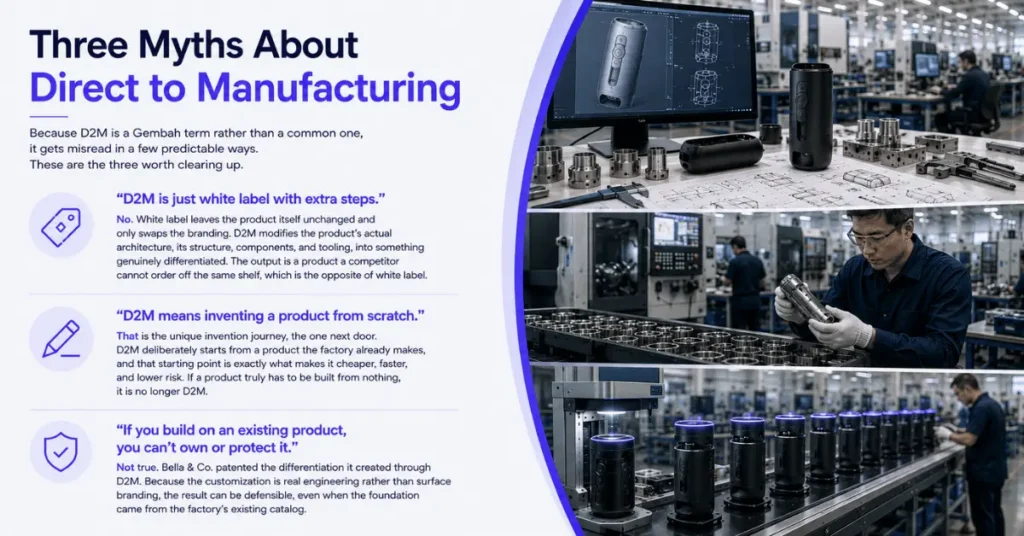
Because D2M is a Gembah term rather than a common one, it gets misread in a few predictable ways. These are the three worth clearing up.
“D2M is just white label with extra steps.”
No. White label leaves the product itself unchanged and only swaps the branding. D2M modifies the product’s actual architecture, its structure, components, and tooling, into something genuinely differentiated. The output is a product a competitor cannot order off the same shelf, which is the opposite of white label.
“D2M means inventing a product from scratch.”
That is the unique invention journey, the one next door. D2M deliberately starts from a product the factory already makes, and that starting point is exactly what makes it cheaper, faster, and lower risk. If a product truly has to be built from nothing, it is no longer D2M.
“If you build on an existing product, you can’t own or protect it.”
Not true. Bella & Co. patented the differentiation it created through D2M. Because the customization is real engineering rather than surface branding, the result can be defensible, even when the foundation came from the factory’s existing catalog.
Frequently Asked Questions
What does D2M mean, and is it an industry term?
D2M stands for Direct to Manufacturing. It is a proprietary methodology Gembah developed, not a standard industry phrase, which is why it needs a real explanation rather than an assumption. The short version: customize a product a factory already makes into something differentiated of your own.
How is D2M different from white label or private label?
White and private label keep the product essentially the same and change the branding, or allow only minor tweaks. D2M changes the product itself through factory-led engineering, producing differentiation a competitor cannot simply buy and rebrand.
How is D2M different from a unique invention?
Unique invention starts from a blank page and builds new tooling and an original design, for maximum defensibility at maximum cost and time. D2M starts from an existing factory product and customizes it, which is why Gembah puts it at under half the cost and time of a unique build.
Is D2M actually cheaper and lower risk?
Yes. Because it builds on proven tooling and engineering rather than a blank slate, Gembah reports a D2M build at under half the cost and time of a unique invention, with a defect risk more than 50 percent lower. The savings depend on the product, but the structure is built to reduce both cost and scale-up risk.
The Bottom Line on D2M
Direct to Manufacturing is Gembah’s third path: take a product a factory already builds well, and customize it into something genuinely yours, for far less cost, time, and risk than a from-scratch build, and far more differentiation than a white label. The whole point is to give founders an option between sameness and starting over.
The choice of journey is the decision that matters most before any money is spent. If your idea can build on an existing product, D2M is likely the path. If it truly cannot, it belongs on the unique invention journey. And if you only need a logo on a stock product, that is white label. Gembah built D2M to own that middle ground, and runs it inside the PDJ framework so founders pick the right path before committing a dollar. Even amid a volatile 2026, with the Tax Foundation tracking shifting US tariff rates and Deloitte’s 2026 Manufacturing Industry Outlook reporting steady reshoring momentum, building on proven manufacturing is one of the cleaner ways to keep cost and risk under control.
Ready to find out which journey fits your product? Talk to a Gembah expert and map your path from idea to production. Get started with Gembah.