
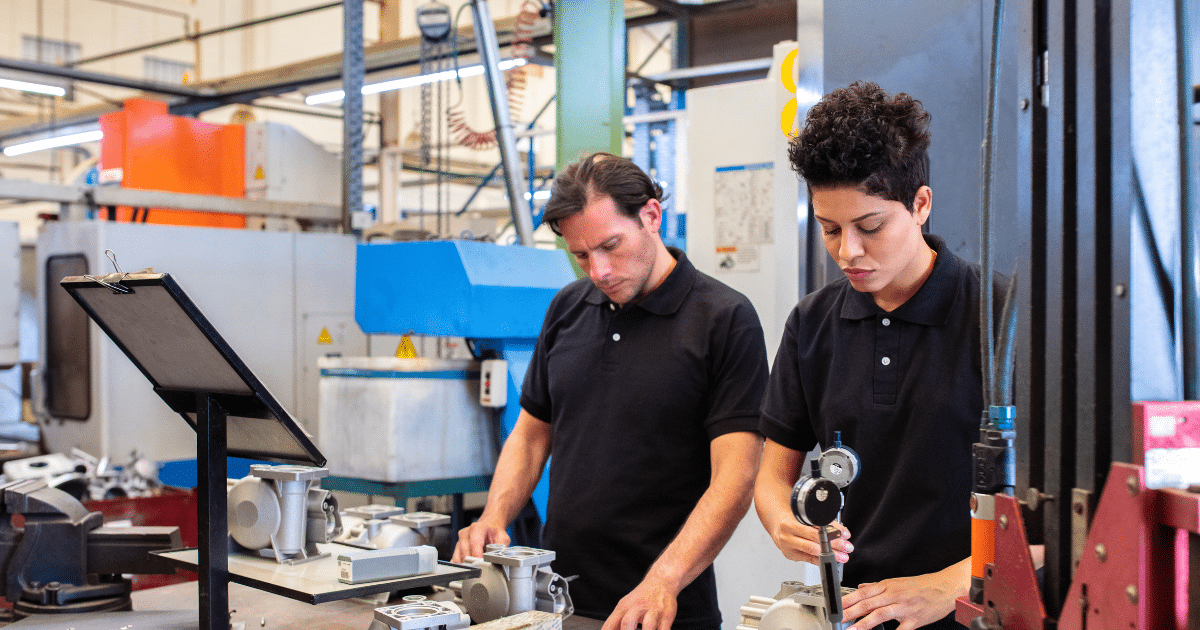
In 2026, knowing which products are still made in the U.S. – and when U.S. manufacturing actually makes sense – can be a competitive edge. Domestic manufacturing is not just about patriotism or nostalgia. It is about regulation, quality control, speed, intellectual property, tariff exposure, customer expectations, and strategic fit. But it is not always the smartest move.
Today’s best operators weigh U.S. production against rising global options like Vietnam, Mexico, India, and digitally enabled Chinese factories. The game is no longer “onshore vs. offshore” – it is who owns the decision-making process. Poor sourcing strategy does not just eat margin. It can delay launches, create compliance problems, and leave your product exposed to avoidable supply chain risk.
If you are a founder weighing “Made in USA” vs. global sourcing, this guide shows you how to make the right call by factoring in cost, compliance, quality, lead times, risk, and brand positioning. And if you are tired of guessing, Gembah helps you architect the right manufacturing strategy from the start.
-> Ready to align your product strategy with the right manufacturing model? Talk to Gembah.
TL;DR
U.S. manufacturing still matters, but only when it aligns with your product’s compliance needs, speed-to-market goals, security requirements, supply chain risk, or brand positioning. For many consumer goods, offshore or nearshore manufacturing in countries like Vietnam, Mexico, India, or China can offer better margin, deeper supplier ecosystems, and faster scale without sacrificing quality if the process is managed well. The smartest operators in 2026 do not choose domestic or overseas by default. They evaluate every product through a sourcing strategy lens. This article explains where U.S. production still leads, where global sourcing delivers better ROI, and how Gembah helps founders design hybrid supply chains that match their growth goals.
Key Points
- Not all manufacturing makes sense in the U.S: High-regulation, high-security sectors such as defense, aerospace, medical, critical infrastructure, and some advanced technology categories often benefit from or require domestic production. Most consumer products still need a cost and capability analysis.
- Labor costs are still a major constraint: U.S. manufacturing labor and overhead costs can make domestic production difficult for price-sensitive products, especially when the product requires manual assembly.
- Quality comes from systems, not geography: Overseas factories can outperform U.S. shops on quality if specs, audits, inspections, and communication are managed well. Transparent processes, not flags, drive consistency.
- Reshoring is real but selective: Some brands are bringing production home, but usually when it improves speed, compliance, resilience, or brand narrative – not because it automatically lowers cost.
- Made in USA is a regulated claim: The FTC expects unqualified “Made in USA” claims to mean all or virtually all of the product is made in the United States, including final assembly and significant processing.
- Premium brands use U.S. production as positioning: For luxury, artisan, custom, or DTC niches, domestic manufacturing can support storytelling and margin – if the customer will pay for it.
- Global sourcing is not about chasing the cheapest bid: It is about matching your product to the right region, supplier capability, compliance standard, logistics plan, and quality system.
- Diversification is the new advantage: Smart operators build hybrid sourcing models that balance domestic and international options based on risk, not guesswork.
- Gembah acts as a sourcing architect, not just a factory matchmaker: Our platform vets global suppliers, validates quality systems, and helps brands build flexible, scalable supply chains from day one.
Also Read:
- How to Evaluate if USA Manufacturing Is Right For You?
- Gembah Manufacturing Countries
- How to Manufacture a Product
Which Products Are Still Made in the U.S. in 2026?
High-Regulation, High-Security Industries
Certain sectors maintain a strong domestic manufacturing presence because of regulatory requirements, security concerns, intellectual property protection, and customer proximity. Defense, aerospace, critical infrastructure, semiconductors, some medical devices, and certain industrial technologies often have stronger reasons to manufacture domestically than basic consumer goods.
Federal procurement rules can also influence sourcing. The Buy American statute uses a two-part test for manufactured end products: the article must be manufactured in the United States, and the domestic component cost threshold is scheduled at 65% for items delivered in calendar years 2024 through 2028 and 75% starting in calendar year 2029, with exceptions and special rules. These rules matter most for businesses selling to government buyers or federally funded projects.
Medical device manufacturers may also gravitate toward domestic production when proximity to engineering teams, customers, regulatory reviewers, and healthcare systems enables faster iteration and compliance. When products require significant customization, such as specialized medical equipment or aerospace components, proximity to customers enables faster iteration and lower lead times.
Domestic Production Leaders
Domestic manufacturing strength varies by sector. Food and beverage processing, industrial machinery, aerospace, defense-related components, fabricated metals, medical devices, and some transportation equipment categories remain more likely to have meaningful U.S. production than labor-intensive consumer goods. The NIST Annual Report on the U.S. Manufacturing Economy provides a broad statistical review of U.S. manufacturing trends, competitiveness, and sector-level dynamics.
These sectors benefit from established domestic supply chains, specialized workforce expertise, customer proximity, regulatory frameworks, or high-value production that can better absorb U.S. costs. The automotive and aerospace sectors also show why the answer is rarely purely domestic or purely offshore: final assembly, engineering, components, tooling, software, and materials may come from different countries while the brand still manages quality and compliance through one coordinated sourcing strategy.
Niche DTC and Premium Goods
Direct-to-consumer brands and premium product manufacturers often leverage U.S. manufacturing as a brand differentiator. These brands understand that domestic production can enable tighter quality control, faster iteration, smaller batches, stronger storytelling, and more visible craftsmanship.
Artisanal goods, custom furniture, specialty kitchenware, luxury accessories, small-batch apparel, and premium home goods may justify higher production costs when customers value local production. But founders should not assume “Made in USA” automatically creates demand. The claim must match the product, customer, price point, and proof behind the supply chain.

The True Cost of Manufacturing in the U.S.
Labor Cost Reality Check
Domestic manufacturing faces substantial labor cost and overhead challenges that extend beyond base wages. U.S. facilities may offer stronger communication, shorter domestic freight lanes, and faster iteration, but labor, rent, insurance, compliance, energy, and equipment costs can make U.S. production difficult for price-sensitive consumer goods.
Recent U.S. labor data shows why cost planning matters. The Bureau of Labor Statistics reported that manufacturing unit labor costs rose in 2025, while manufacturing compensation also increased. For founders, the takeaway is not that U.S. manufacturing is impossible. It is that the product must carry enough value, price, automation potential, or strategic need to support the cost base.
When comparing U.S. and overseas production, do not compare factory quotes alone. Compare total landed cost, including freight, duties, tariffs, inspections, packaging, rework, inventory carrying cost, lead time, quality risk, working capital, and returns. A lower overseas unit price can still lose if the product is delayed, damaged, over-ordered, or poorly controlled.
Global Sourcing: The Strategic Reality
Evolution Beyond Simple Cost Arbitrage
International manufacturing still offers compelling advantages, but the best sourcing teams no longer treat overseas production as a race to the cheapest bid. Global sourcing now means choosing the right region for the product’s material needs, tooling requirements, compliance burden, supplier ecosystem, order volume, and risk profile.
China remains strong in deep supplier ecosystems, tooling, electronics, plastics, and high-volume production. Vietnam can be attractive for textiles, furniture, bags, consumer goods, and some electronics assembly. Mexico can work well for nearshoring, bulky products, North American customers, and faster replenishment. India continues gaining attention for textiles, engineering, consumer goods, and select manufacturing categories. The best answer depends on the product, not the country name.
Quality Through Process, Not Geography
Product quality depends more on manufacturing processes and oversight than geographic location. Many global factories have achieved world-class quality standards, while some domestic producers still struggle with capacity, documentation, or repeatability. Quality comes from clear specifications, material controls, trained operators, inspections, corrective action systems, and supplier accountability.
The key lies in establishing rigorous quality control systems and maintaining transparent communication with suppliers. Regular audits, clear specifications, golden samples, pre-shipment inspections, and well-defined expectations ensure consistent quality across borders, whether dealing with American manufacturers or international partners.
Strategic Diversification Imperative
Leading companies diversify their sourcing strategies, establishing hybrid models that optimize risk, cost, and resilience. Global sourcing, particularly from China, is becoming less cost-competitive in some categories due to wage inflation, stricter regulations, tariffs, and higher operational expenses, driving businesses to consider alternative locations like Vietnam and Mexico.
This diversification provides agility in responding to disruptions, tariff changes, supplier failures, regional conflict, port congestion, or shifting market demands. Companies increasingly view sourcing as a dynamic strategic function rather than a static cost decision, balancing domestic and international options based on product requirements and market conditions.
2026 Outlook for American Manufacturing
U.S. Manufacturing Is Becoming More Technology-Driven
American manufacturing is not simply returning to the past. It is becoming more automated, data-driven, and specialized. NIST says AI is transforming how manufacturers improve efficiency, quality, and competitiveness, from predictive maintenance to generative design. That matters because technology can help offset some U.S. cost disadvantages when the product or process is a good fit for automation.
Smaller manufacturers are also getting more access to automation, robotics, and expert support. The NIST Manufacturing Extension Partnership supports small and medium-sized U.S. manufacturers through a national network of experts, helping companies improve operations, reduce risk, and strengthen supply chains.
Reshoring Works Best When It Solves a Specific Problem
Reshoring is most useful when it solves a clear business problem: long lead times, IP exposure, volatile freight, high minimum orders, compliance risk, national security concerns, or the need for faster iteration. NIST MEP notes that reshoring is driven by supply chain resiliency and can improve responsiveness, but it can be intimidating for small and medium-sized manufacturers without supply chain expertise.
For many consumer product companies, the winning move is not a full reshoring decision. It is a balanced model: U.S. prototyping or final assembly where speed matters, nearshore production where lead time matters, and overseas production where supplier depth and cost efficiency matter.
When U.S. Manufacturing Makes Strategic Sense
Government Procurement and Regulatory Compliance
Federal and state contracts often require domestic production or domestic content compliance. These requirements extend beyond defense to infrastructure, transportation, public-sector technology, and certain federally funded projects. If your target customer is a government agency or government-funded buyer, sourcing strategy must account for domestic content rules early.
For defense, aerospace, critical infrastructure, secure communications, and some advanced manufacturing categories, U.S. production can be strategic for intellectual property protection, cybersecurity, supply assurance, and geopolitical risk reduction. In these categories, domestic manufacturing may be worth the premium because the cost of disruption or exposure is much higher than the cost of production.
Premium Positioning and Brand Equity
Manufacturing in the U.S. can enhance brand equity and support premium pricing for products where storytelling, craftsmanship, transparency, and perceived quality matter more than lowest cost. But the claim must be accurate. The FTC says an unqualified Made in USA claim generally requires the product to be all or virtually all made in the United States, including final assembly and significant processing.
Luxury goods, specialty equipment, custom products, and iconic American brands often justify higher production costs through premium positioning. Products in these categories can use domestic manufacturing as a central element of brand identity, supporting messages around craftsmanship, speed, transparency, and exclusivity.
Low Volume, High Customization Requirements
U.S. manufacturing can minimize inventory requirements and improve cash flow because of shorter transit times and more predictable domestic delivery schedules. This advantage proves especially valuable for small businesses, custom products, limited runs, early-stage launches, or products with uncertain demand.
Custom or made-to-order goods benefit significantly from domestic production’s flexibility and communication advantages. When products require frequent design changes or limited production runs, proximity to end customers enables faster response to market feedback and more efficient iteration. For products with high urgency, fast iteration cycles, or rapid prototyping requirements, U.S. manufacturing can provide reduced shipping times and direct communication benefits that outweigh higher unit costs.

Learning from Manufacturing Missteps
Common Pitfalls in Domestic Manufacturing
Not all domestic manufacturing initiatives succeed. Companies often underestimate the complexity of establishing U.S. operations after years of international sourcing. A brand may find domestic assembly capacity but still depend on imported components, tooling, specialty materials, or subassemblies. If those upstream inputs are unavailable domestically, reshoring final assembly does not eliminate supply chain risk.
Workforce development challenges present another common failure point. U.S. production can require skilled technicians, machinists, quality engineers, operators, production planners, and maintenance teams. If local labor is scarce, the company may need to build training programs before it can hit target output, increasing startup costs and extending timelines.
Regulatory Compliance Surprises
Environmental, safety, zoning, labor, and permitting requirements can also surprise teams moving production to the U.S. These rules can be manageable, but they must be priced into the plan. A domestic quote that excludes compliance work, emissions controls, facility upgrades, testing, insurance, or permitting does not represent the true cost of manufacturing.
The safest approach is to model domestic manufacturing as a full operating system, not just a factory address. Include supplier depth, workforce, equipment, material access, compliance obligations, customer value, and total landed cost before deciding whether to make the product in America.
Learn:
More About Global Sourcing
Find the BEST Manufacturer for Your Project
Gembah’s Approach to Smarter Sourcing
Global Sourcing Architect, Not Just a Factory Finder
Gembah differentiates itself by serving as a strategic partner in designing and managing comprehensive sourcing strategies rather than simply connecting clients with factories. The company’s approach recognizes that each manufacturing route presents its own mix of costs and challenges, requiring a holistic evaluation of operational, logistical, compliance, and quality factors beyond per-unit cost.
Founded in Austin, Texas, Gembah leverages technology, expert guidance, and a network of vetted factories across multiple countries to optimize sourcing decisions. Their platform provides access to manufacturing partners while performing detailed reviews to ensure each supplier aligns with the product, compliance needs, and certification requirements.
The company’s sourcing approach supports proactive decision-making, helping clients anticipate issues and optimize lead times whether sourcing domestically, nearshoring, or manufacturing internationally.
Proven Client Success Stories
101 Commerce credits Gembah for speeding up production and simplifying processes, demonstrating the impact of integrated sourcing strategies. The client benefited from rapid quoting and the ability to scale through Gembah’s design, sourcing, and manufacturing support.
MUD\WTR’s founders reported that working with Gembah was both impactful and regret-free, contrasting with previous negative sourcing experiences. Gembah’s expert network provided transparency for informed manufacturing decisions, strengthening trust in sourcing partners and enabling efficient product line expansion.
For businesses trying to find American-made products, compare U.S. and global manufacturing, or optimize sourcing strategy, Gembah’s approach demonstrates that success comes from strategic planning rather than geographic assumptions about quality or cost.
Conclusion
Here is the hard truth: “Made in USA” is powerful only when it fits the product, customer, cost model, and compliance reality. Some products belong in the U.S. because speed, security, regulation, customization, or brand positioning make domestic production worth the premium. Other products perform better through global or nearshore sourcing because the supplier ecosystem, cost structure, or production scale is stronger outside the U.S.
The right sourcing strategy is not domestic by default or overseas by default. It is product-specific. Gembah helps teams compare U.S., nearshore, and overseas options, vet suppliers, validate quality systems, and build manufacturing plans that protect margin while reducing launch risk.
Get your sourcing strategy built right. Schedule a Gembah session – and make the right manufacturing decision before you commit to tooling, inventory, or a supplier.
FAQs
How can I verify if a product is truly made in the USA? Start with the FTC standard. A product advertised with an unqualified “Made in USA” claim should be all or virtually all made in the United States. That generally means final assembly, significant processing, and all or virtually all components are domestic. Ask the manufacturer for a bill of materials, component origin details, assembly location, and substantiation for any U.S.-origin claim.
Which product categories are still commonly manufactured domestically? Food and beverage, aerospace, defense-related components, industrial machinery, medical devices, fabricated metals, custom goods, and some premium consumer products often have stronger domestic manufacturing fit. Labor-intensive consumer goods, commodity electronics, and high-volume low-margin products often need a global sourcing comparison.
What’s the difference between “Made in USA” and “Assembled in USA”? “Made in USA” generally requires that all or virtually all of the product is made in the United States. “Assembled in USA” means substantial assembly happens domestically, but the product may include imported components. The FTC expects marketers to qualify U.S.-origin claims clearly when foreign content is meaningful.
Are American-made products always better quality? No. Quality depends more on manufacturing processes, oversight, material controls, supplier relationships, and quality systems than geography alone. Many international manufacturers maintain world-class standards, while some domestic producers may have capacity or consistency issues. Evaluate quality by process, not country.
How do I decide between U.S. manufacturing and global sourcing? Compare total landed cost, lead time, compliance needs, order volume, supplier depth, risk exposure, customer expectations, and brand value. U.S. production often makes sense for regulated, custom, urgent, premium, or security-sensitive products. Global sourcing often makes sense when supplier ecosystems, tooling, unit cost, and scale matter most.