


The Product
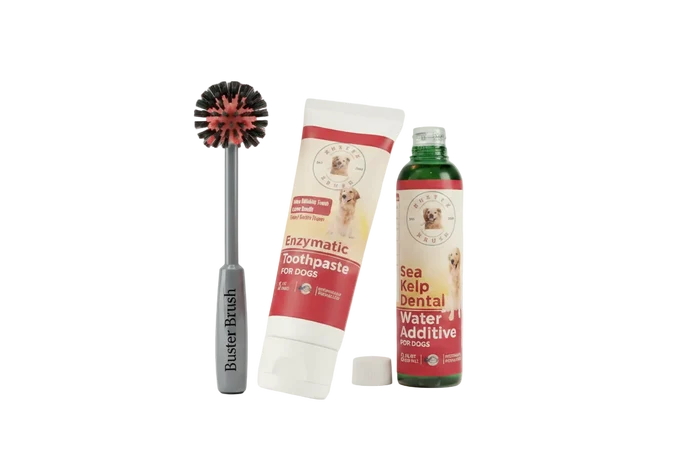
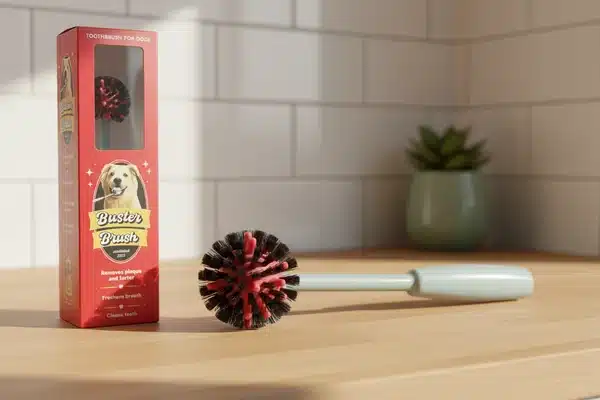
A dog toothbrush built for dogs that chew. Multilayered, with a silicone insert underneath and bristles tufted through it, plus a metal insert for rigidity. It launches as an oral care bundle alongside a toothpaste and a water additive, with the brush as the flagship.
The Founder
Erik Radbill taught for 27 and a half years. He has had dogs for 40 of them, mostly Labrador Retrievers, and he walks them off leash in the open space behind his house in Marlton, New Jersey.
The idea came from a specific repeated moment. He would brush his dog’s teeth, and the dog would chew the toothbrush. Every time.
“There’s got to be a better way to incorporate his instinct to want to chew.”
What existed already were small toothbrushes, the plastic sleeve that goes on your finger, and chew toys marketed as promoting dental health. Nothing that was actually a toothbrush and actually built to be chewed.
The Problem
The product was very hard to make, and it took Erik years to find out how hard.
He was turned down by more than one design team. One of them turned him down twice, eighteen months apart, without realizing they had spoken before. He engaged a design firm that produced something he refused to put into the world, because they could not work out how to bond the silicone layer to the outer material. That layer was the entire point of the product.
“I was really depressed, to be honest with you, because I thought, my God, I’m not going to be able to make this.”
By the time he reached Gembah he had been at it for roughly three years, had a utility patent, and had nothing he could sell.
What Happened
Gembah was Erik’s second design team. The engineer assigned to the project, working out of London, took the two-material problem away and came back with a construction that a factory could actually run.
“He’s like, give me a couple of days, I’ve got to figure out how to incorporate the two materials and be able to get the factory to make it. Oh my God, did he. It’s the greatest thing ever.”
Erik still has the drawing.
Factory sourcing took four attempts. One factory came in, started on the prototype, and pulled out.
“The factory themselves bailed. Said, we’re so sorry, this is too hard to make.”
The factory that took it on committed properly. They bought a new machine, at a cost of around $20,000, to run the tufting through the silicone layer, and they run independent testing on the output.
The Honest Part
The project was scoped at roughly 12 months and ran longer.
Erik’s view, unprompted:
“I was never worried about that, because it took me so long to get here anyway. I think when Will started our project it was maybe 12 months, and we’re beyond that, and I couldn’t care less because it got done. And to me, that’s the most important thing.”
The Unexpected Upside
The difficulty that nearly killed the project turned out to be the product’s best protection.
“Nobody’s going to be like, I’m just going to make this thing and steal it. It’s not going to be that easy to steal.”
He holds a utility patent on the brush. But the practical barrier is that copying it requires solving the same manufacturing problem that made four factories say no.
Where It Is Now
As of 15 July: 3,000 units in production and about to ship, 3PL being set up, site moving from WordPress to Shopify, onboarding as a Chewy vendor, floor display agreements with ten independent pet stores in New Jersey, and a social following built over three years with one video past 11,000 views. All of that was two months out from launch at the time of the call.
The business is self-funded. Erik, his wife, and a minority partner own it outright, with no outside money.
“Sink or swim. All gas, no brakes.”
What Founders Can Take From This
- A patent is not a product. Erik held a utility patent for a long time before he held something he could sell, and the gap between those two things was entirely a manufacturing problem.
- Being turned down is information. Four factories and multiple design firms said no because the product was genuinely difficult, not because Erik was doing something wrong. The right response was to keep looking for a partner who could solve it, not to simplify the product until anyone could make it.
- Difficulty cuts both ways. The thing that made it nearly impossible to build is the thing that makes it hard to copy.
Interested in building your product? Let’s talk.
Start Your Journey Today