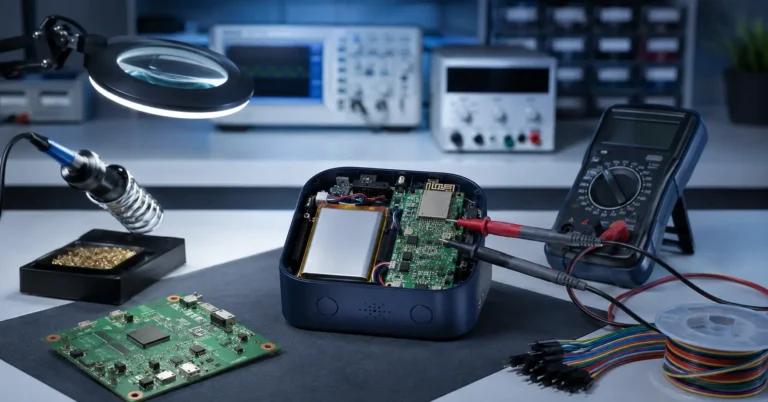

Product funding for startups doesn’t have to drain your savings or force you into deals you’ll regret. The key is matching the right funding source to where your product actually is in development, not where you hope it’ll be. But here’s what most funding guides won’t tell you: the biggest funding mistake isn’t choosing the wrong investor. It’s not knowing what your product will actually cost to make.
You can’t secure the right amount of capital if you’re guessing at tooling costs, underestimating MOQs, or ignoring the gap between prototype and production. Investors smell unrealistic budgets from a mile away. Banks won’t lend without clear cost breakdowns. Even crowdfunding campaigns fail when creators promise delivery timelines that manufacturing realities can’t support.
This is where professional product development changes your funding equation. When you have accurate manufacturing costs, realistic timelines, and proof your design is actually producible, you’re no longer asking for money based on hope. You’re presenting a fundable business plan.
At Gembah, we’ve guided hundreds of entrepreneurs through the funding maze while developing their products from concept to manufacturing. The companies that succeed aren’t necessarily the ones with the most capital. They’re the ones who understand their real costs, choose funding that fits their stage, and avoid common traps that sink products before they reach customers.
Not sure how much funding you actually need? Get a free cost breakdown based on real factory quotes and manufacturing timelines.
ALSO READ:
How To Launch A New Product (A Guide For Established Businesses)
The Product Feasibility Study: How To Prep For A Successful Product Launch
TL;DR: Product Funding for Startups
Most product-based startups need between $10,000 and $130,000 to launch, depending on product complexity and industry. The smartest funding strategy matches your capital source to your development stage and business goals. Start with bootstrapping or small business loans for early validation, move to crowdfunding once you have a manufacturable prototype, then consider investors only after proving demand. The biggest mistakes founders make are raising money before understanding true costs and giving up equity too early.
Key Points:
Break down real costs first—development, tooling, inventory, and marketing add up differently than expected
Bootstrapping and friends/family loans work best for research and prototyping stages
Crowdfunding doubles as both funding and market validation before large-scale production
Small business loans and grants preserve equity when you have clear budgets
Angel investors and VC make sense only with proven traction and aggressive growth plans
Most first-time founders can launch for $15K-$50K with staged funding

How Much Money Do You Actually Need?
The biggest mistake product founders make is guessing at their funding needs. You can’t choose the right capital source until you know exactly what you’re paying for at each stage.
Break Down Your Real Costs First
Product development isn’t one line item. Research shows that new product businesses spend an average of $40,000 in their first year, but that figure hides massive variation. A simple consumer product sourced overseas might launch for $15,000, while electronics or regulated products can easily hit six figures.
Your real costs break into distinct buckets: product research and design, prototyping and testing, tooling and manufacturing setup, initial inventory, business formation and legal, and marketing and launch. Each category scales differently based on your product type.
Equipment costs alone range from $10,000 to $130,000 depending on whether you’re assembling simple goods or manufacturing electronics in-house. Add inventory, which typically consumes 15-25% of your budget, plus permits, insurance, and professional services.
Real Example: ShadeCraft’s Launch Path
ShadeCraft launched its SUNFLOWER robotic shading system at CES 2020, entering the consumer robotics market without prior external funding. The company bootstrapped its early development, focusing on building awareness for a novel product category. Post-launch, ShadeCraft connected with investors and global distributors, demonstrating how hardware startups can validate concepts before raising significant capital. The challenge they faced—securing partners for an entirely new product category—is common for robotics and smart home devices where customer education is as critical as the technology itself.
Electronics startups like ShadeCraft often push toward the higher end of equipment spend because of test gear and initial tooling. Food and CPG brands face heavier regulatory costs but simpler equipment needs.
Most First-Time Founders Need $10K–$50K to Launch
For straightforward consumer products using contract manufacturing, $10,000 to $50,000 covers the full journey from concept to first inventory. That assumes you’re not building complex electronics or dealing with FDA approvals. This range includes basic product development, simple prototyping, overseas tooling and sampling, your first production run, formation and insurance, and initial digital marketing.
Online-only product businesses report spending around $35,000 in their first year, while brands with physical retail locations average closer to $100,000. The difference is real estate, build-out, and staff. If you’re launching direct-to-consumer, your capital goes into product and marketing rather than rent and fixtures.
More complex products shift the budget higher. Electronics might need $50,000 to $150,000 for engineering, certifications, and specialized manufacturing. Regulated food and beverage products often land in the $75,000 to $200,000 range when you factor in commercial kitchen requirements, health permits, and safety testing.
Funding Strategy Depends on Where You Are
Early-stage funding looks completely different from growth-stage capital. When you’re still validating your concept, you need small, flexible money for research and prototypes. Self-funding or a small business loan of $5,000 to $15,000 covers this phase for most products.
Once you have a working prototype and early customer feedback, you’re ready for larger capital to fund tooling and first production. This is when crowdfunding, bigger loans, or your first outside investors make sense. Your funding needs jump from thousands to tens of thousands.
The biggest capital requirement hits when you’re scaling to meet demand. Inventory financing, revenue-based funding, or growth investors become relevant only after you’ve proven your product sells. Raising too much too early creates pressure to grow before you’ve figured out your model.
Gembah advises clients to align funding to specific milestones: get to a manufacturable prototype on minimal capital, then secure production funding once you can clearly describe your customer and show early validation through waitlists or preorders.
The Seven Ways to Fund Your Product (Ranked by Difficulty)
Different funding sources require different levels of proof, give up different amounts of control, and work at different speeds. Here’s how they actually stack up for product startups.
1. Bootstrapping (Use Your Own Money)
Self-funding is the fastest path because you only need to convince yourself. You maintain 100% ownership, make all decisions, and keep any upside. It works brilliantly if you have savings, can start small, and don’t need to race competitors.
The downside is obvious: your personal financial risk is total. If the product fails, you’ve lost your own cash. You’re also limited by how much you’ve saved, which might cap your product ambitions or force you to launch slower than competitors with outside capital.
Bootstrapping works best for simple products with low tooling costs, founders with relevant expertise who can do design and sourcing themselves, and markets where speed to scale isn’t critical.
2. Friends and Family Loans
Borrowing from your personal network is only slightly harder than self-funding. The pitch is easier than talking to strangers, terms are usually flexible, and funding can close in days instead of months. You still keep equity and control.
The risk is personal relationships. Money conflicts strain even strong friendships and family bonds. Treat these arrangements with the same formality as bank loans. Put terms in writing, be realistic about repayment, and only borrow from people who can genuinely afford to lose the money.
Friends and family capital typically covers that early validation phase, usually ranging from $5,000 to $25,000—perfect for getting to a prototype and initial market testing before you need institutional money.
3. Crowdfunding (Pre-Sell Before You Manufacture)
Crowdfunding platforms like Kickstarter and Indiegogo sit in a sweet spot: you raise manufacturing capital while proving market demand. Success rates vary significantly by category, with Design products succeeding 35-40% of the time, while Technology/hardware campaigns succeed 20-30% of the time due to more ambitious builds and higher failure rates.
A successful campaign requires more than posting your idea. You need compelling visuals, usually a working prototype, clear manufacturing plans, and dedicated marketing during the campaign. Expect to spend 3-6 months preparing and 30-45 days running the campaign itself.
Stel Life’s Validation Strategy
Stel Life showcased its wireless patient monitoring system at CES as a digital health startup, using the event to reach specialized audiences and demonstrate remote monitoring technology. While specific funding amounts aren’t disclosed, their approach illustrates how medical hardware startups validate concepts through industry exposure before pursuing larger funding rounds. The challenge of reaching the right audiences for niche health technology mirrors what many B2B hardware founders face when building credibility in regulated markets.
Gembah frequently brings in crowdfunding experts to help clients structure campaigns, develop accurate cost estimates, and ensure the product design is actually manufacturable at the quantities you’re promising. The validation from a funded campaign makes later investor conversations much easier.
4. Small Business Loans
Traditional bank loans or SBA-backed financing give you structured capital without giving up equity. Banks issued $84.2 billion in loans to businesses with revenues under $1 million, showing real appetite for small business lending.
The catch is qualification. Lenders want to see personal credit history, business financials if you have them, collateral, and a clear repayment plan. SBA 7(a) loans offer amounts up to $5 million with favorable terms, but approval takes time and requires documentation.
Small business loans make sense when you have a detailed budget and realistic revenue projections, some business history or strong personal credit, and want to keep 100% ownership.
5. Grants (Free Money, But Competitive)
Government funding for startups through programs like Small Business Innovation Research provides non-dilutive capital for specific types of innovation. SBIR Phase I awards typically run $50,000 to $275,000 for proof-of-concept work in technology sectors.
Grants are genuinely free money—you don’t repay them and don’t give up equity. But the application process is intensive, timelines are long, and most programs target specific industries like technology, healthcare, or sustainability. Success rates are low because competition is fierce.
Grants work best as supplemental funding rather than your primary strategy. Apply for relevant programs but don’t bet your launch timeline on winning.
6. Angel Investors (Give Up Equity for Cash)
Angel investors are wealthy individuals who invest their own money in early-stage companies. They typically write checks from $25,000 to $100,000 and take 10-20% equity. Unlike institutional VCs, angels often invest based on the founder and vision rather than requiring extensive traction.
BenjiLock’s Investor Path
BenjiLock launched its innovative smart lock at CES and secured Shark Tank funding after gaining exposure. The company also landed distribution partnerships with major retailers and manufacturing partners, demonstrating how consumer hardware products can use media visibility and retail relationships to scale. Their path shows that for physical products, strategic partnerships with established brands can matter as much as capital itself.
Good angels bring industry expertise, connections to customers and distribution partners, and guidance through early scaling challenges. Expect them to want regular updates, some input on major decisions, and clear communication about progress and challenges.
7. Venture Capital (Big Money, Big Expectations)
VC firms manage funds raised from institutions and invest in startups with massive growth potential. Recent benchmarks show typical Seed rounds ranging £0.5-2M, Series A around £15M, Series B £20-30M, and Series C ~£68M for tech-heavy startups including hardware and electronics. You’ll give up 15-25% equity per round, and VCs expect board seats and significant input.
The math only works if you’re building something that can reach $100 million in revenue and beyond. VCs need big exits to return their fund, so they push for aggressive growth and won’t be patient with slow-and-steady models.
VC funding makes sense when you have clear product-market fit with strong early traction, a market large enough to support a $100M+ business, and a plan requiring rapid scaling that justifies the dilution. For most product startups, VC is the wrong choice too early.
Common Funding Mistakes That Sink Products
Research shows that over 60% of seed-stage failures stem from funding missteps like poor investor targeting or inadequate financial planning. 82% of small business failures are tied to cash flow problems, often because founders underestimated their true needs or chose the wrong funding source for their stage.
Asking for Unrealistic Amounts (Too Much or Too Little)
Founders frequently miscalculate needs, requesting amounts that cause excessive dilution or fail to cover critical milestones like manufacturing for physical products. In 2025, investors scrutinize 18-24 month financial models closely. Underestimating needs—particularly product development, tooling, and inventory costs—creates funding gaps that force expensive bridge rounds or, worse, stalled production.
Calculate your real runway with a 15-20% buffer. If tooling costs $30,000, budget $35,000. If your first production run is $25,000, assume $30,000. The companies that stay on track are those with detailed, milestone-based budgets that account for delays and surprises.
Targeting the Wrong Investors
Approaching mismatched investors wastes time and misses opportunities. Over 70% of seed funds in 2025 focus on specific verticals like healthtech, climate tech, or B2B software. Pitching a consumer hardware product to a SaaS-focused VC is pointless, yet founders make this mistake constantly.
Research investor portfolios before reaching out. Look for firms that have funded physical products, understand manufacturing timelines, and have networks in retail or distribution. One misaligned pitch wastes weeks; ten waste a quarter.
Taking Investment Too Early
Giving up equity at the idea stage means you’re valued as if nothing is proven—because nothing is. Your 20% dilution for $100,000 would have been 5% dilution for the same amount after you had sales and momentum.
Early investors also create pressure to grow fast and raise again. If you haven’t figured out your unit economics yet, that pressure leads to burning cash on unproductive marketing or building features customers don’t want. Wait until you can show proof: prototype, customer feedback, preorders, or initial revenue.
Prolonging the Fundraising Process
Extended timelines burn runway and erode momentum. Startups that close funding rounds in under 90 days are 2.5x more likely to secure follow-on funding compared to those that drag the process beyond six months. Delays hit physical product founders particularly hard, as they exhaust capital needed for production while markets normalize post-2020 boom conditions.
Set a firm deadline for your fundraising process. If you’re not seeing traction after 60 days, either adjust your pitch, lower your ask, or pivot to different funding sources. Don’t let fundraising become an excuse for not building.
Raising at Unreasonably High Valuations
High early valuations set impossible growth bars for next rounds. This problem has hit hardware startups especially hard in 2023-2024 as VC funding tightened and interest rates rose. Companies that raised at inflated valuations struggle to show the exponential growth needed to justify higher Series A valuations, leading to down rounds or shutdowns.
Price your round based on comparable companies at similar stages, not your dreams of future value. Modest valuations leave room for growth and make future raises easier.

How to Pitch for Funding (No Matter the Source)
Your pitch determines whether you get funding and on what terms. These principles work whether you’re talking to family, a bank, or a VC firm.
Lead With the Problem, Not Your Product
Investors and lenders fund solutions to real problems, not cool products. Start by describing the pain point your customer experiences, how big that market is, and why current solutions fall short. Only after establishing the problem do you introduce your product as the better solution.
Show Proof, Not Promises
You can’t show $1 million in revenue at the idea stage, but you can show evidence you’re on the right track. Customer interviews, waitlist signups, prototype feedback, or preorders all demonstrate real interest.
Successful pitches feature concrete metrics from day one. One AI software company used a 9-slide deck emphasizing forecasting accuracy improvements with clear numbers. A consumer brand raised $19 million in Series B by highlighting 86% recurring revenue and clear contribution margins.
Explain Exactly What the Money’s For
Break down your use of funds into specific categories with dollar amounts: tooling costs, initial inventory order, marketing and customer acquisition, legal and compliance, or hiring. Gembah clients who secure funding fastest tie their ask to explicit milestones—”With $50,000, we’ll complete tooling, run a 1,000-unit production batch, and launch a targeted ad campaign to our waitlist of 500 customers.”
Be Realistic About Timelines
Product development takes longer than first-time founders expect. International manufacturing and shipping adds months. Building a customer base requires sustained effort. If you think something takes three months, say four to five. Investors appreciate honesty about complexity, and you’ll look smart when you deliver early instead of making excuses for delays.
Alternative Funding Models Most People Ignore
Beyond the standard options, several funding types work brilliantly for product businesses but don’t get enough attention.
Revenue-Based Financing (Pay Back From Sales)
Revenue-based financing lets you borrow based on future revenue, repaying with a percentage of monthly sales until you hit a capped total. The RBF market expanded 69.5% from 2024 to 2025, driven by product businesses with predictable sales.
RBF works when you have revenue history, need inventory or marketing capital, and want to avoid equity dilution. One consumer app took $500,000 in RBF funding in mid-2023, used it for customer acquisition, and achieved 210% annualized growth without giving up ownership. Payments flex with your revenue, so slow months cost less than fixed loan payments.
Inventory Financing (Borrow Against Your Stock)
Inventory financing and purchase-order financing let you borrow against products you’ve already made or orders you’ve already received. Your inventory or POs serve as collateral, making approval easier than unsecured loans. One e-commerce brand raised $1.7 million through inventory financing to avoid stockouts during high-demand periods, with repayments tied to monthly revenue for flexibility.
Strategic Partnerships (Free Support From Aligned Companies)
Partners with aligned interests sometimes provide funding, expertise, or resources without formal investment. A packaging supplier might extend better terms or cover tooling costs in exchange for volume commitments. A retailer might help fund a product line they want to carry exclusively. Gembah emphasizes partnerships and ecosystem resources like incubators and makerspaces that offer funding, mentorship, and cost reductions beyond capital alone.

When to Stop Looking for Funding and Just Start
Fundraising can become an excuse for not launching. At some point, the right move is to start with what you have.
If you’re stuck researching funding options for more than three months, you know enough to make a decision. Pick an approach, secure whatever capital you can access now, and start executing. Perfect funding doesn’t exist—you’ll always wish you had more money or better terms.
Most products can be simplified for a first version. Skip custom packaging and use stock boxes. Start with one SKU instead of five. Handle fulfillment yourself instead of using a 3PL. If a stripped-down version costs under $5,000, you can probably self-fund or borrow from friends. Launch that version, generate revenue and learning, and use that traction to fund the full vision.
Sometimes founders tell themselves they need more funding when what they actually need is confidence. If you have enough to build and test a prototype, that’s enough to start. Revenue from early customers can fund later stages, and the learning from putting something in the market matters more than having every dollar in place before you begin.
Conclusion
Product funding for startups comes down to matching your capital source to your stage, protecting your equity until you have proof, and being honest about what you actually need. Most founders don’t need venture capital or massive loans. They need $10,000 to $50,000 staged smartly across validation, prototyping, tooling, and first production.
But here’s the truth that separates funded founders from those who struggle: you can’t secure funding with guesswork. Banks won’t lend based on Alibaba screenshots. Investors won’t write checks for vague budgets. Even crowdfunding backers can smell unrealistic promises.
The best funding strategies combine multiple sources (bootstrap for research, crowdfunding for production capital, loans or investors for scale) with one critical element: accurate manufacturing costs and timelines from day one.
Gembah helps entrepreneurs navigate funding decisions while developing products that are actually manufacturable and financially viable. Our end-to-end platform connects you with expert designers, production engineers, and vetted factories while helping you understand real costs and secure the right capital for your stage.
Our process includes:
Product development with manufacturing costs built into every design decision
Factory sourcing and validation so your budget reflects real quotes, not guesses
Cost breakdowns and timeline mapping you can present to investors or lenders
Production management to ensure funded projects actually ship
The companies that secure funding fastest are those who can prove their numbers are real. That proof comes from working with manufacturing experts before you pitch.
Ready to fund your product without going broke? Talk to Gembah’s product development experts to map your funding strategy and build a product that hits your budget and timeline.